HomeBlogGovernance and ComplianceISO 27001 vs SOC 2: Key Differences Explained
ISO 27001 vs SOC 2: Key Differences Explained

ISO 27001 and SOC 2 at a Glance
ISO 27001 and SOC 2 are two commonly referenced frameworks in information security and compliance. They both deal with security controls and the protection of information, but their purpose and structure are different.
ISO 27001 defines requirements for establishing and maintaining an Information Security Management System, commonly known as an ISMS. It provides a structured approach to identifying information security risks, applying appropriate controls and reviewing those controls as part of continual improvement.
SOC 2 takes a control-based approach to the systems and services used to handle customer information. It is based on the AICPA Trust Services Criteria, covering security, availability, processing integrity, confidentiality and privacy. A SOC 2 engagement results in an attestation report issued by an independent CPA firm.
The difference becomes clearer when looking at the outcome of each framework. ISO 27001 can lead to certification against the standard, whereas SOC 2 provides an attestation report covering the controls examined during the engagement.
Both can be relevant to the same company. A SaaS provider, for example, may work towards ISO 27001 certification while also preparing for a SOC 2 examination because customers have different security requirements.
What is ISO 27001?
ISO 27001 is an international standard for establishing, implementing, maintaining and continually improving an Information Security Management System, commonly known as an ISMS. It provides a structured way to identify information security risks and decide how those risks should be treated.
The standard applies across different sectors and company sizes. Its scope can include policies, people, processes, technology and physical security, depending on what is covered by the ISMS.
Key Objectives of ISO 27001
The main objective is to protect the confidentiality, integrity and availability of information. To achieve this, an ISO 27001 programme typically involves:
- Identifying information security risks
- Assessing and treating those risks
- Implementing appropriate security controls
- Establishing security policies and responsibilities
- Reviewing the effectiveness of the ISMS
- Continually improving information security processes
The approach is risk-based, so controls are selected according to the risks and requirements within the defined scope.
ISO 27001 Certification and Audit
ISO 27001 includes requirements for internal audits and management reviews, along with regular evaluation of the ISMS. Annex A also provides a set of security controls covering areas such as access control, cryptography, physical security, incident management and supplier relationships.
For certification, an accredited certification body assesses the ISMS against the requirements of the standard. Once certification is achieved, it normally follows a three-year cycle, with surveillance audits during that period.
What is SOC 2?
SOC 2 is an assurance framework developed by the American Institute of Certified Public Accountants, known as the AICPA. It looks at how service providers manage controls that protect customer information and support the secure operation of their systems.
The framework is built around five Trust Services Criteria: security, availability, processing integrity, confidentiality and privacy. Security is required for a SOC 2 examination, while the other criteria can be included depending on the services provided and the requirements being assessed.
Unlike ISO 27001, SOC 2 does not result in a certification. The outcome is an attestation report prepared by an independent CPA firm, which provides information about the controls covered by the examination.
SOC 2 Trust Services Criteria
The five Trust Services Criteria are:
- Security, protection of systems and information against unauthorised access and other security threats
- Availability, whether systems are available for operation and use as agreed
- Processing Integrity, whether system processing is complete, valid, accurate, timely and authorised
- Confidentiality, protection of information designated as confidential
- Privacy, collection, use, retention, disclosure and disposal of personal information
The scope of a SOC 2 examination can include security alone or additional criteria that are relevant to the services being assessed.
SOC 2 Type I and Type II
SOC 2 reports are commonly divided into Type I and Type II.
A Type I report examines whether the relevant controls are suitably designed and implemented at a specific point in time. A Type II report goes further by examining how those controls operate over a defined period.
This difference matters when a customer wants evidence of controls working consistently rather than simply seeing that the controls were in place on one date.
ISO 27001 vs SOC 2: Key Differences
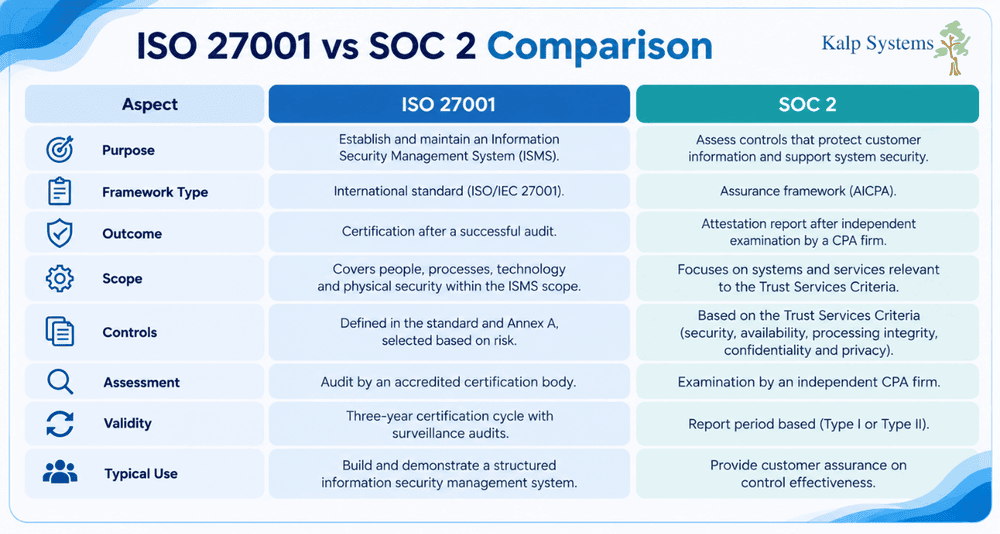
ISO 27001 and SOC 2 cover several similar security concerns, but the way each framework approaches them is different. The differences become clearer when you look at the purpose, scope, assessment process and type of assurance provided.
Purpose and Scope
ISO 27001 is built around an Information Security Management System. The scope defines which information, processes, locations, systems and other areas are included in the ISMS. Risk assessment then helps determine the controls needed within that scope.
SOC 2 is concerned with controls relating to systems and services that are relevant to the examination. This makes it particularly relevant for service providers that need to give customers assurance about how their systems and information are handled.
The scope therefore depends on what the company needs to be assessed. The two frameworks can cover some of the same security practices, but they do so from different starting points.
Certification vs Attestation
One of the clearest differences is the outcome.
ISO 27001 can lead to certification after an accredited certification body assesses the ISMS against the requirements of the standard. The certification demonstrates that the defined ISMS has been assessed against ISO 27001 requirements.
SOC 2 results in an attestation report from an independent CPA firm. The report describes the controls included in the examination and the results of the assessment.
This distinction is important when a customer, partner or procurement team specifically asks for an ISO 27001 certificate or a SOC 2 report.
Controls and Assessment
ISO 27001 uses a risk-based approach to determine the controls needed for the defined ISMS scope. Annex A provides a set of information security controls that can support the risk treatment process.
SOC 2 uses the Trust Services Criteria as the basis for assessing relevant controls. Depending on the scope, the examination can cover areas such as access management, monitoring, change management, incident response and protection of information.
The controls may overlap, but the assessment is carried out against different requirements.
Audit and Reporting
ISO 27001 certification involves an external audit of the ISMS, supported by internal audits and management reviews. Certification then follows a three-year cycle with surveillance audits during the period.
SOC 2 can involve either a Type I or a Type II examination. Type I consider the design and implementation of relevant controls at a specific point in time. Type II examines the operating effectiveness of those controls over a defined period.
The final outputs also differ. ISO 27001 provides a certificate, while SOC 2 provides an attestation report.
Market and Customer Requirements
The framework a company pursues can depend on what customers, partners and markets expect.
ISO 27001 is an international standard that can support companies seeking ISO 27001 compliance in India while meeting information security requirements across different markets.
SOC 2 is often relevant to service providers that need to provide customers with assurance about the controls protecting systems and information. Customer security reviews and procurement requirements can therefore influence whether a SOC 2 examination is pursued.
A company serving customers in different markets may also have reasons to work towards both frameworks.
What do ISO 27001 and SOC 2 Have in Common?
ISO 27001 and SOC 2 have a fair amount of common ground. Both involve security controls, documented processes and evidence that security practices are being followed.
Risk management is also relevant to both. Access controls, system monitoring, incident response, data protection and vendor management can appear within the scope of work for either framework.
Both can also involve an independent assessment. The difference is in what that assessment is based on and what the final result looks like.
This overlap is one reason companies sometimes work towards both frameworks. Existing security policies, access controls, monitoring processes and other controls may support requirements across both, although the evidence and assessment requirements still need to be addressed separately.
For a company already working with one framework, this shared ground can make it easier to identify areas that may support the other. It does not mean that meeting one framework automatically satisfies the requirements of the other.
ISO 27001 vs SOC 2: Which One Should You Choose?
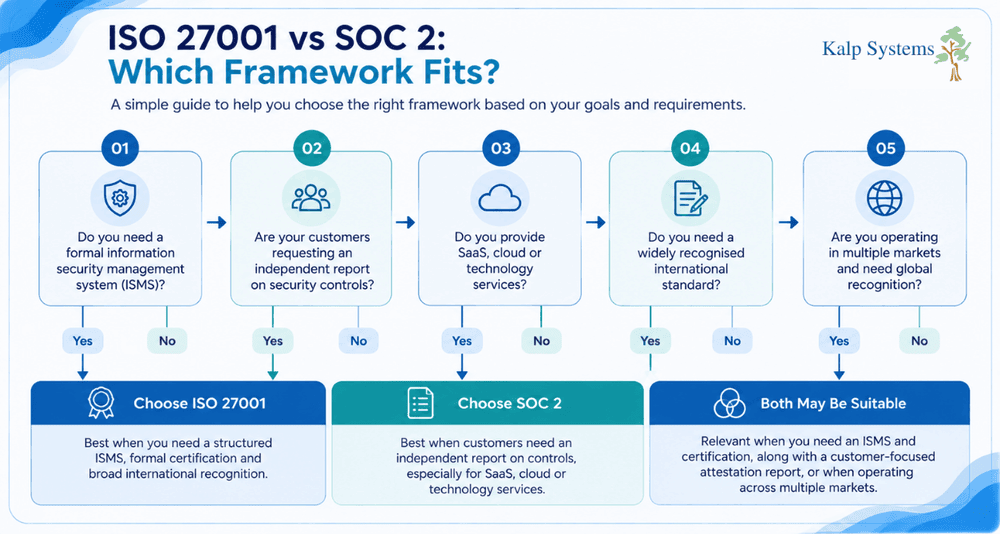
The choice usually comes down to what the company needs to demonstrate and what its customers or partners expect. ISO 27001 may make sense when a formal information security management system and recognised certification are important. SOC 2 may be more relevant when customers want an independent report on controls used to protect systems and information.
When ISO 27001 May be Suitable
ISO 27001 may be suitable when:
- A recognised information security certification is required
- A structured ISMS is needed
- Information security risks need to be managed through a formal process
- The company operates across different markets
- Customers or partners specifically request ISO 27001 certification
When SOC 2 May be Suitable
SOC 2 may be suitable when:
- The company provides SaaS, cloud or other technology services in India
- Customers request a SOC 2 report
- Evidence of control effectiveness is important
- Customer data is handled through defined systems and services
- Security assurance forms part of customer or vendor reviews
When Both Frameworks May be Appropriate
Some companies may have requirements for both ISO 27001 and SOC 2. ISO 27001 can provide the broader ISMS structure, while SOC 2 can provide an attestation report covering relevant controls.
Working towards both does require separate assessment requirements, but there can be useful overlap in areas such as access control, risk management, monitoring, incident response and data protection.
How Kalp Systems Supports ISO 27001 and SOC 2 Compliance
Preparing for ISO 27001 or SOC 2 requires more than putting a few security policies in place. The work usually involves reviewing existing controls, identifying gaps, documenting processes and making sure the required evidence is available for assessment.
Kalp Systems supports this work across different stages of the compliance process. This includes ISO 27001 gap assessments and ISMS implementation, SOC 2 readiness assessments and audit support, risk assessment and control mapping, policy development and documentation, and continuous compliance and audit management.
The focus is on understanding the existing security environment first, then addressing the gaps that matter for the selected framework. This can help create a clearer path towards certification or attestation while keeping security processes practical for day-to-day use.
Conclusion
ISO 27001 and SOC 2 are often compared because both deal with information security and control practices, but they serve different purposes. ISO 27001 is centred on an Information Security Management System and a formal certification process. SOC 2 focuses on controls covered by the Trust Services Criteria and provides an independent attestation report.
The choice comes down to what needs to be demonstrated. Customer requirements, market expectations, the existing security setup and the scope of the compliance programme all have a role in that decision. For some companies, ISO 27001 may be the main requirement. Others may need SOC 2, and some may decide to work towards both.
What matters is understanding the difference before starting the compliance work. This makes it easier to define the right scope, prepare the required evidence and avoid treating ISO 27001 and SOC 2 as interchangeable frameworks.
Frequently Asked Questions
Is ISO 27001 Equivalent to SOC 2?
No. ISO 27001 and SOC 2 are separate frameworks. ISO 27001 deals with the management of information security through an ISMS, whereas SOC 2 looks at specific controls against the Trust Services Criteria. The type of assurance provided is different too.
Can a Company Have both ISO 27001 and SOC 2?
Yes, it can. This usually happens when different customers or contracts ask for different types of assurance. There is some common ground between the two, so work already done for access control, incident management, monitoring and data protection may be useful when preparing the other framework.
Is ISO 27001 Mandatory?
ISO 27001 certification is not automatically required. The requirement can come from a customer, contract, procurement process or a particular industry requirement. Where none of these apply, certification can still be pursued as part of an information security programme.
Is SOC 2 Mandatory?
SOC 2 is not a mandatory requirement for every company. In practice, the question often comes from customers or prospective customers who want independent evidence that security controls are in place and operating as expected.
What is the Difference Between ISO 27001 Certification and SOC 2 Attestation?
They provide different forms of assurance. With ISO 27001, the Information Security Management System is assessed against the requirements of the standard and certification can be issued by a certification body. With SOC 2, an independent CPA firm examines the controls covered by the engagement and issues an attestation report.