HomeBlogGovernance and ComplianceISO 27001 and SOC 2 for SaaS Companies: Benefits, Differences and Compliance
ISO 27001 and SOC 2 for SaaS Companies: Benefits, Differences and Compliance
Why ISO 27001 and SOC 2 Matter for SaaS Companies
A SaaS provider may have strong technical controls in place, but enterprise customers often want evidence of how those controls are managed. During vendor assessments, security teams may ask for policies, risk assessments, audit records, access control details and proof that controls are being monitored over time.
ISO 27001 and SOC 2 provide evidence in different ways. ISO 27001 centres on an information security management system, with risk assessment, defined processes and continual review forming part of the framework. SOC 2 examines whether controls relating to areas such as security, availability, confidentiality and privacy are designed and operating as expected.
This matters when a SaaS provider is going through enterprise procurement. A recognised certification or independent assurance report can answer some of the security questions raised during due diligence before they turn into lengthy rounds of questionnaires and evidence requests.
The need can be even more pronounced for providers serving healthcare and pharmaceutical customers. These sectors deal with patient records, research data, clinical information and intellectual property, so security requirements can form a significant part of vendor selection. Your existing article already highlights the additional scrutiny placed on technology vendors working with sensitive healthcare and pharmaceutical data. Pasted markdown
For a SaaS company, the value of these frameworks therefore extends into areas such as customer assurance, risk management and enterprise procurement. The choice between ISO 27001, SOC 2, or both depends on the customers being served, the markets being targeted and the type of assurance those customers require.
What ISO 27001 and SOC 2 Offer SaaS Companies
ISO 27001 and SOC 2 address security assurance from different angles, so it is useful to understand what each framework brings to a SaaS environment.
Key Benefits of ISO 27001 for SaaS Companies
ISO 27001 gives a SaaS company a structured way to identify information security risks and decide how those risks should be managed. It brings security policies, risk assessments, controls, reviews and improvement activities into a defined management system.
For a SaaS provider, this can make security responsibilities clearer across teams. Access controls, incident response, vendor management and other security processes can be documented and reviewed instead of being handled informally.
The framework can also support customer and regulatory requirements across different markets. Your existing article notes that ISO 27001 can help SaaS companies demonstrate alignment with requirements such as GDPR and India’s DPDP Act, particularly when they operate across borders.
Key Benefits of SOC 2 for SaaS Companies
SOC 2 is particularly relevant to SaaS providers because it gives customers independent assurance about how controls are designed and operated. The assessment covers the Trust Services Criteria of security, availability, processing integrity, confidentiality and privacy.
For customers reviewing a cloud service, this provides useful evidence about the provider’s control environment. SOC 2 Type II can offer deeper assurance because it examines whether controls operate effectively over a defined period rather than at a single point in time.
A strong SOC 2 report can also help during enterprise sales. Security teams may have fewer concerns to validate from scratch, while procurement teams receive documented evidence that can support their vendor’s assessment. Your existing article identifies faster enterprise onboarding, fewer repeated security questionnaires and stronger differentiation as key commercial benefits.
ISO 27001 vs SOC 2, What is the Difference
ISO 27001 and SOC 2 are used for different types of security assurance. For a SaaS company, the choice depends on what it needs to put in place and what its customers want to see during a security review.
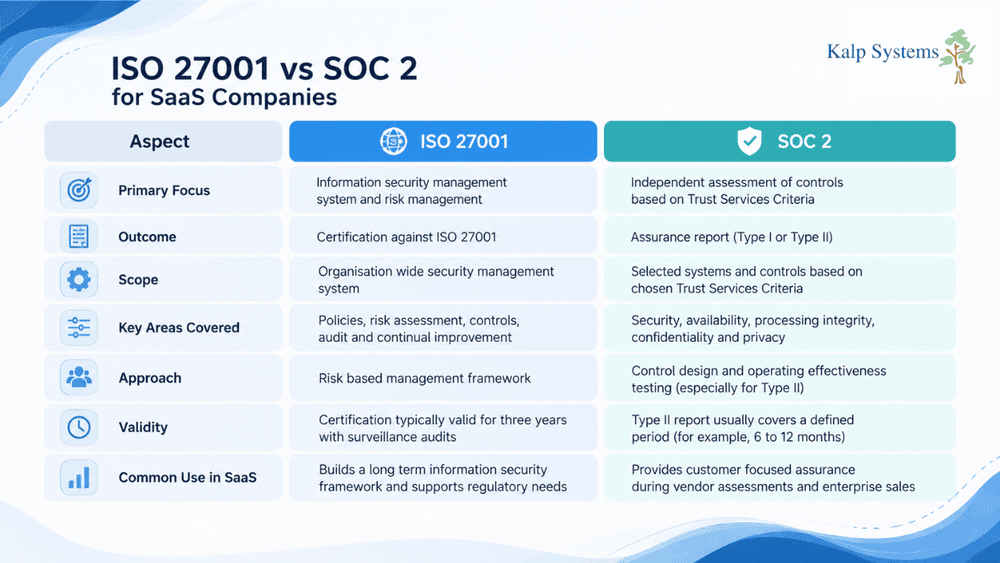
ISO 27001 Certification vs SOC 2 Report
ISO 27001 is built around an information security management system. It requires a company to identify security risks, decide how those risks will be handled, put suitable controls in place and review those controls regularly. The work covers areas such as security policies, risk treatment, internal audits and continual improvement.
SOC 2 takes a different route. An independent auditor examines selected controls against the Trust Services Criteria. These include security, availability, processing integrity, confidentiality and privacy, depending on the scope of the assessment.
There is also a difference in what the final outcome represents. An ISO 27001 assessment can lead to certification against the standard. A SOC 2 engagement results in an assurance report. With SOC 2 Type II, the report also covers how the controls operated during the review period.
Risk Management vs Control Testing
Risk management sits at the centre of ISO 27001. A SaaS company needs to understand where its information security risks come from and decide what needs to be addressed. That process can cover access rights, suppliers, incidents, cloud environments, data protection and other areas within the defined scope.
SOC 2 puts more attention on the controls themselves and the evidence available to show that they are working as intended. During the assessment, auditors review the relevant controls and supporting evidence. For a Type II report, they also consider controls over a period of time.
For SaaS companies, this distinction can make both frameworks useful for different reasons. ISO 27001 provides a structured way to manage information security, while SOC 2 gives customers detailed assurance about specific controls and their operation. A company serving different enterprise markets may choose to maintain both.
Can SaaS Companies Use ISO 27001 and SOC 2 Together
A SaaS company does not always have to choose between ISO 27001 and SOC 2. Both can be used at the same time, especially when the company works with enterprise customers that have different security requirements.
The reason is simple. ISO 27001 looks at how information security is managed across the defined scope, while SOC 2 gives customers an independent view of selected controls. They overlap in some areas, but they are not the same assessment.
How ISO 27001 and SOC 2 Work Together
A company working towards ISO 27001 will already have several practices in place that can support a SOC 2 assessment. Risk assessments, access controls, incident response procedures, security policies and regular reviews are examples of areas that may be relevant to both.
The same does not mean that one assessment automatically satisfies the other. SOC 2 requires evidence that relates to the controls included in its scope. Depending on the engagement, auditors may look at access records, system monitoring, change management, incident records and other evidence to see how controls have operated.
This is where planning makes a difference. Instead of creating separate processes for every requirement, the security team can map common controls and maintain the evidence properly. A single access control process, for example, may support work carried out for both ISO 27001 and SOC 2.
The scope also needs attention. The systems, applications, data and services covered by ISO 27001 may not be identical to those included in a SOC 2 assessment.
Benefits of Combining ISO 27001 and SOC 2
Having both can be useful when customer requirements vary. One enterprise customer may ask for an ISO 27001 certificate during procurement, while another may request a SOC 2 Type II report before approving a SaaS provider.
It can also make security discussions easier. Instead of relying only on answers to long security questionnaires, the company can provide recognised certification and independent audit evidence where applicable.
ISO 27001 and SOC 2 can be pursued together because they share several security controls, even though the two frameworks have different purposes. ISO 27001 focuses on establishing and continually managing an Information Security Management System, while SOC 2 focuses on showing that relevant controls are properly designed and, for Type II, operating effectively over time. A unified security programme can therefore support both frameworks without treating them as a single assessment.
This matters even more when the platform handles sensitive information or serves sectors such as healthcare and financial services. Procurement and security teams often want evidence of access controls, incident handling, data protection, and ongoing oversight before approving a technology provider.
There is additional work involved in maintaining both programmes, including evidence collection, reviews and assessments. Even so, the two can fit well together when the underlying security processes are planned from the start. ISO 27001 provides the management structure, while SOC 2 gives customers a closer look at how selected controls operate.
How ISO 27001 and SOC 2 Help SaaS Companies Win Enterprise Customers
For a SaaS company, security requirements often appear before the contract is signed. An enterprise customer may ask about access controls, incident response, data protection, vendor risk and independent security assessments during procurement.
ISO 27001 and SOC 2 give the sales and security teams something concrete to present during these discussions. Instead of relying only on statements about how systems are protected, the company can provide recognised evidence of its security practices.
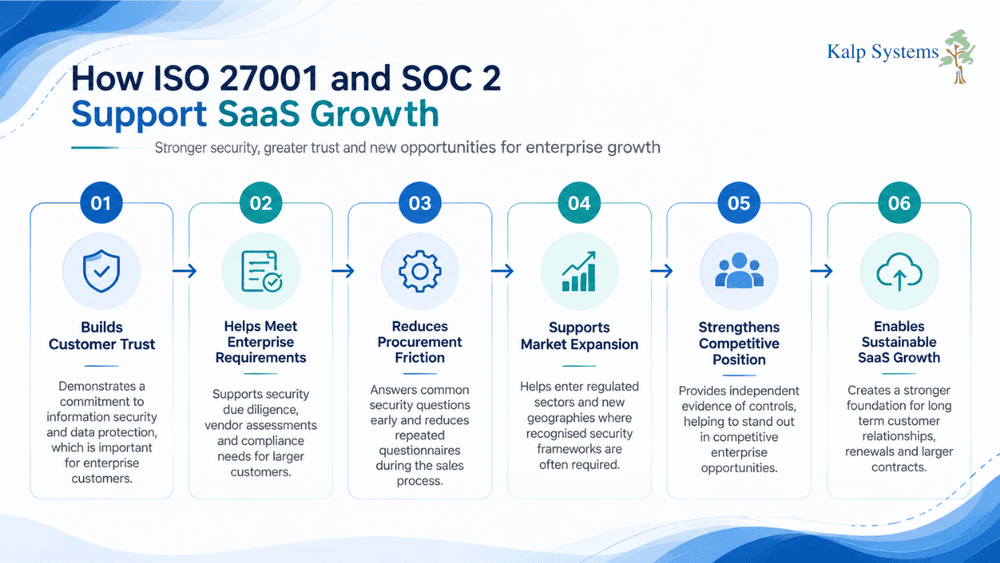
Meeting Enterprise Security Requirements
Large customers often have their own security requirements for technology providers. These may include a completed security questionnaire, supporting documentation, audit evidence or a recognised certification.
ISO 27001 can demonstrate that information security is being managed through a defined system of risk assessment, controls and regular review. A SOC 2 report can provide further evidence about the controls used to protect systems and customer data.
This can be particularly useful for SaaS providers selling into healthcare, financial services and other sectors where customer data receives close scrutiny.
Reducing Security Review and Procurement Friction
Security reviews can become a lengthy part of enterprise procurement. Customers may send detailed questionnaires and request policies, technical evidence, audit records and information about previous security incidents.
Having ISO 27001 certification or a SOC 2 report does not remove every question, but it can reduce the amount of time spent proving basic security maturity. Procurement and security teams have independent evidence they can review rather than relying entirely on written responses from the vendor.
For a growing SaaS provider, that can make a noticeable difference when several prospective customers are going through reviews at the same time.
Building Customer Trust and Competitive Advantage
Enterprise buyers are often comparing several providers offering similar technology. Security can become one of the factors that separates one vendor from another.
A recognised certification or independent assurance report gives customers greater visibility into how the provider manages information security. It also shows that security controls have been subject to an external assessment rather than being based only on internal claims.
For SaaS companies targeting larger contracts, this credibility can support customer conversations, shorten some stages of due diligence and make the provider easier to evaluate.
How to Prepare for ISO 27001 and SOC 2 Compliance
Before starting an ISO 27001 certification or SOC 2 assessment, it is worth taking a hard look at what is already in place. Most SaaS companies already have some security measures running. The problem is often that they are spread across different teams, tools and processes, or there is no proper record to show how they are being followed.
Conduct a Gap Assessment
Start with the areas that already affect day-to-day security. Check who can access production systems, how access is approved and removed, how incidents are recorded, how risks are reviewed and how suppliers are assessed.
The review should also cover the systems that will actually be included in the assessment. There is little value in reviewing everything if the final scope covers only a particular application, cloud environment or service.
Once the gaps are listed, separate the issues that need a new control from those that simply need better documentation or more consistent follow-through. This makes the preparation much more manageable.
Define Scope and Implement Security Controls
Scope should be decided early because it affects almost every part of the assessment. A SaaS environment may include the production of applications, cloud infrastructure, development systems, employee access and third-party services.
After that, the controls can be matched to the risks. Access should be limited to people who need it. MFA should be enabled where appropriate. Logs should be retained and reviewed. Vulnerabilities should be tracked, incidents should have a defined response process and software development should include security checks.
The practical test is whether these controls are part of normal work. If an access review is required every quarter, there should be a record showing that someone actually completed it. If incidents have to be reported, there should be a process and records to support them.
Collect Evidence and Prepare for Assessment
This is where preparation often becomes more detailed. The auditor will need evidence, not just a collection of policies.
Access to review records, risk assessments, incident records, vulnerability reports, training records, change logs and monitoring evidence can all become relevant, depending on the scope and controls being assessed.
It is worth carrying out an internal check before the formal assessment. Go through the controls one by one and ask a simple question: can we show that this is actually being done?
If the answer is no, fix the process or collect the missing evidence before the assessment starts. This gives the team a much better chance of entering the ISO 27001 certification audit or SOC 2 assessment with its records in order.
ISO 27001 and SOC 2 for Healthcare and Regulated SaaS
Healthcare SaaS providers deal with a different level of scrutiny. A platform may store patient information, support clinical workflows or handle data connected with research and trials. A security incident in such an environment can affect far more than technology itself.
Customers therefore tend to ask detailed questions before allowing a provider to handle sensitive information. They may want to see how access is controlled, how incidents are handled, where data is stored, and what safeguards are in place to keep services available.
ISO 27001 can provide a useful foundation for managing these areas through risk assessment, documented controls and regular review. SOC 2 can add independent evidence showing how selected controls operate in practice.
This can also matter when a healthcare SaaS provider works with customers outside India. Different customers may have their own contractual and regulatory requirements, and security assessments can become part of the procurement process.
For a provider trying to enter larger healthcare accounts, recognised certification and independent assurance can make those conversations easier. They do not replace the customer’s own due diligence, but they give the security and procurement teams something concrete to assess.
The same principle applies to SaaS companies in Ahmedabad. For companies considering ISO 27001 for SaaS companies in Ahmedabad, a documented security programme can provide a stronger foundation for enterprise customer reviews, particularly where customer data and third-party risk receive close attention.
Conclusion
ISO 27001 and SOC 2 can play a useful role in the growth of a SaaS company, particularly when enterprise customers expect clear evidence of security practices.
ISO 27001 provides a structured way to manage information security and security risks. SOC 2 gives customers an independent view of selected controls and, in the case of Type II, how those controls operate over a period of time.
For companies selling into healthcare, financial services and other sectors where vendor security receives close attention, these credentials can make procurement discussions easier and provide stronger evidence during customer reviews.
The right choice depends on the customers being targeted, the services being provided and the security requirements that apply. In some cases, ISO 27001 may be sufficient. In others, SOC 2 may be requested. Companies serving a broad enterprise market may find value in maintaining both.
Frequently Asked Questions
Is ISO 27001 or SOC 2 Better for SaaS Companies?
There is no single answer for every SaaS company. ISO 27001 is useful when the company wants a structured information security management system and formal certification. SOC 2 is often useful when customers want independent evidence about how specific controls are designed and operating.
The better fit depends on the customers being targeted, the services provided and the security requirements included in customer contracts.
Can a SaaS Company Have Both ISO 27001 and SOC 2?
Yes. A SaaS company can maintain both. Some controls, such as access management, incident response and risk management, can support work under both assessments.
Having both can also be useful when different enterprise customers ask for different forms of security assurance.
What is the Difference Between ISO 27001 and SOC 2?
ISO 27001 focuses on the management of information security and the way security risks are handled within a defined scope. Certification is issued following an assessment against the standard.
SOC 2 focuses on controls relevant to the Trust Services Criteria and results in an independent assurance report. A Type II report also provides evidence of how those controls operate during a specified period.
Does SOC 2 Help SaaS Companies Win Enterprise Customers?
It can. Enterprise customers often want evidence that a SaaS provider has appropriate controls for protecting systems and customer data. A SOC 2 report gives them independent evidence to review during vendor assessment and procurement.
It does not guarantee a contract, but it can make security due diligence easier when SOC 2 is part of the customer’s requirements.
How Long Does ISO 27001 Certification Take?
The time varies according to the size of the company, the scope of the certification and how much of the required security management system is already in place.
A company starting with well documented processes and established controls may need less preparation than one building its information security management system from the ground up. Gap assessment, implementation, internal review and the certification audit all need to be considered when planning the timeline.