HomeBlogGovernance and ComplianceHow to Build an Effective Information Security Management System (ISMS)
How to Build an Effective Information Security Management System (ISMS)

What is an Information Security Management System
An Information Security Management System, or ISMS, is a structured way to manage information security across an organisation. It brings together people, processes and technology to protect information and manage the risks that could affect it.
An ISMS covers more than IT systems. It can include information assets, applications, physical facilities, employees, third-party relationships and internal processes. Each area can introduce different security risks, so the framework needs to account for how information is created, stored, accessed, shared and protected.
At its core, information security focuses on three areas: confidentiality, integrity and availability. Confidentiality helps prevent unauthorised access to information. Integrity helps keep information accurate and protected from unauthorised changes. Availability ensures that authorised users can access information when they need it.
Risk assessment is another important part of an ISMS. Security teams first identify relevant assets and the risks associated with them. They can then assess the likelihood and potential impact of those risks and decide which controls or other treatment measures are appropriate.
An ISMS also provides a basis for managing regulatory and contractual requirements. ISO 27001 is one of the most widely recognised standards associated with information security management and provides requirements for establishing, maintaining and continually improving an ISMS.
Why an Effective ISMS Matters
Information security problems rarely stay limited to a single system. A security incident can affect sensitive data, interrupt operations, create compliance issues and require action from several teams at the same time. An effective ISMS helps bring these responsibilities into a defined framework.
It gives management and security teams a clearer way to identify risks, assign responsibility and track the controls used to address them. Policies can be documented, access rights can be reviewed, incidents can be handled through defined procedures, and security risks can be reviewed as circumstances change.
An effective ISMS can help companies:
- identify information security risks before they lead to incidents
- protect sensitive and critical information
- establish clear security policies and responsibilities
- apply controls according to identified risks
- manage access to systems and information
- improve incident response and recovery
- support regulatory and contractual requirements
- maintain evidence for audits and reviews
- track security performance and areas requiring improvement
The value of an ISMS also depends on how well it fits into day-to-day operations. Policies need to be followed, controls need to be reviewed and responsibilities need to remain clear as systems, processes and risks change.
For companies handling personal, financial, healthcare or other sensitive information, this provides a practical foundation for managing information security. It also creates a clearer connection between risk assessment, security controls, compliance requirements and management decisions.
Core Principles of an Effective ISMS
An effective ISMS needs a clear structure that can be maintained as security risks and operational requirements change. A few principles form the basis of that structure, including risk-based decision-making, leadership involvement, defined objectives and regular improvement.
Risk-Based Approach
Risk assessment provides the foundation for deciding where security controls are needed. The process starts with identifying important information assets and understanding the threats, vulnerabilities and potential impact associated with them.
Controls can then be selected according to the level of risk. A critical system handling sensitive information may require stronger safeguards and closer monitoring than a lower-risk asset. Regular reassessment also helps account for changes in technology, suppliers, processes and the threat environment.
Leadership and Governance
Senior management has an important role in setting security objectives, assigning responsibilities and providing the resources required to maintain the ISMS.
Governance should establish clear ownership for information security decisions. Security teams, system owners, compliance teams and other relevant stakeholders need to understand their responsibilities and how those responsibilities connect with the wider security framework.
Regular management reviews can also provide a formal point for reviewing security performance, significant risks, audit findings and areas that require action.
Defined Scope and Objectives
An ISMS needs a clearly defined scope. The scope determines which systems, locations, processes, information assets and supporting activities fall within the management system.
Security objectives should then reflect the risks and requirements within that scope. Clear objectives make it easier to decide what the ISMS needs to achieve and how its performance will be assessed.
Scope and objectives should also be reviewed when there are significant changes to systems, processes, services or regulatory requirements.
Continual Improvement
An ISMS requires regular review and improvement. Risk assessments, security incidents, internal audits, management reviews and changes in requirements can reveal areas that need attention.
Findings should lead to appropriate corrective actions, followed by review to determine whether those actions have addressed the identified issue. This creates a practical cycle of assessment, action, review and improvement rather than treating ISMS implementation as a one-time activity.
Key Components of an Information Security Management System
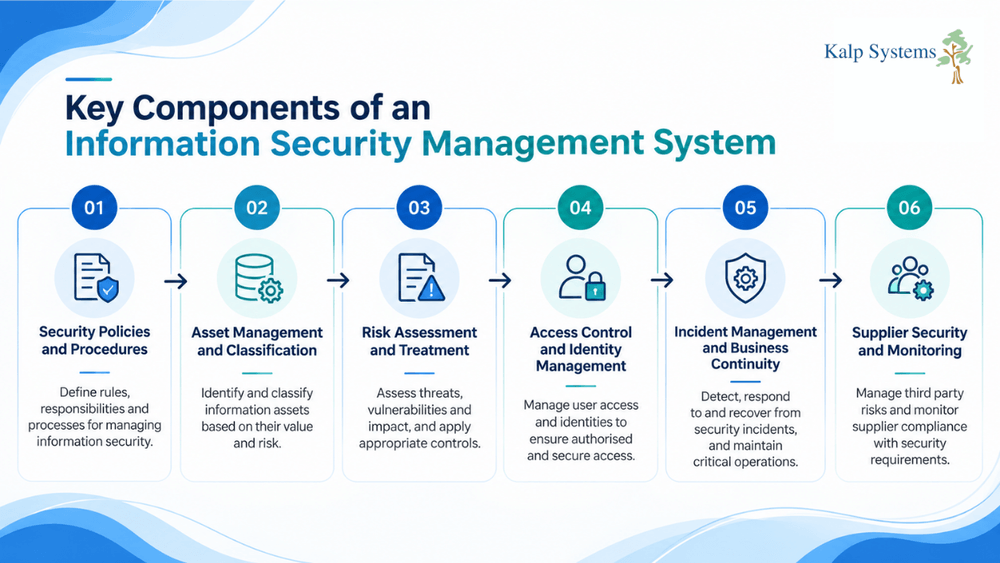
An ISMS brings together several areas that support the protection of information and the management of security risks. Each component has a specific role, but they also need to work together. A policy without defined responsibilities, for example, will have limited value if the controls and processes needed to support it are not in place.
Security Policies and Procedures
Information security policies establish directions for how information should be protected. They can define security objectives, responsibilities, acceptable practices and the requirements that apply to different areas.
Supporting procedures provide more practical guidance for carrying out those requirements. Policies and procedures should also reflect applicable regulatory obligations, contractual commitments and the risks identified through the ISMS.
Asset Management and Classification
Before security risks can be assessed properly, important information assets need to be identified. These can include data, applications, servers, endpoints, cloud services and other supporting infrastructure.
Classification helps determine the level of protection required for different types of information. Sensitive personal data, financial records and critical operational information may require stronger safeguards than information with a lower level of sensitivity.
Asset records should also remain current. Changes such as new applications, cloud services, system replacements or changes in ownership can affect the risks associated with an asset.
Risk Assessment and Treatment
Risk assessment helps determine which threats and vulnerabilities could affect information assets and what impact an incident could have. Risks can arise from cyber-attacks, insider activity, system failures, supplier relationships and other sources.
Once risks have been assessed, suitable treatment options can be considered. Depending on the circumstances, a risk may be reduced through additional controls, accepted, transferred or avoided.
Documented risk treatment plans also provide useful evidence during audits and management reviews. They show how identified risks were evaluated and what actions were taken in response.
Access Control and Identity Management
Access controls help ensure that users receive access appropriate to their responsibilities. Common measures include role-based access, least privilege, strong authentication and regular access reviews.
Identity management becomes particularly important when systems are accessed through cloud platforms, remote connections and multiple applications. User accounts should be created, modified and removed through defined processes, with access reviewed when roles or responsibilities change.
Incident Management and Business Continuity
An ISMS should include processes for detecting, reporting, responding to and recovering from security incidents. Incident procedures can define escalation paths, responsibilities, communication requirements and actions for containing the incident.
Business continuity and disaster recovery arrangements support the recovery of critical services after a security incident, system failure or other disruption. These arrangements should be tested periodically so that recovery procedures can be reviewed and improved.
Supplier Security and Monitoring
Third-party services can introduce additional information security risks, particularly when suppliers handle sensitive data or have access to critical systems. Supplier security assessments, contractual requirements and periodic reviews can help manage these risks.
Monitoring provides visibility into whether security controls continue to work as intended. Relevant activities can include reviewing security events, access activity, incidents, vulnerabilities and compliance findings. The results can then feed into risk reviews and improvement activities.
How to Implement an ISMS
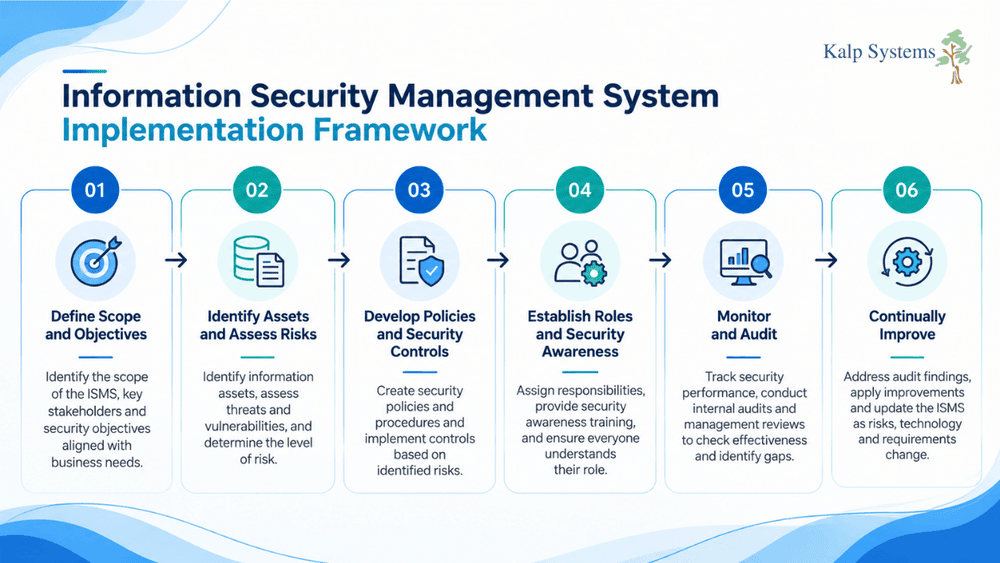
An ISMS implementation usually starts with understanding what needs protection and where the main risks sit. The work then moves through policies, controls, responsibilities and reviews. The sequence matters because later decisions depend on information gathered earlier in the process.
Define Scope and Objectives
The first decision is the scope of the ISMS. It should be clear which locations, systems, services, processes and information the framework will cover. A scope that is too broad can make implementation difficult to manage, while a narrow scope may leave important information or processes outside the security framework.
Security objectives can then be defined around the risks and requirements within that scope. These objectives give the security team and management a common reference when priorities, controls and performance measures are reviewed.
Identify Assets and Assess Risks
Once the scope is clear, the next task is to understand what information and supporting assets fall within it. This can include applications, databases, endpoints, cloud services, infrastructure and important records.
The assessment should consider what could happen if information were disclosed, changed without authorisation or became unavailable. Threats, vulnerabilities and potential impacts can then be considered together to determine which risks require treatment.
The results should lead to documented decisions. Some risks may require additional controls, while others may be accepted, transferred or avoided depending on the circumstances.
Develop Policies and Security Controls
The risk assessment provides a practical basis for deciding what policies and controls are required. Policies should set clear expectations for areas such as access, information handling, incident reporting and acceptable use.
Controls then put those requirements into practice. Depending on the risks identified, this may involve stronger authentication, access reviews, encryption, vulnerability management, backup arrangements, incident response procedures or supplier controls.
Documentation needs attention at this stage as well. Risk assessments, treatment decisions, policies and control records should be maintained so that there is a clear record of how security decisions were made.
Establish Roles and Security Awareness
Someone needs to be responsible for each important part of the ISMS. Responsibilities can cover risk ownership, policy management, control operation, incident response, audit activities and management review.
People who work with company information also need to know what the security requirements mean for their daily work. Training can cover practical issues such as handling sensitive information, recognising phishing attempts, protecting credentials and reporting incidents.
The training should reflect the roles involved. Someone working with privileged systems, for example, may need different guidance from an employee who mainly handles customer information.
Monitor, Audit and Continually Improve
Implementation does not end when the policies and controls are in place. Their performance needs to be reviewed through security monitoring, access reviews, incident records, internal audits and risk assessments.
An audit may reveal that a documented control is not being followed consistently. An incident may expose a weakness that was not identified during the original risk assessment. Changes to cloud services, suppliers or internal processes can also introduce new risks.
These findings should feed back into the ISMS. Policies can be updated, controls can be adjusted and responsibilities can be reviewed where necessary. This ongoing cycle keeps the system aligned with the risks it is intended to manage.
ISMS and ISO 27001
An ISMS provides the management framework for handling information security risks, while ISO 27001 sets out the requirements used to establish and maintain that framework. The two terms often appear together, but they refer to different things.
ISO 27001 can be used as a reference when defining the scope, assessing risks, selecting controls and establishing processes for the ISMS. It also provides a basis for assessing whether the system meets the requirements of the standard.
ISO 27001 Requirements for an ISMS
An ISO 27001-aligned ISMS needs to address areas such as the scope of the system, information security objectives, risk assessment, risk treatment, documented information, operational controls, performance evaluation and continual improvement.
Risk management plays an important role throughout the process. The organisation needs to determine which information security risks apply to its scope and decide how those risks will be treated.
The ISMS should also have evidence showing how its processes and controls operate. This can include policies, risk assessments, treatment plans, audit records, review findings and other relevant documentation.
ISMS Certification and Audit Readiness
Certification provides an independent assessment of an ISMS against the requirements of ISO 27001. Before an external certification audit, internal reviews can help identify gaps in policies, controls, records and day-to-day practices.
Audit readiness should therefore be treated as an ongoing activity. Risk assessments need to remain current, controls should continue to operate as intended, and evidence should be available to demonstrate how requirements are being managed.
Regular internal audits and management reviews can help identify areas that need attention before an external assessment. Findings can then be addressed through corrective actions and subsequent review.
Common Challenges in ISMS Implementation
Implementing an ISMS can become difficult when security requirements are defined without enough attention to existing processes, responsibilities and available resources. The challenges often become clearer once the framework moves from documentation into regular use.
A common issue is an unclear scope. If the scope does not clearly identify the systems, processes, locations and information covered by the ISMS, it becomes harder to assess risks and determine which controls apply.
Leadership involvement can also affect implementation. Security responsibilities require appropriate ownership, resources and decisions from management. Without that support, risk treatment actions and security improvements can remain incomplete.
Risk assessment can present another challenge. A generic assessment may overlook risks linked to specific systems, suppliers or processes. Risk information needs to remain relevant as technology, services and operating practices change.
Documentation can create additional work when it is treated separately from actual security activities. Policies, procedures and records should reflect how controls operate in practice. Keeping them aligned requires regular review rather than updating documents only before an audit.
Maintaining the ISMS over time can be another challenge. New applications, cloud services, suppliers, regulatory requirements and security incidents can change the risk profile. Regular reviews help identify these changes and determine whether existing controls still provide appropriate protection.
Emerging Trends in Information Security Management
Information security management continues to change as companies adopt cloud services, work with more third party providers and face tighter data protection requirements. These changes also affect how an ISMS is maintained and reviewed.
Cloud and Third-Party Risk Management
Cloud platforms and external service providers can introduce risks that may not exist within directly managed infrastructure. Data may be stored across different environments, while suppliers can have access to systems or information needed for their services.
An ISMS should account for these relationships through appropriate supplier assessments, contractual requirements, access controls and periodic reviews. Cloud responsibilities should also be clearly defined so that security gaps do not arise from assumptions about which party manages a particular control.
Data Protection and Privacy
Data protection requirements have increased the connection between information security and privacy management. Personal data may need specific safeguards throughout its collection, use, storage, sharing and disposal.
For companies operating in India, the Digital Personal Data Protection Act adds another consideration when personal data is handled. An ISMS can support these requirements by helping identify relevant information, assess associated risks and establish controls for protecting it.
Automation and Continuous Monitoring
Security teams increasingly use automation to collect security events, identify unusual activity, track vulnerabilities and support compliance reporting. These capabilities can provide more timely information than periodic manual checks alone.
Continuous monitoring also gives the ISMS a stronger connection with day-to-day security operations. Findings from monitoring can feed into risk assessments, incident management and control reviews, helping teams respond when the security environment changes.
How Kalp Systems Supports ISMS Implementation
Kalp Systems supports companies with the design, implementation and improvement of Information Security Management Systems aligned with ISO 27001 and applicable regulatory requirements.
The approach can cover risk assessment, security policies, control implementation, governance, audit preparation and continual improvement. The focus is on building an ISMS that fits the existing environment and addresses the risks relevant to the company.
Kalp Systems also brings together governance, risk and compliance expertise with technical security capabilities. This helps connect management requirements with the controls and processes used in day-to-day security operations.
For companies preparing for ISO 27001 certification or reviewing an existing ISMS, support can include identifying gaps, strengthening documentation, improving controls and preparing for audits.
Conclusion
An effective Information Security Management System provides a structured way to identify security risks, protect information and maintain appropriate controls. Its effectiveness depends on how well the ISMS is connected to the company’s processes, responsibilities and changing security requirements.
A risk-based approach, clear ownership, defined policies and regular monitoring help keep the system relevant as technology, suppliers and threats change. ISO 27001 can provide a recognised framework for establishing and maintaining these practices, while internal reviews and continual improvement help address gaps over time.
Building an ISMS should therefore be treated as an ongoing process rather than a one-time implementation. Regular risk assessments, audits, management reviews and improvements help maintain effective information security as requirements evolve.
Frequently Asked Questions
What is an Information Security Management System?
An Information Security Management System, or ISMS, is a way for a company to manage its information security in a structured manner. It brings policies, people, processes and security controls together so that risks can be identified, handled and reviewed over time.
How do you Implement an ISMS?
The first step is to decide what ISMS will cover. From there, the company can identify its important information and systems, assess the risks involved and decide how those risks should be treated. Policies and controls are then put in place, responsibilities are assigned, and the system is reviewed regularly.
What are the Main Components of an ISMS?
The main components include security policies, asset management, risk assessment, access control, identity management, incident management and business continuity. Supplier security, monitoring and regular reviews also form part of an effective ISMS.
How does an ISMS Relate to ISO 27001?
An ISMS is the framework a company uses to manage information security, while ISO 27001 sets out requirements for that management system. A company can use ISO 27001 to structure its ISMS and, when the requirements are met, go through the certification process.
How Long does ISMS Implementation Take?
The timeframe depends on what is included in the ISMS and how much is already in place. A company with established policies, controls and risk processes may have less work to complete. If these areas need to be developed from the beginning, implementation can take considerably longer.