HomeBlogPolicy and ProcessesBuilding Practical Information Security Policies That Teams Actually Follow
Building Practical Information Security Policies That Teams Actually Follow

What Makes an Information Security Policy Practical
A policy can look complete on paper and still be difficult for employees to use. The real test comes when someone has to make a decision during their normal work and needs to know what the policy requires.
Take an access control policy. It should fit with the way new employees receive access, how permissions change when someone moves to another role, and what happens when they leave. If the policy does not match these processes, employees and IT teams have to fill in the gaps themselves.
The same applies to data handling. A rule saying that sensitive information must be protected does not tell an employee what to do with a file received by email, where it can be uploaded, or whether it can be shared with an external party. Practical policies give enough direction for situations like these.
The language should be straightforward as well. Employees should not have to work through long technical explanations before they understand a requirement. Where a technical term is necessary, it should be explained in a way that relates to the work being done.
Responsibility also needs to be clear. A policy should identify who owns it, who approves changes, and who handles questions or exceptions. Without that clarity, even a well-written policy can become a document that people refer to only when an audit is approaching.
Why Information Security Policies Often Fail
A policy can be correct and still fail in practice. The document may have been approved, shared with employees and stored in the right place, but that does not mean people will use it when they need to make a security decision.
The problem often starts during policy development. If the focus stays on documentation, compliance or completing an audit requirement, it is easy to overlook the people who have to work with the policy every day.
Policies Written for Audits Instead of Everyday Use
Some policies are written with the audit in mind first. They include the required statements, responsibilities and controls, so the organisation can show that the policy exists and has been approved.
The difficulty comes later. An employee may need to know whether they can send a particular file to an external contact, use a personal device for work, or install a piece of software. If the policy does not give enough direction for situations like these, the employee still has to decide what to do.
A policy should be useful outside an audit. Employees should be able to refer to it when a security question comes up during normal work.
Complex Language and Unclear Requirements
A policy does not become better simply because it uses formal or technical language. In some cases, that makes the document harder for the people who are expected to follow it.
Consider a requirement that says sensitive information must be handled appropriately. Wording may sound reasonable, but what does it mean in practice? Can the information be sent by email? Can it be stored in a cloud application? Can an employee share it with an external party?
These details matter. When requirements are vague, different people can interpret the same rules differently. Clear wording gives employees a better idea of what is expected without making them search for an explanation every time they encounter an unfamiliar situation.
Generic Policies That Do Not Match Real Workflows
A policy template can save time when creating the first draft, but using it without making the necessary changes can create problems later. Every company has its own applications, access arrangements, data flows and working practices.
For example, a policy may contain rules for systems that are no longer used or fail to mention cloud services that employees now rely on every day. A remote working policy could have the same problem if it was written before the current working arrangements were introduced.
This is particularly relevant in cloud and hybrid environments. The way people access systems and share information can change considerably, while the policy remains unchanged.
A useful policy needs to be checked against actual working practices. When systems, processes or responsibilities change, the related policy should be reviewed as well.
Key Elements of an Effective Information Security Policy
A useful policy should make its expectations clear from the beginning. Employees should be able to tell why the policy exists, who it applies to and what they are expected to do. The people responsible for managing the policy should also be clear.
These details can seem basic, but leaving them out creates problems later. Questions about ownership, exceptions or approval can quickly become unclear when the document does not address them.
Clear Purpose, Scope and Responsibilities
The policy should explain what it covers and who needs to follow it. This could include employees, contractors, particular systems, types of information or specific activities.
Responsibility should not be left as an assumption. Someone should own the policy and be responsible for keeping it current. There should also be a clear person or authority for approval and a defined way for employees to raise questions or request an exception.
This becomes especially useful when a policy needs to be reviewed or when an issue occurs. People should not have to work out who is responsible after the problem has already appeared.
Practical Security Requirements and Examples
The actual rules need to be clear enough for people to use them in their work. Broad statements about protecting information or maintaining secure access are not always enough on their own.
A data handling policy, for example, can explain how sensitive information should be stored and shared. An access control policy can set out expectations around user accounts, permissions and access changes. A short example can also help where a requirement may otherwise be open to interpretation.
The point is not to describe every possible situation. It is to give employees enough context to understand how the requirement applies when they are dealing with a real task.
Review, Exceptions and Enforcement
A policy also needs to account for situations where the normal rule cannot be followed. There may be a genuine reason for an exception, but the process for requesting and approving it should be clear. Exceptions should not become informal workarounds that no one records or reviews.
The policy should be reviewed when there are significant changes to systems, processes, risks or regulatory requirements. A fixed review schedule can help, but waiting for the scheduled date is not sensible if a major change happens earlier.
Enforcement needs similar clarity. Employees should understand what happens when a requirement is ignored and who is responsible for dealing with repeated or serious violations. This gives the policy some practical weight instead of leaving it as a document that is simply approved and stored.
How to Create Information Security Policies That Teams Follow
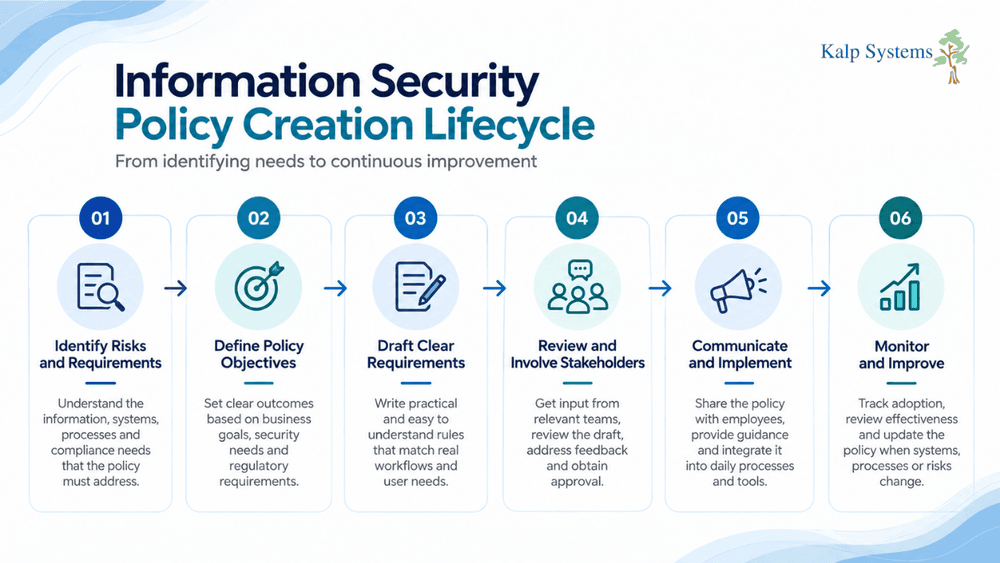
Creating a policy should start with the way security requirements fit into actual work. Before writing the document, it is worth looking at the risks, processes and systems that the policy needs to address. This gives the policy a clear purpose instead of turning it into another document that employees are expected to read and remember.
Identify Security Risks and Requirements
Start by identifying what the policy needs to protect and where problems could occur. This may involve looking at access to systems, handling sensitive information, remote working arrangements, third-party access or other areas relevant to the environment.
The requirements should also reflect applicable compliance obligations and internal security rules. For companies operating in India, Information Security Policies in India may also need to account for relevant regulatory and sector-specific requirements. Once these are understood, the policy can focus on the areas that actually need to be controlled rather than including rules that have little connection to day-to-day work.
Define Clear Policy Objectives
The policy should have a clear reason for being created. Its objectives should explain what the policy is intended to achieve and what type of behaviour or control it expects.
For example, an access policy may aim to make sure users receive only the access required for their roles and that unnecessary access is removed when responsibilities change. A clear objective makes the rest of the policy easier to write and review.
Involve Relevant Stakeholders
Security teams should not be the only people involved in writing a policy. IT, HR, legal teams, process owners and the people who will actually use the policy may all have useful input.
Their involvement can bring practical issues to light before the policy is approved. A requirement that looks reasonable from a security perspective may be difficult to apply within a particular workflow. Discussing those issues early gives the policy owner a chance to adjust the wording or define a suitable process.
Write, Review and Communicate the Policy
Once the requirements are clear, write the policy in straightforward language and keep the requirements focused. Remove statements that do not add useful direction and make responsibilities clear.
The draft should then go through the appropriate review and approval process before it is issued. After approval, employees need to know what has changed, why it matters and what they are expected to do differently.
Simply placing the document in a shared folder is rarely enough. Communication should reach the people affected by the policy, with additional guidance or training where the requirements are more involved.
Embedding Information Security Policies into Daily Operations
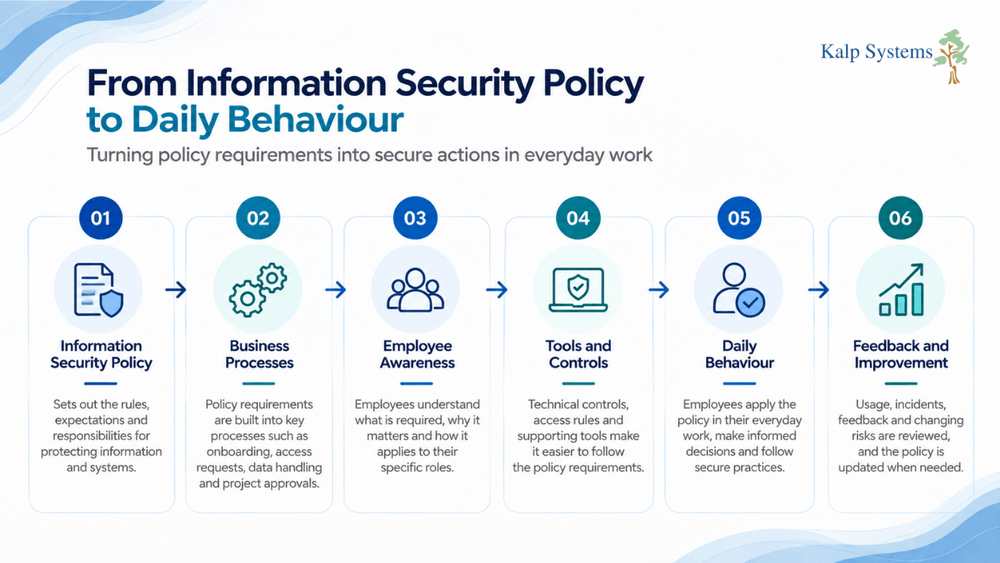
A policy becomes easier to follow when it is part of the work people already do. Employees should not have to remember a separate set of rules and then figure out how those rules fit their tasks. The relevant requirements can be built into processes such as onboarding, access requests, project approvals and incident handling.
Align Policies with Everyday Workflows
The policy should connect with the processes that support it. For example, an access control policy should be reflected in how access is requested, approved, changed and removed. A data handling policy should fit the tools employees use to store and share information.
This connection also makes it easier to spot gaps. If a policy says that certain access requires approval but the related workflow has no approval step, the requirement is difficult to enforce consistently. Reviewing the policy alongside the relevant process can reveal these issues before they become routine.
Reinforce Requirements Through Training and Controls
Employees still need guidance after a policy has been published. Training should focus on what people are expected to do in situations they are likely to encounter rather than simply asking them to read about the policy.
Technical controls can provide another layer of support. Access restrictions, approval workflows and monitoring can reinforce requirements without relying entirely on employees remembering every rule.
The aim is to make the secure action easier to follow during normal work. When the policy, training and supporting controls point in the same direction, employees have less room for confusion and fewer requirements depend on memory alone.
Measuring and Improving Policy Effectiveness
Publishing a policy does not tell you whether it is working. There needs to be some way to see where the requirements are being followed and where people are still running into problems.
Monitor Exceptions, Incidents and Audit Findings
Policy exceptions can show where a requirement is difficult to apply. Repeated exceptions may point to a process that needs changing or a rule that no longer fits the way work is carried out.
Security incidents and audit findings can provide similar information. If the same policy-related issue keeps appearing, reviewing the policy may be more useful than simply reminding employees about it again.
Training results and employee feedback can also reveal areas that need attention. Questions raised during training or repeated requests for clarification may indicate that a requirement is not clear enough.
Review Feedback and Update Policies Regularly
Policies should not be treated as documents that are written once and left unchanged. Systems, working practices, security risks and regulatory requirements can change, so the related policies need to keep pace.
A regular review gives the policy owner an opportunity to check whether the requirements still match current processes. Feedback from employees and process owners can make this review more useful, particularly when people are reporting practical difficulties with a requirement.
The review should result in changes when needed. Keeping an outdated policy simply because it has already been approved can create a gap between documented requirements and the way work is actually performed.
Common Mistakes When Creating Information Security Policies
A policy can lose its value when it is treated as a one-time documentation exercise. Writing the document, getting approval and publishing it does not mean the work is finished. The policy still needs to reflect current risks, systems and working practices.
One common mistake is relying too heavily on templates. A template can provide a useful starting point, but copying it without adapting to the requirements can leave gaps between the document and actual operations.
Another issue is introducing rules without involving the people who have to follow them. If employees and process owners have no opportunity to raise practical concerns, a requirement may be difficult to apply once it reaches day-to-day work.
It is also easy to focus on the document while overlooking the controls and processes that support it. A policy may require strong access controls, for example, but the related approval and access management process must support that requirement.
Policies should therefore be treated as part of the wider security process. They need appropriate ownership, practical controls, employee awareness and periodic review to remain useful as the environment changes.
The Role of Leadership in Policy Adoption
Employees are more likely to take a policy seriously when leadership treats security requirements as part of normal working practice. If managers ignore a requirement or make exceptions without following the proper process, employees can receive a very different message from the one written in the policy.
Leadership also has a role in setting expectations. Managers should give teams enough time and support to understand new requirements, raise questions and make changes to the way they work where necessary. Security should not be presented only as a compliance task that sits with the security team.
Visible support also matters when a policy needs to be enforced. When leaders follow the same requirements expected of their teams and support appropriate controls, it becomes easier to build consistent security behaviour across the workplace.
Conclusion
An information security policy should fit the way people actually work. If a rule is difficult to understand or does not match the process it is meant to support, employees may end up relying on their own judgement instead.
Good policies need attention after they are approved as well. Systems change, teams adopt new tools, working practices shift, and new security risks appear. A policy that made sense a year ago may need changes today.
Keeping the wording clear, assigning proper ownership, reviewing the requirements and listening to the people who use them can make a noticeable difference. The policy then becomes part of normal security practices rather than a document that is brought out only for an audit.
Frequently Asked Questions
What is an Information Security Policy?
An information security policy sets the basic rules for protecting information and the systems used to handle it. It also explains who is responsible for following, managing and reviewing those rules. The exact requirements will depend on the systems, information and working practices covered by the policy.
What should an Information Security Policy Include?
There is no single structure that fits every situation. A policy will normally need a clear purpose and scope, responsibilities, security requirements, rules for exceptions, and details about review and enforcement. The requirements should relate to the risks and processes the policy is intended to address.
How do you Create an Effective Information Security Policy?
Start with the problem the policy needs to address rather than a blank template. Look at the relevant risks and current processes, then involve the teams that will have to work with the requirements. Once the draft is ready, it should be reviewed, approved and explained to the people affected by it.
How Can You Get Employees to Follow Security Policies?
People are less likely to follow a rule they do not understand or cannot apply to their work. Keep the wording clear and use examples where a requirement could be misunderstood. Training also needs to cover what employees should actually do, while access controls, approval processes and other technical measures can support the requirements.
How often Should Information Security Policies Be Reviewed?
A regular review should be scheduled, but the calendar should not be the only trigger. A significant change to a system, working process or regulatory requirement may require an earlier review. A security incident can also reveal that a policy needs to be clarified or changed.