HomeBlogGovernance and ComplianceCybersecurity Leadership: Roles, Responsibilities and Compliance
Cybersecurity Leadership: Roles, Responsibilities and Compliance

What is Cybersecurity Leadership
Cybersecurity leadership refers to the direction and oversight that senior leaders provide for protecting information, systems, and critical operations. It covers security strategies, risk decisions, governance, compliance, and accountability across the organisation.
The responsibility extends beyond the security team. The board needs visibility into significant cyber risks, executives need to support security priorities and resources, and security leaders need to turn those priorities into practical policies and controls. For companies in India, this makes cybersecurity leadership in India important when setting security priorities, managing risk, and meeting regulatory requirements. Department heads and employees also have responsibilities when their work involves sensitive information or critical systems.
Effective cybersecurity leadership gives these responsibilities a clear structure. It helps senior decision-makers understand where the greatest risks sit, which issues require attention, and how security requirements fit within wider operational priorities.
Why Cybersecurity Leadership Matters
Cybersecurity decisions can affect regulatory compliance, service continuity, sensitive information, and stakeholder trust. Leadership therefore has an important role in deciding how risks are assessed, prioritised, reported, and addressed.
Strong leadership also creates accountability. When responsibilities are clearly assigned, security teams can act with better direction and senior management can track whether important issues are being resolved.
Setting the Security Tone at the Top
Senior leaders influence how cybersecurity is treated across the organisation. Their involvement in security reviews, risk discussions, policy decisions, and incident planning shows that security responsibilities extend beyond the IT department.
Leadership behaviour matters as well. When senior management follows security policies and supports regular awareness activities, employees receive a clear expectation about how information and systems should be handled.
Aligning Cybersecurity with Business Objectives
Cybersecurity decisions need to reflect operational priorities, regulatory requirements, critical systems, and the information that requires protection. Leadership helps determine where security resources should be directed and which risks require immediate attention.
This connection also helps security teams contribute to wider planning. When cybersecurity is considered during technology projects, vendor decisions, and changes to critical services, potential risks can be addressed before they become difficult to manage.
Establishing Accountability for Cyber Risk
Clear ownership is essential when a significant cyber risk is identified. Leaders need to know who is responsible for assessing the issue, deciding how it should be treated, and reporting its status.
Regular reporting can give senior management a clearer view of security incidents, compliance gaps, audit findings, vulnerabilities, and remediation work. It also strengthens leadership accountability in cybersecurity, particularly when an unresolved risk could affect critical operations or regulatory obligations.
Key Cybersecurity Leadership Responsibilities
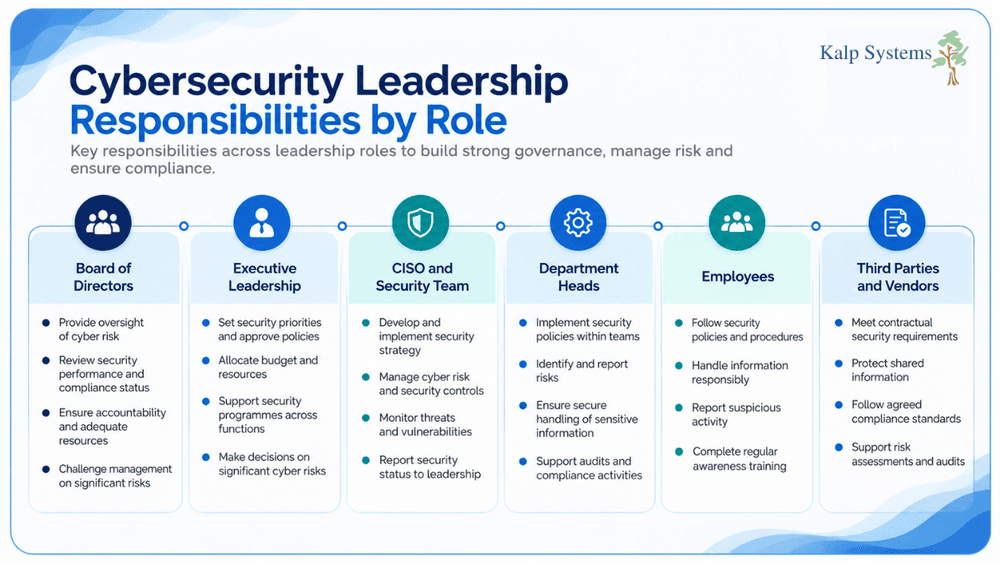
Cybersecurity leadership becomes practical when responsibility is clear. A board may oversee the wider risk position, while executives make decisions about priorities and resources. The CISO and security teams then work with other departments to put those decisions into practice.
The important point is that these responsibilities need to connect. A risk identified by the security team should reach the people who can make a decision about it, and agreed actions should have someone responsible for seeing them through.
Board Oversight and Accountability
The board needs enough information to question the organisation’s cyber risk position and understand where serious gaps remain. Regular reporting can cover significant risks, audit findings, compliance issues, major incidents, and unresolved remediation work.
This does not mean that board members need to understand every technical detail. Their role is to provide oversight and challenge management when a significant risk lacks clear ownership, funding, or a suitable response.
This is also where leadership accountability in cybersecurity becomes important. If a serious risk remains unresolved, there should be a clear record of who owns it and how senior management is addressing it.
Executive and CISO Responsibilities
Executives have an important part in turning security priorities into decisions. They approve policies, support security programmes, allocate resources, and decide how significant risks should be handled.
The CISO works more closely with the security function. The role can include setting security priorities, managing cyber risk, overseeing controls, supporting compliance, and presenting the security position to senior management.
The two levels need regular communication. Security teams may identify a technical weakness, but an executive decision may be needed to provide funding, accept a risk, change a process, or delay a project until the issue has been addressed.
Cyber Risk Management and Decision Making
Leadership needs a clear picture of the risks that could affect critical systems, sensitive data, and essential services. This requires more than a list of technical vulnerabilities. The potential effect on operations, regulatory obligations, suppliers, and customers also needs to be considered.
Risk assessments can help determine which issues require immediate attention. Leaders can then decide whether a risk should be reduced through additional controls, monitored more closely, transferred, or formally accepted.
This gives senior decision-makers a practical basis for setting priorities instead of treating every security issue in the same way.
Security Policies and Governance
Security policies provide rules that guide how information and systems should be protected. Leadership needs to approve these requirements and make sure they remain relevant as systems, regulations, and working practices change.
Governance provides follow-up. Reviews, audits, risk assessments, and management reporting can reveal where a policy is not being followed or where a control needs improvement.
Clear governance also helps connect cybersecurity compliance with day-to-day decisions. When responsibilities are documented and reviewed regularly, gaps are easier to identify and assign for remediation.
Cybersecurity Leadership and Compliance
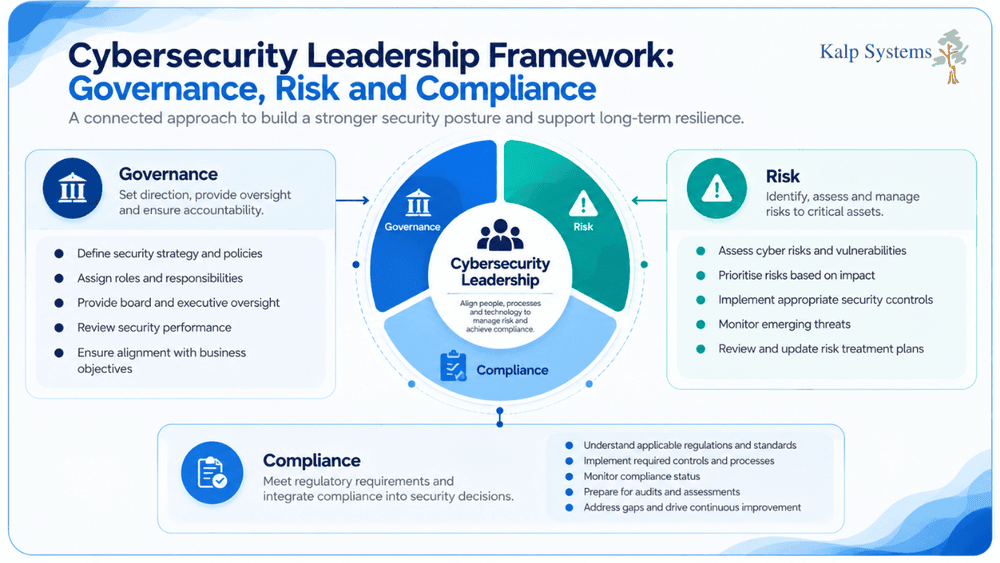
Compliance decisions eventually reach people, processes, and systems. A policy may require stronger access controls, an assessment may identify a weakness, or a regulation may introduce a new responsibility for handling personal data. Someone has to decide what action is required, who owns it, and when it needs to be completed.
That is where senior leadership is important. Compliance cannot sit separately from security planning when regulatory requirements affect how data is collected, stored, accessed, shared, or protected.
Regulatory and Compliance Responsibilities
The first responsibility is knowing which requirements apply. Cybersecurity compliance in India may involve obligations under the Digital Personal Data Protection Act, ISO/IEC 27001 requirements, or sector-specific rules from regulators such as RBI, SEBI, or IRDAI, depending on the activities involved.
Senior leaders do not need to manage each requirement themselves. They do need a clear view of the obligations, the major gaps, and the people responsible for addressing them.
The same principle applies when requirements change. A new regulatory obligation should lead to a review of relevant policies, controls, contracts, processes, and reporting responsibilities.
Audit Readiness and Compliance Monitoring
An audit should not be the point at which missing evidence, outdated policies, or unresolved findings first come to light. These issues are easier to manage when they are tracked as part of normal security governance.
Leadership can review open findings, overdue actions, control weaknesses, and recurring issues through regular reporting. A finding that remains open for months may require a different decision from one that can be resolved through routine corrective work.
This also gives senior management a clearer picture of the organisation’s cyber security compliance position before an external review takes place.
Integrating Compliance into Security Decisions
Compliance requirements can affect decisions made well before a security control is implemented. A new application may involve personal data. A supplier may receive access to sensitive information. A change in infrastructure may alter how data is stored or transferred.
These decisions need the right compliance considerations at the planning stage.
When leadership brings security and compliance into such discussions early, teams have more room to choose appropriate controls and address gaps before they become expensive or difficult to correct.
Building a Strong Cybersecurity Culture
Security culture usually shows itself in small decisions. An employee receives an unexpected request for customer information. Someone notices a strange login. A team member finds that a security procedure makes a task harder and considers taking a shortcut.
The response to situations like these says a lot about the security culture. People need to know what they are responsible for, where they can ask for help, and how to report something that does not look right.
Leadership sets much of that environment. If security receives attention only after an incident, employees are unlikely to treat it as part of their normal responsibilities. Regular communication and practical support make a bigger difference.
Security Awareness and Training
Training should relate to the work people actually do. A finance team may need guidance on payment fraud and suspicious requests, while a technical team may deal with privileged access, system changes, or exposed credentials.
The same presentation repeated every year rarely keeps people engaged. Short sessions, examples from incidents, phishing exercises, and reminders linked to current risks can make security awareness more relevant.
Leadership support matters here as well. When managers make time for training instead of treating it as an interruption to normal work, participation becomes easier to maintain.
Employee Accountability
Clear responsibilities give employees a better idea of where their role begins and ends. They should know how company information can be handled, which systems they can access, and what they should do when they notice a possible security problem.
Accountability should also work in both directions. Employees need to follow established requirements, while managers need to make sure those requirements are practical and understood.
A mistake should not automatically become a disciplinary issue. If people are afraid to report an accidental disclosure or suspicious message, a security team may hear about the problem too late.
Leadership Support for Secure Practices
Employees often take their cues from management. If a senior leader ignores an access control requirement or asks staff to bypass a security procedure to save time, the message is clear even if the written policy says something else.
Leaders can reinforce better habits by following the same requirements, responding to reported issues, and giving teams enough time to complete security activities properly.
That consistency helps turn security from a document sitting on a shared drive into something people actually consider when making everyday decisions.
Leadership During Cybersecurity Incidents
When a cyber incident occurs, technical teams usually take the lead on containment and investigation. Senior leaders have different responsibilities. They need to make decisions that can affect operations, regulatory obligations, customers, employees, and third parties while the facts are still being established.
The first few hours can therefore involve difficult choices. Affected systems may need to be isolated, access may need to be restricted, and critical services may need to continue while the investigation is underway. Leadership needs to make sure these decisions have the right people behind them.
Incident Response Decision Making
A serious incident can quickly move beyond the security team’s immediate technical response. Senior management may need to approve operational changes, bring in external specialists, decide how critical services should be handled, or determine when an issue needs to be escalated further.
A documented incident response plan gives everyone a clearer route when this happens. It should identify who needs to be involved, who can make specific decisions, and when an incident needs to move to senior management.
The quality of those decisions can affect what happens next. A delay in containing an incident, for example, may give an attacker more time to move through systems or access additional information.
Regulatory and Stakeholder Communication
Some incidents also create reporting and communication obligations. The response may involve regulators, customers, employees, suppliers, or other parties depending on what happened and whose information or services were affected.
Leadership needs to coordinate closely with security, legal, compliance, and communications teams before important information is shared. Early assumptions can change as the investigation develops, so statements should reflect what has actually been established.
For incidents involving personal data, the applicable regulatory requirements also need to be considered alongside the technical response. Keeping decisions, findings, and communications properly documented can provide useful evidence during later reviews.
Lessons Learned and Continuous Improvement
Once the incident has been contained, leadership needs to look at why the problem happened and what needs to change. The review may point to a weakness in security control, an outdated procedure, unclear ownership, or a gap in employee awareness.
The purpose is to turn those findings into specific actions. That might mean changing an access control, updating an incident response procedure, improving training, or addressing a risk that had previously received limited attention.
This follow up is an important part of cybersecurity leadership because accountability continues after the immediate incident has ended.
Best Practices for Effective Cybersecurity Leadership
Good cybersecurity leadership depends on having enough visibility to make sensible decisions. Senior leaders need to know which risks deserve attention, where responsibility sits, and whether agreed actions are actually being completed.
That becomes difficult when reporting is too technical or ownership changes from one team to another. A simpler approach is to make responsibilities clear, report what matters, and revisit unresolved issues regularly.
Define Clear Roles and Responsibilities
A security issue should have an owner. Without one, remediation can easily stall between IT, security, legal, compliance, or another department.
Roles should therefore be clear before an incident or audit exposes the confusion. The board provides oversight, executives make decisions about priorities and resources, the CISO directs security activities, and individual teams take responsibility for the controls and information within their area.
The same clarity is useful when a risk needs escalation. People should know who can accept the risk, who can approve corrective action, and when senior management needs to become involved.
Establish Regular Cyber Risk Reporting
Senior leaders rarely need a long list of every vulnerability detected during the month. They need enough context to see which issues could affect critical operations, sensitive information, regulatory requirements, or important third parties.
Useful reporting might include major incidents, overdue remediation, audit findings, compliance gaps, and changes in high-priority risks. Trends also matter. If the same weakness keeps appearing after previous corrective work, it deserves closer attention.
Reporting in this way gives decision-makers something they can act on rather than another technical document to review.
Review and Improve Security Performance
Security controls and policies can lose relevance as systems, regulations, suppliers, and working practices change. Periodic reviews help identify where an existing approach no longer matches the risk.
Audit results, incidents, risk assessments, control testing, and employee feedback can all point to areas that need attention. The useful part comes afterwards: assigning the work, setting a realistic timeframe, and checking that the issue has actually been resolved.
For senior leadership, improvement is easier to track when progress is tied to specific risks and actions rather than broad security targets.
Conclusion
Cybersecurity leadership affects how security risks are discussed, funded, managed, and reviewed. The board provides oversight, executives set priorities, and security leaders turn those priorities into practical controls and processes.
Clear ownership also makes cybersecurity compliance easier to manage. When risks have accountable owners, important findings are tracked, and leadership receives useful reporting, security decisions can be made with a better view of their potential impact.
The role does not end with policies or audit requirements. Leadership also shapes how people respond to security issues, how incidents are handled, and whether lessons from those incidents lead to meaningful changes. Consistent involvement at senior levels can therefore support stronger governance, clearer accountability, and a more resilient security programme.
Frequently Asked Questions
What is the Role of Leadership in Cybersecurity?
Cybersecurity cannot be left entirely with the IT or security team. Senior leaders have to get involved when a risk needs funding, a policy needs approval, or a serious issue has not been fixed. They also have a say in how security fits into wider decisions, particularly when those decisions involve important systems, sensitive information or regulatory requirements.
What are the Cybersecurity Responsibilities of the Board?
The board does not need to understand every technical control in place. What matters is having a clear picture of the bigger risks and asking the right questions about them. If there has been a major incident, a serious audit finding or a compliance problem that remains open, the board should know about it and understand what is being done in response.
What is the Role of a CISO in Cybersecurity Leadership?
The CISO has to keep one eye on the security team and the other on the wider company. They deal with security risks, controls, incidents and compliance, but they also need to explain what those issues mean to people making senior decisions. A good part of the role is making sure important security concerns do not get lost between technical teams and management.
Why is Leadership Important for Cybersecurity Compliance?
A compliance requirement does not fix itself once it has been identified. Someone has to decide what needs changing, who will handle it and what happens if the work is not completed on time. Leadership becomes important when those decisions involve resources, priorities or different departments and the issue cannot simply be handed back to the security team.
How can Leaders Improve Cybersecurity Accountability?
Start with ownership. When a risk or compliance issue comes up, there should be a clear answer to the question, “Who is dealing with this?” It also helps to revisit important open issues rather than assuming that an assigned action has been completed. That simple follow through can make a noticeable difference to how seriously security responsibilities are taken.