HomeBlogPolicy and ProcessesVendor and Third-Party Risk Management Policy: Key Components and Best Practices
Vendor and Third-Party Risk Management Policy: Key Components and Best Practices

What is Third-Party Risk Management
A vendor can have a direct connection to your systems without being part of your internal team. Cloud providers may store company or customer information, software suppliers may connect to applications, and external service providers may handle tasks that involve sensitive records.
That connection creates third-party risks.
Third-party risk management is the process of checking what could go wrong through these relationships and deciding how those risks should be handled. The work starts before a vendor is approved and continues throughout the relationship. It can involve reviewing security controls, checking compliance, limiting access, assessing the information being shared and keeping track of changes.
The level of review should depend on the role of the provider. A vendor with access to personal data or a critical application needs closer attention than a supplier with little or no access to internal systems.
This is where a third-party risk management policy becomes useful. It gives the teams involved in procurement, IT, security and compliance a common way to assess vendors instead of making each decision from scratch.
The assessment also needs to be revisited. A vendor may later receive access to another system, start handling additional information, change its subcontractors or experience a security incident. Any of these changes can affect the original risk assessment.
Why a Third-Party Risk Management Policy Matters
A third party can become part of your security environment as soon as it receives access to systems, information or services. If that relationship is not assessed properly, a weakness at the provider’s end can create security, compliance or operational problems for the company using its service.
A clear third-party risk management policy gives procurement, IT, security and compliance teams a consistent way to decide what needs to be checked, which controls are required and when a vendor needs to be reviewed again. The level of attention can then be based on the vendor’s access, the information involved and the importance of the service.
Growing Vendor and Supply Chain Risks
A security problem at a supplier can quickly become a problem for the company using its service. Attackers may target a trusted provider because it has access to several customers, applications or information sources.
The risk is not limited to large technology vendors. Software suppliers, consultants, managed service providers, logistics partners and other third parties can all introduce different forms of exposure.
A vendor risk management policy helps set expectations before access is provided. It can define the checks required during onboarding, the controls expected from a provider and the circumstances that require another assessment.
Data Protection and Compliance Requirements
Third parties often process information on behalf of another company. That makes data handling an important part of vendor assessment.
The review should establish what information will be shared, why the provider needs it, how it will be protected and what happens when the service ends. Contractual requirements can also cover confidentiality, incident reporting, audit rights and data deletion.
In India, the Digital Personal Data Protection Act is an important consideration when personal data is handled through external providers. Depending on the sector, service and type of information involved, requirements linked to ISO 27001, GDPR, RBI or SEBI may also need to be considered.
Increasing Reliance on External Service Providers
Cloud platforms, SaaS applications and outsourced services have become part of routine operations. This can make vendor relationships difficult to manage through procurement alone.
A provider may start with limited access and gradually become involved in a more important process. That change can increase the level of third-party risk without anyone deliberately creating a new risk.
Regular vendor reviews help identify these changes. They can also highlight expired certifications, new security concerns, changes in ownership or other issues that may require action.
A well-defined policy gives teams a practical reference for handling these situations and keeping vendor risk management connected to everyday security and compliance work.
Key Components of a Third-Party Risk Management Policy
A vendor policy needs to answer some practical questions. Who needs a detailed assessment? What information can be shared? Which security conditions need to be agreed before access is given? What happens when the vendor’s circumstances change?
The answers will differ from one provider to another. A payroll service, cloud platform and office supplier do not carry the same level of exposure, so applying an identical review to all three would add work without giving much additional protection.
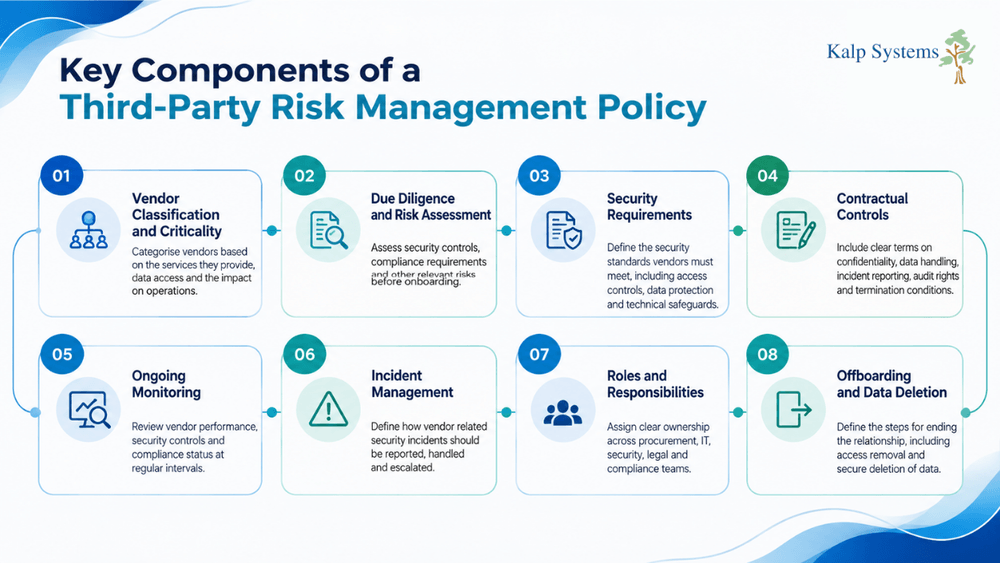
Vendor Risk Classification and Criticality
Start by looking at what the provider does and what the company would face if something went wrong.
Access to personal data is one consideration. Access to internal applications, dependence on the service, regulatory obligations and the effect of an outage also matter. A provider supporting a critical system may deserve a higher risk rating even when it does not handle large volumes of personal information.
A simple classification, such as low, medium and high risk, can make the process easier to manage. The important part is documenting why a vendor falls into a particular category. That decision then guides the depth of due diligence, approval requirements and frequency of later reviews.
Due Diligence and Vendor Risk Assessment
The initial assessment should give the security and procurement teams enough evidence to decide whether the provider is suitable.
Depending on the risk level, this could involve security questionnaires, independent audit reports, ISO 27001 certification, SOC reports, penetration testing results, information about previous incidents and details of how data is stored or transferred.
For a provider with access to sensitive information, simply accepting a completed questionnaire may leave important questions unanswered. Supporting evidence gives reviewers a better view of the controls actually in place.
The assessment can also cover financial stability and continuity arrangements where the service is important to daily operations. A provider that cannot maintain its service during a disruption can create operational problems even without a cyber incident.
Contractual and Data Protection Controls
Security requirements need to be agreed before the relationship becomes operational.
The contract can set out confidentiality obligations, permitted data use, security requirements, incident notification, audit rights, subcontracting conditions and termination arrangements. These clauses give both sides a clear understanding of their responsibilities.
Data access deserves particular attention. A provider should receive only what it needs to deliver the agreed service. If personal data is involved, the agreement should also address how that information is protected, retained, returned or deleted.
These details become especially important when a service involves several parties. A vendor may rely on another provider, so subcontracting arrangements should be known and assessed where they can affect the risk.
Ongoing Monitoring and Risk Reassessment
The risk rating given during onboarding can become outdated.
A vendor might add a new service, connect to another application, change its ownership or start using a different subcontractor. A security incident or expired certification can also change the picture.
Reviews should therefore focus on information that can reveal a meaningful change. Security posture, compliance status, incident history, service performance and changes to access are useful areas to check.
The review cycle can be risk-based. A critical provider may need closer and more frequent attention than a low-risk supplier. Significant changes should also prompt a review rather than waiting for the next scheduled assessment.
Incident Management and Secure Offboarding
Vendor-related incidents need a defined route for reporting and escalation. The agreement should specify how quickly a provider must report an incident, who needs to be contacted and what information should be supplied during the investigation.
The relationship also needs a proper ending.
When a contract is terminated, accounts and permissions should be revoked, credentials should no longer work, and company information should be returned or securely destroyed according to the agreed requirements. Any remaining access should be checked rather than assumed to have disappeared automatically.
Keeping a record of these steps provides evidence that the vendor’s access and information were dealt with after the relationship ended.
How to Implement a Third-Party Risk Management Policy
A policy only becomes useful when it is connected to the actual vendor process. When a new supplier is proposed, someone needs to know what information to collect, who reviews it, what level of approval is required and what happens after the contract is signed.
The same process should continue during the relationship. Vendor details, access permissions and risk ratings can change, so the records and controls need to keep pace with those changes.
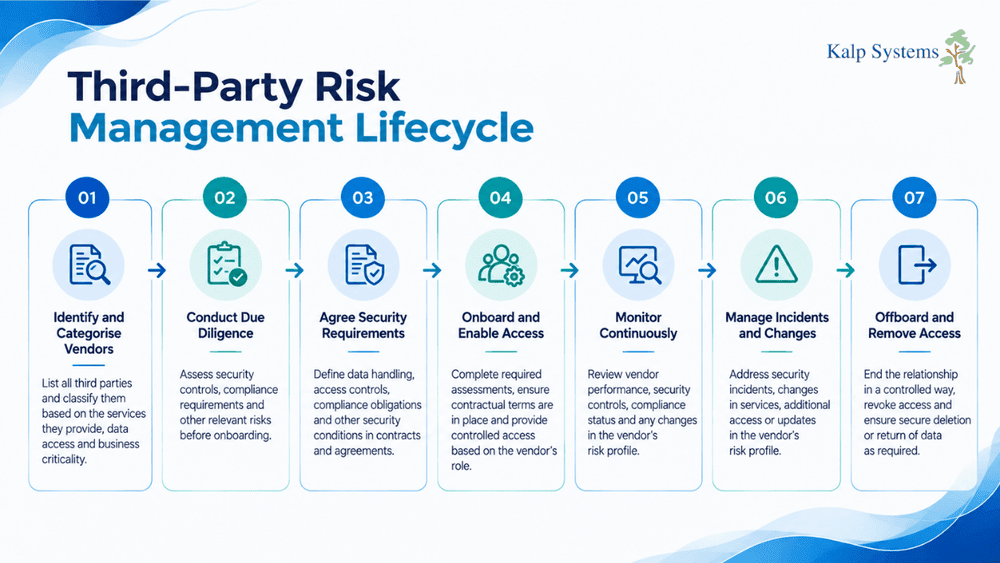
Identify and Categorise Vendors
Start with a clear view of who has access to company information, applications or important services. This can include cloud providers, software suppliers, consultants, managed service providers and other external partners.
The vendor record should capture useful details such as the service provided, information handled, systems accessed, business owner and level of criticality.
From there, vendors can be grouped according to their level of exposure. A supplier with no access to internal systems may need a straightforward review. A provider storing sensitive information or supporting a critical application will require closer attention.
Keeping this information up to date is important. A vendor that starts with limited access may later become involved in a more sensitive process.
Assess Vendor Risk and Define Security Requirements
The assessment should answer a straightforward question: what could this relationship expose us to?
Look at the information being shared, access being granted, security controls provided by the vendor, compliance requirements and the effect a service failure could have.
The evidence requested should match the level of risk. Depending on the relationship, this could include security questionnaires, ISO 27001 certification, SOC reports, audit findings, penetration testing reports, incident records or details of data handling practices.
The outcome should be clear enough for the responsible team to decide whether the vendor can be approved, whether additional safeguards are needed or whether a risk needs to be formally accepted.
Establish Controls and Monitor Vendor Performance
Once the vendor is approved, the agreed requirements need to remain part of the relationship.
Access should be limited to what the provider actually needs. Contractual security obligations should be tracked, and important evidence such as certifications or assessment reports should be reviewed when required.
Performance also deserves attention. A provider that repeatedly misses service commitments, responds slowly to security issues or fails to provide requested compliance evidence may need a closer review.
For higher-risk vendors, periodic checks can cover security posture, incidents, compliance status and service performance. Keeping these findings documented makes it easier to spot a pattern rather than dealing with each issue in isolation.
Review and Update Vendor Risk Regularly
A vendor’s risk rating should reflect its current role, not the situation from the day it was approved.
Consider what has changed since the previous assessment. Has the provider received access to another system? Is it processing additional information? Has ownership changed? Has a new subcontractor been introduced? Has the vendor experienced a security incident?
These changes may require the risk assessment to be updated.
The policy should also define when a formal review is required and who is responsible for carrying it out. Higher risk relationships can follow a closer review cycle, while lower risk providers may need less frequent checks.
Keeping the policy itself current matters as well. Changes to technology, regulations, services or internal processes can make older requirements less useful. A periodic review keeps the document aligned with how vendor relationships are actually being managed.
Regulatory and Compliance Considerations
A vendor can affect compliance simply because of the work it performs or the information it handles. That is why regulatory requirements need to be considered when a third-party is being assessed.
The exact requirements will depend on the service, the type of information involved and the sector in which the provider operates. A vendor processing personal data will have different considerations from one supporting a non-sensitive internal service.
Digital Personal Data Protection Act
The Digital Personal Data Protection Act is particularly relevant when personal data is handled by an external provider.
The review should establish what information the provider will receive, why it needs that information and how the data will be handled during the service. These points can then be reflected in the vendor agreement along with requirements covering confidentiality, security, incident reporting and the handling of information when the relationship ends.
This should form part of the normal vendor risk assessment. Looking at data protection separately from the vendor’s wider security posture can leave gaps in the review.
ISO 27001 and GDPR
ISO 27001 can provide useful evidence when checking a provider’s information security practices. A current certification or relevant audit report can support the assessment, particularly when the vendor handles sensitive information or has access to important systems.
GDPR may also need to be considered where its requirements apply to the data or processing activity involved. The assessment can look at the provider’s security measures, data handling arrangements and responsibilities under the relevant agreement.
Neither certification nor compliance documentation should be treated as the entire assessment. The evidence still needs to be considered in relation to the actual service and access being provided.
RBI and SEBI Requirements
Vendors supporting financial services may also fall within relationships where RBI or SEBI requirements need to be considered.
In these cases, the vendor review should take account of the service being provided and the controls expected for that type of relationship. Security measures, oversight, incident handling and the provider’s role in a critical service may all need attention.
This is one reason a single vendor checklist does not work well for every provider. The review needs to reflect the risk, sector and service involved.
Common Mistakes in Third-Party Risk Management
A vendor review can look complete while still missing practical security issues. This usually happens when the process becomes a routine checklist rather than something connected to the way an external service is actually being used.
Three areas deserve particular attention.
Treating Vendor Assessments as a One-Time Activity
A questionnaire completed during onboarding only reflects the situation at that point.
Six months later, the same supplier might have access to another application, handle additional information or introduce a new subcontractor. A security incident or change in ownership could also affect the original decision.
The review cycle should reflect this. Higher risk relationships generally need closer follow-up, while lower risk suppliers may require fewer checks. A significant change should be enough to trigger another review even if the scheduled assessment is still some time away.
This is particularly important for critical services, where a change in the supplier’s security position can have a direct effect on operations.
Using the Same Controls for Every Vendor
A vendor with access to sensitive customer information should not be assessed in exactly the same way as a supplier that provides a basic service without touching internal systems.
The difference should be reflected in the level of due diligence, approval, contractual requirements and monitoring.
For example, a critical cloud provider may need detailed security evidence and regular reviews. A low-risk supplier may only need a limited set of checks. Risk classification makes this distinction easier to manage and gives the security team a reason for applying different levels of oversight.
Overlooking Vendor Access and Offboarding
Access is easy to grant and surprisingly easy to forget.
A third party may receive an account to complete a project, connect to an application or access a particular set of records. If those permissions are never reviewed, the account can eventually have more access than the service requires.
The same issue appears when the relationship ends. Removing the vendor from a contract does not automatically remove every account, credential or permission associated with that relationship.
Offboarding should therefore include access revocation, credential review and the return or secure destruction of information, where required. Keeping a record of those actions gives the security team evidence that the relationship was properly closed.
Best Practices for an Effective Third-Party Risk Management Policy
A third-party policy should answer practical questions that come up when a vendor is being considered or reviewed. Who needs to approve it? What information can the vendor access? Which security checks are required? What happens if the provider does not meet one of those requirements?
These details are easier to manage when responsibilities are agreed in advance. Procurement can handle the initial vendor information, while IT and security can look at access and technical controls. Legal may review the contract, and compliance may need to be involved where personal data or sector-specific requirements are concerned.
The review should also make sense for the vendor being assessed. A provider storing sensitive information deserves a closer look than a supplier with no access to internal systems. Asking both to complete the same level of assessment adds work without necessarily improving security. The risk rating should have a real purpose and influence the checks, approvals and review frequency.
Access is another area that deserves attention after onboarding. A vendor may need access to one application for a particular service, but that does not mean the same access should remain indefinitely. Changes in the scope of work are a good reason to check whether existing permissions are still required.
Vendor records should tell the story of the relationship. Someone reviewing the file later should be able to see why the vendor received its risk rating, what checks were completed, which systems or data were involved and whether any issues were left open. This becomes particularly useful when the same provider comes up for review several months later.
There will also be cases where a vendor cannot meet every requirement. That does not always mean the relationship has to stop. The reason for accepting the gap should be recorded, along with who approved it and whether there is any action needed later. Leaving exceptions undocumented makes it difficult to know which risks were consciously accepted and which were simply missed.
The policy should be reviewed when the way vendors are managed changes. New systems, new regulatory requirements, changes in supplier arrangements and lessons from security incidents can all point to areas that need updating.
A good policy does not need to cover every possible situation in lengthy detail. It needs to give the people handling vendors enough direction to make sensible decisions, record those decisions and revisit them when circumstances change.
Conclusion
Vendor relationships do not stay the same from the day a contract is signed. The service can expand, access can change, new data can be shared, or the provider itself can go through changes that affect its security position.
That is why a third-party risk management policy needs to work beyond the initial vendor assessment. It should give the teams involved a clear way to decide what needs to be checked, what controls are required and when a relationship needs another review.
There is no need to make every vendor go through the same process. A provider with access to sensitive information or a critical system deserves closer attention than one with limited involvement. What matters is that the decision is based on the actual level of exposure and is reviewed when circumstances change.
A well-maintained policy gives procurement, IT, security, legal and compliance teams a common reference when dealing with these relationships. It also makes it easier to spot gaps before they turn into a larger security or compliance problem.
Frequently Asked Questions
What is a Third-Party Risk Management Policy?
A third-party risk management policy explains how vendors and other external providers are handled when they have access to information, systems or important services. It sets the basic rules for checking a vendor before approval, deciding what security requirements apply, keeping track of the relationship and dealing with the vendor when the contract comes to an end.
What should a Third-Party Risk Management Policy Include?
The exact contents will depend on the type of vendors involved, but the policy normally covers vendor classification, due diligence, risk assessment, data handling, access controls, contractual requirements and ongoing reviews. Incident reporting and offboarding also need to be addressed, particularly where a vendor has access to sensitive information or supports a critical service.
How is Vendor Risk Assessed?
Vendor risk starts with the relationship itself. The review needs to consider what the provider is doing, what information it will handle, which systems it needs to access and how important the service is. A vendor handling sensitive personal data or supporting a critical application will generally require more detailed checks than a supplier with limited access and little impact on day-to-day operations.
How Often should Third-Party Risk be Reviewed?
There is no useful single timetable for every vendor. A critical provider may need more regular attention, while a low-risk supplier may be reviewed less often. The important point is to reassess the relationship when something changes, such as new system access, additional data, a new subcontractor, a security incident or a significant change in the service being provided.
Who is Responsible for Managing Third-Party Risk?
Vendor risk usually involves several teams, and their roles need to be clear. Procurement may deal with the supplier and initial requirements; IT and security may review access and technical controls, while legal and compliance teams may handle contractual or regulatory matters. The policy should make ownership clear so that a concern raised during a vendor’s review has someone responsible for taking it forward.