Overview
Data protection has become a board-level priority for organisations operating in a digital-first economy. Regulations are no longer limited to IT teams; they directly influence how businesses collect, process, store, and share personal data. For security and compliance leaders, understanding data protection laws is now essential to managing risk, maintaining trust, and avoiding regulatory penalties.
Two of the most discussed data protection frameworks today are the General Data Protection Regulation (GDPR) of the European Union and India’s Digital Personal Data Protection Act (DPDP Act). While GDPR has been the global benchmark since 2018, India’s DPDP Act marks a significant shift in how personal data protection is regulated within the country.
This article provides a side-by-side comparison of GDPR and the DPDP Act, highlights similarities and key differences, and explains what changes organisations must consider when aligning global GDPR based systems with India’s DPDP requirements.
Why GDPR and India's DPDP Act Matter for Modern Organisations
Data-driven business models depend heavily on personal data. Customer analytics, digital marketing, employee management, cloud services, and SaaS platforms all process sensitive personal information daily.
Security and compliance leaders face increasing pressure due to rising data breaches and cyber attacks, stronger regulatory enforcement globally, increased awareness of individual privacy rights, and complex cross-border data flows.
GDPR and DPDP aim to address these challenges by defining clear rules for data protection, accountability, and individual rights. However, the way they approach compliance and enforcement differs in important ways.
Two of the most discussed data protection frameworks today are the General Data Protection Regulation (GDPR) of the European Union and India’s Digital Personal Data Protection Act (DPDP Act). While GDPR has been the global benchmark since 2018, India’s DPDP Act marks a significant shift in how personal data protection is regulated within the country.
This article provides a side-by-side comparison of GDPR and the DPDP Act, highlights similarities and key differences, and explains what changes organisations must consider when aligning global GDPR based systems with India’s DPDP requirements.
Understanding GDPR and Its Core Data Protection Principles
The General Data Protection Regulation GDPR is a comprehensive data protection law enforced across the European Union and applicable to organisations worldwide that process personal data of EU residents.
GDPR focuses on strong individual rights over personal data, lawful and transparent processing, accountability, documented governance, risk-based security controls, and strict penalties for non-compliance.
GDPR applies regardless of where the organisation is located, as long as EU personal data is involved.
Who GDPR applies to
A surprising number of businesses assume GDPR becomes relevant only after opening an office somewhere in Europe. That isn’t how the Regulation works.
An Indian software company selling subscriptions to customers in Germany, a cloud provider supporting clients in Spain, or an online business analysing website visitors from the EU may all come within GDPR’s scope. The location of the organisation matters less than the personal data it handles.
This catches companies during expansion. Internal processes that worked perfectly in one market suddenly need another look because customer rights, privacy notices, contracts, and data handling practices now have to meet GDPR expectations as well.
Key GDPR compliance requirements
Ask someone who’s been through a GDPR audit what took the most time, and the answer is rarely encryption or access controls. More often, it’s documentation. Knowing where personal data sits, why it was collected, who can access it, and proving those decisions with evidence usually takes far longer than expected.
Technical controls still matter. So do privacy notices, lawful processing, retention practices, and responding to individual rights requests. The difference is that GDPR expects these activities to work together. A policy saying one thing while day to day operations follow another quickly becomes obvious during an assessment.
Understanding India's DPDP Act and Its Compliance Requirements
The Digital Personal Data Protection Act DPDP Act is India’s primary data protection law, designed to regulate the processing of digital personal data of individuals in India, referred to as Data Principals.
DPDP emphasises consent-based data processing, purpose limitation, data minimisation, clearly defined responsibilities for Data Fiduciaries, proportionate compliance obligations, and protection of digital privacy rights of Indian citizens.
The DPDP Act is structured to balance privacy protection with ease of doing business in India.
Who must comply with the DPDP Act
A startup collecting user registrations, a hospital managing patient records, an online retailer processing customer orders, or a software company running a cloud platform may look like completely different businesses. The one thing they have in common is personal data.
That is where the DPDP Act starts to matter. The focus is not on the size of the organisation or the number of employees. It is on whether digital personal data is being collected or processed as part of normal business activities.
Companies already following GDPR often expect the transition to be straightforward. Some controls do carry across, but the DPDP Act introduces its own approach to consent, governance, and regulatory obligations. A fresh review usually uncovers areas that need local changes rather than a simple copy and paste from an existing GDPR programme.
Key concepts every organisation should understand
Privacy conversations become much easier once everyone is speaking the same language. Terms such as Data Principal, Data Fiduciary, and Data Processor appear throughout the Act, but they quickly move beyond legal definitions and become part of everyday decision making.
Picture a customer signing up for an online service. Their details are collected, verified, stored, shared with a payment provider, and later used by customer support. Each step involves someone making decisions about that information. Who decides why it is collected? Who processes it? Who is responsible if something goes wrong? Those answers shape the roles defined under the DPDP Act.
Looking at personal data as a journey, rather than a single record in a database, usually makes the legislation much easier to understand and apply in practice.
Core Similarities Between GDPR and India's DPDP Act
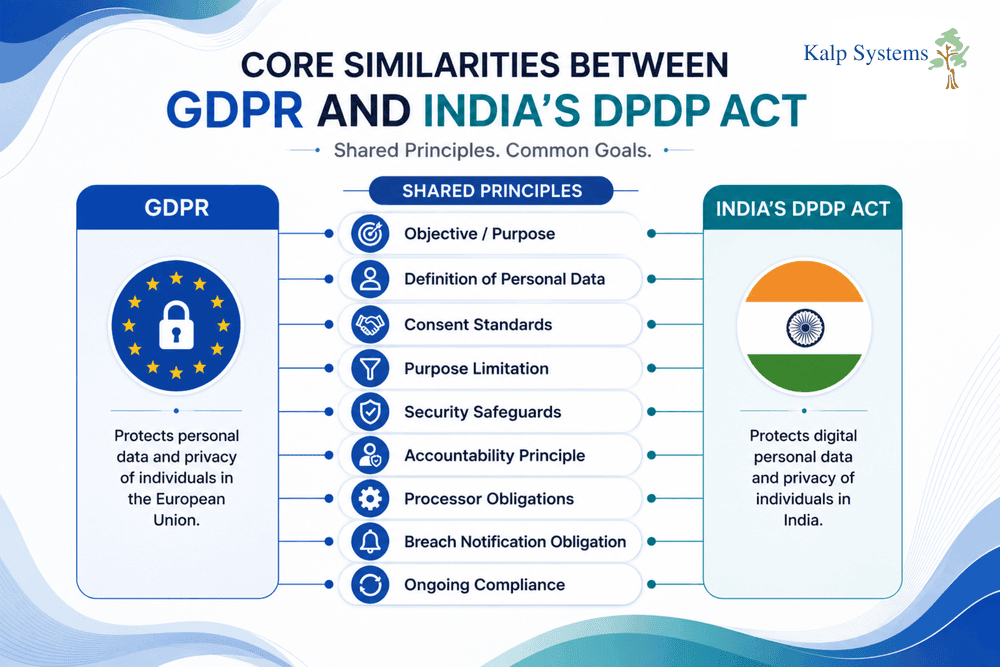
The following infographic highlights the shared technical and governance principles that form the foundation of both GDPR and India’s DPDP Act.
Shared privacy principles and compliance objectives
Read GDPR and the DPDP Act side by side, and the differences stand out quickly. Spend a little more time with them, though, and the common ground becomes clearer. Both expect organisations to know what personal data they collect, why they collect it, and how they protect it throughout their lifecycle.
Neither framework is comfortable with collecting information simply because it might become useful one day. Every piece of personal data carries responsibility; from the moment it is collected until it is securely deleted. Transparency, accountability, and appropriate security controls remain central to both approaches, even if the legal language differs.
Common responsibilities for organisations
Privacy rarely belongs to one department. Product teams decide what information is collected. Developers build applications. Security protects the infrastructure. HR manages employee records. Procurement works with vendors. Each team influences how personal data is handled, even if privacy isn’t part of their job title.
That is why GDPR and the DPDP Act both places so much emphasis on accountability. Organisations need clear ownership, documented processes, and enough visibility to understand where personal data moves inside the business. Without that, even well-designed security controls can leave gaps that only become visible during an audit or after an incident.
Key Differences Between GDPR and India's DPDP Act
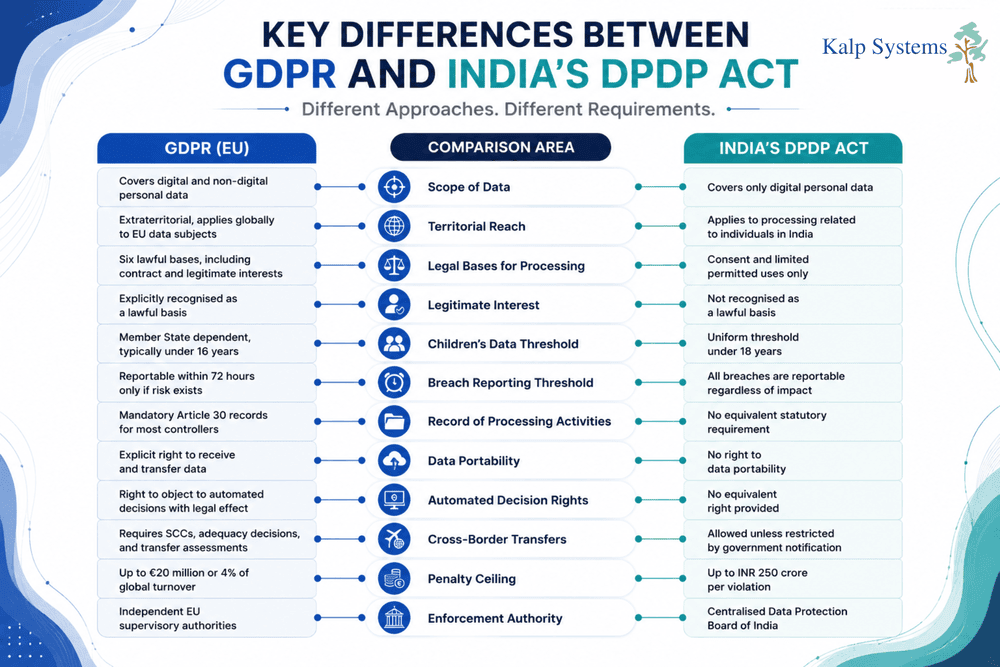
The Infographic below outlines the key technical, legal, and operational differences between GDPR and the DPDP Act that security and compliance leaders must address.
Consent, individual rights, and regulatory approach
Consent sits at the centre of both laws, but the way it is managed isn’t identical. Organisations already familiar with GDPR often discover that simply copying existing notices and consent flows into the Indian market leaves questions unanswered.
The same applies to individual rights. Both frameworks recognise that people should have greater control over their personal data, although the way those rights are defined and exercised differs. Anyone working across both jurisdictions quickly realises that treating GDPR compliance as a universal template usually creates extra work later.
Cross-border data transfers and enforcement differences
Moving personal data across borders has never been a simple technical decision. Legal obligations travel with that data, and they don’t always look the same from one jurisdiction to another.
Organisations already operating under GDPR are familiar with strict requirements around international data transfers. The DPDP Act approaches the same topic from India’s regulatory perspective, which means global businesses need to review data flows carefully instead of assuming one framework automatically satisfies the other.
The same principle applies to enforcement. Both laws include regulatory oversight and financial penalties, but the authorities, processes, and compliance expectations are not identical. Understanding those differences early usually saves a great deal of rework when expanding into new markets.
Practical Example: A GDPR Compliant Organisation Expanding into India
Consider an Indian technology organisation providing a cloud-based, multi-tenant SaaS platform. The company already complies with the GDPR due to its operations in the European Union and is now aligning its data protection programme with the requirements of India’s Digital Personal Data Protection (DPDP) Act.
Where GDPR and DPDP Align
The organisation already maintains well-documented data processing activities, implements role-based access controls, and applies encryption for data at rest and in transit. Centralised logging, monitoring, and defined incident response procedures are in place, including breach detection and notification workflows. Consent management mechanisms capture user approvals with appropriate audit trails. Collectively, these controls establish a strong foundational alignment with DPDP expectations.
Where additional DPDP compliance is required
To achieve DPDP compliance, consent notices must be reviewed and updated to ensure India-specific purpose limitation, plain-language disclosures, and compliance with local consent standards. Data governance structures must explicitly designate responsibilities under the Data Fiduciary construct, including accountability for personal data handling. Grievance redressal mechanisms must be formalised with defined timelines and escalation paths, and incident reporting procedures must be aligned with the expectations of the Data Protection Board of India. While GDPR compliance provides a robust starting point, it does not, by itself, guarantee DPDP readiness and requires targeted localisation.
How Security and Compliance Leaders Can Align GDPR and DPDP Compliance
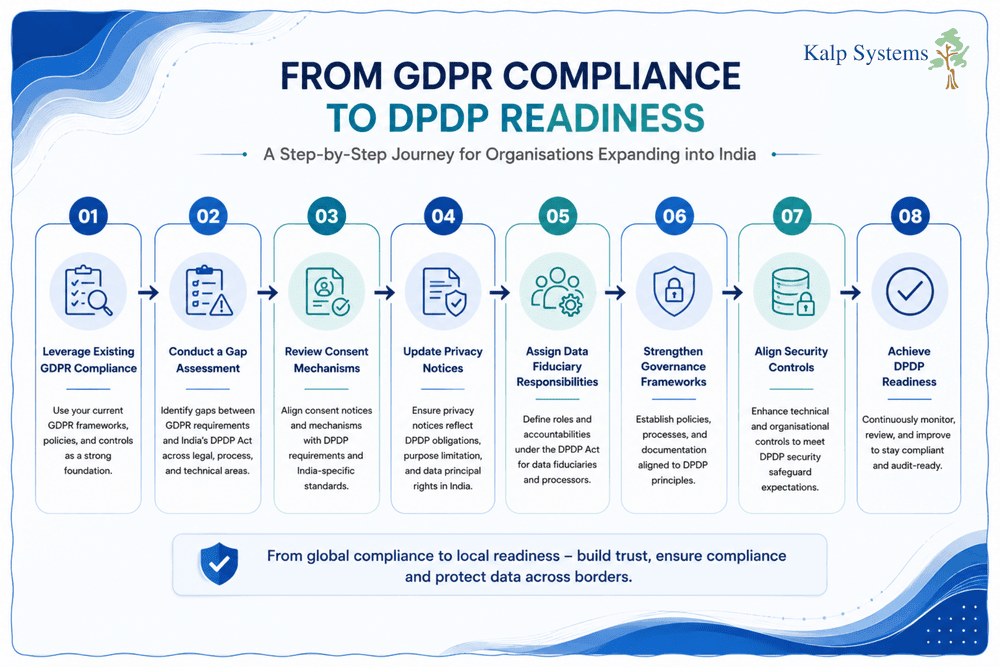
To manage GDPR and DPDP effectively, security and compliance leaders must take a structured and proactive approach to data protection alignment.
Conduct a Data Protection Gap Assessment
Assess differences in consent handling, data subject rights, retention policies, and breach notification requirements between GDPR and DPDP.
Update privacy notices and internal policies
Privacy notices and internal policies should explicitly address DPDP obligations for Indian data subjects.
Align technical and organisational security controls
Identity management, encryption, logging, and continuous monitoring should support both regulatory frameworks.
Prepare for ongoing regulatory compliance
Maintain documentation, training, and response processes to support audits, investigations, and breach reporting under both laws.
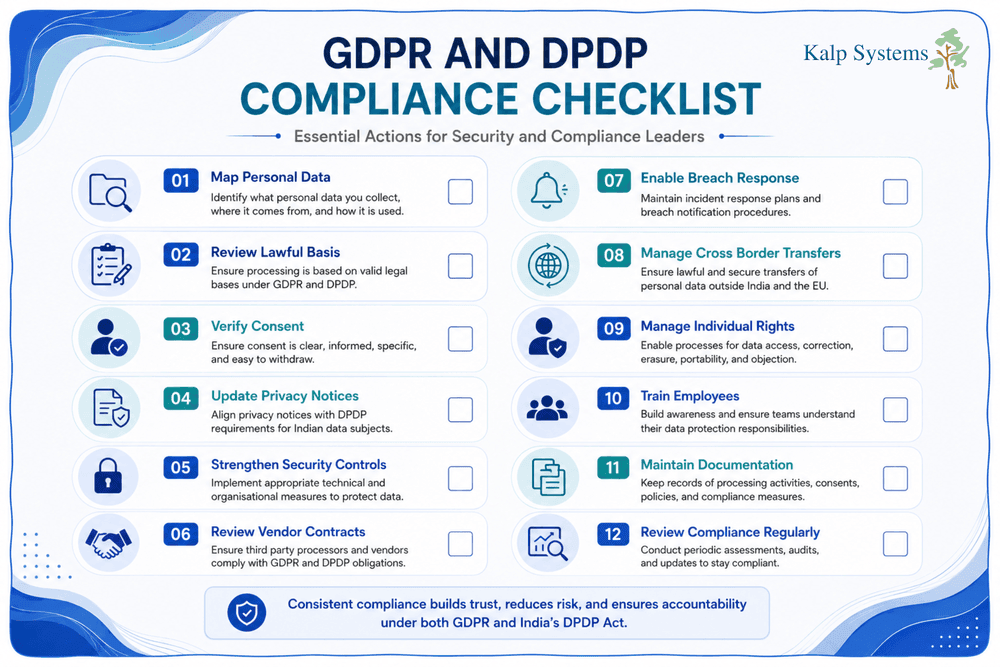
A Practical GDPR and DPDP Compliance Checklist
Policies alone rarely tell you whether a privacy programme is working. The real test comes when someone asks a simple question. Where is this personal data stored? Who can access it? How was consent recorded? Could the team respond confidently if a regulator or customer asked for evidence tomorrow?
Those questions often reveal where the gaps are.
The checklist below brings together the activities that deserve regular attention when managing both GDPR and India’s DPDP Act. It isn’t something to complete once and file. As systems change, new vendors are introduced, and business operations grow; the same checklist becomes a useful way to review whether privacy controls are keeping pace.
Conclusion
GDPR and India’s DPDP Act share a common objective: protecting personal data and strengthening trust in digital ecosystems. However, their scope, compliance models, and enforcement approaches differ in important ways.
For security and compliance leaders, understanding these differences is critical. GDPR compliance does not automatically translate into DPDP readiness. Organisations must adopt a risk-based, India-specific compliance strategy that aligns governance, consent management, and security controls with DPDP requirements.
By proactively addressing these gaps, organisations can not only meet regulatory obligations but also strengthen their overall data protection posture and long-term resilience.