
Introduction
As organisations in India continue expanding through cloud platforms, global vendors, remote operations, and international business environments, personal data now moves across borders far more frequently than before. Customer information may be processed through overseas SaaS applications; employee records may sit on foreign cloud infrastructure, and support teams in different countries may access sensitive data as part of normal operations.
Because of this shift, cross-border data transfers have become an important discussion under India’s Digital Personal Data Protection Act, 2023 (DPDP Act).
One reason this topic creates confusion is that the DPDP Act does not completely restrict international data movement. Compared to some global privacy regulations, the framework is relatively flexible. At the same time, flexibility does not mean organisations are free from responsibility once personal data moves outside India.
In practice, many businesses discover that the real challenge is not the transfer itself. The bigger challenge is maintaining visibility and control once data starts moving across cloud environments, vendors, processors, and distributed operational teams.
This article explains how cross-border data transfer rules work under the DPDP Act, how the framework differs from GDPR, and what organisations should practically focus on while handling international data flows.
Understanding Cross Border Data Transfer Under the DPDP Act and Why It Matters
A cross-border data transfer happens whenever personal data is accessed, processed, stored, or transferred outside India. This can happen in several ways, sometimes even without organisations fully realising how widely their data moves across systems and vendors.
For example, a company may use a global CRM platform hosted overseas, rely on cloud infrastructure spread across multiple countries, or allow remote support teams outside India to access operational systems. In all these situations, personal data may move beyond Indian jurisdiction as part of normal business operations.
This is one reason cross-border compliance is no longer relevant only for multinational corporations. Even mid-sized organisations using cloud-based tools or third-party platforms may still process personal data internationally.
The DPDP Act approaches this issue differently from stricter localisation models. Instead of completely restricting international transfers, the law generally allows personal data to move outside India unless the Government of India specifically restricts certain countries or territories.
That flexibility is important for businesses because modern digital operations often depend on globally distributed infrastructure. Cloud platforms, analytics tools, SaaS products, cybersecurity systems, and enterprise applications frequently operate across multiple regions simultaneously.
At the same time, organisations are still expected to maintain accountability for how personal data is handled after transfer. This becomes especially important once multiple vendors, cloud providers, and processors become involved in the operational environment.
Cross Border Data Transfer Rules Under the DPDP Act 2023 Explained
One of the most important things organisations should understand is that the DPDP Act focuses more on accountability than procedural complexity. Unlike GDPR, the framework does not rely heavily on predefined transfer mechanisms or extensive approval processes before data moves internationally.
Instead, the law places greater emphasis on how organisations manage personal data operationally after transfer.
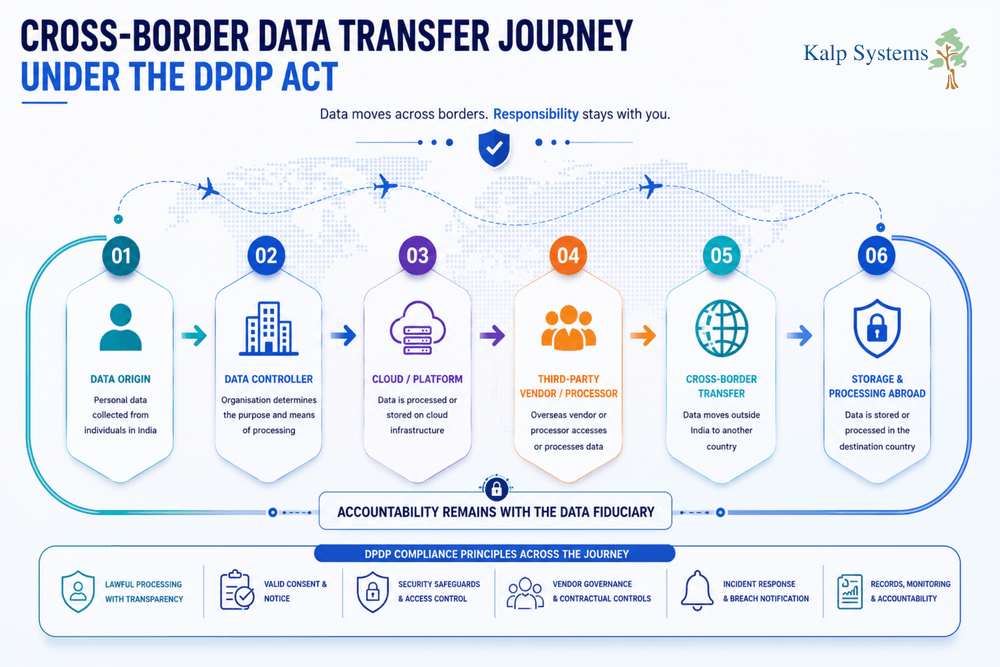
When organisations can transfer personal data outside
Even when personal data is processed outside India, organisations remain responsible for how that information is handled, protected, accessed, and monitored across external environments.
This responsibility extends across several operational areas. Organisations are expected to maintain reasonable safeguards, ensure vendors handle personal data appropriately, and continue protecting user rights even when data moves through overseas systems or cloud infrastructure.
Some of the most important areas organisations usually review include:
- Consent and processing transparency:
Businesses should ensure individuals understand how their personal data may be processed, including situations where cloud platforms, global vendors, or international operational teams become involved.
- Security safeguards and access governance:
Security responsibilities continue even after data leaves India. Organisations are still expected to maintain controls such as encryption, monitoring, access restrictions, logging visibility, and incident response readiness.
- Vendor and processor oversight:
Modern cloud ecosystems depend heavily on external processors, SaaS providers, analytics platforms, and support vendors. Organisations are still expected to maintain oversight into how those vendors handle personal data operationally.
- Incident handling and grievance response:
If a breach, operational issue, or user complaint occurs, organisations remain responsible for responding appropriately even when external infrastructure or overseas processors are involved.
In practice, many organisations initially assume cross-border compliance is mainly about legal approvals or transfer of permissions. Over time, they usually realise the larger challenge is governance visibility across increasingly distributed environments.
Responsibilities of Data Fiduciaries and Data Processors
The DPDP framework generally allows organisations to transfer personal data outside India while continuing to support global operations, cloud adoption, and international service delivery models.
This is especially important because many businesses today depend on globally distributed systems for routine operations. Cloud hosting, analytics environments, communication platforms, disaster recovery infrastructure, and support operations often involve multiple regions and external service providers.
Under the current framework, organisations can generally:
- Use international cloud platforms
- Work with overseas vendors and processors
- Operate globally distributed support environments
- Store or process personal data outside India
Unlike GDPR, there is currently no mandatory requirement for predefined transfer mechanisms, such as Standard Contractual Clauses, before every transfer.
However, the Government of India still has the authority to restrict transfers to specific countries or territories if necessary for security or policy reasons. This means organisations cannot treat cross-border compliance as a one-time implementation activity. Ongoing monitoring and governance remain important as regulations and operational environments continue to evolve.
How Vendor Governance Supports Secure Cross-Border Data Transfer Compliance
One area receiving much more attention under DPDP is vendor governance.
Modern organisations rarely process personal data only within their own infrastructure. In many cases, customer information flows through analytics tools, cloud hosting providers, communication platforms, customer support systems, monitoring environments, and external processors simultaneously.
As cloud ecosystems become more interconnected, businesses may lose visibility into how many vendors actually interact with personal data operationally.
This is exactly why organisations are increasingly reviewing:
- Which vendors can access personal data
- Where vendors operate geographically
- What external processors secure information
- Whether vendors rely on sub-processors
- How incidents and breaches are escalated
In many environments, compliance risks emerge not from the organisation’s primary systems, but from fragmented third-party ecosystems where multiple processors and integrations interact with customer information behind the scenes.
Managing overseas vendors and third-party processors
Most organisations can name the cloud platform they use, but the picture rarely ends there. A single business application may rely on several external providers behind the scenes. One company hosts the platform; another manages backups, while a separate vendor may provide technical support from a different country. Personal data can pass through this chain during everyday operations, often without attracting much attention until someone starts mapping the entire process.
That is why organisations need a clear understanding of every third party involved in handling personal data. Knowing where a vendor is based is only one part of the exercise. It is equally important to understand who can access the data, whether subcontractors are involved, how information is protected during processing, and what happens if a security incident occurs.
Regular vendor reviews help answer these questions before they become compliance issues. Businesses that maintain an accurate inventory of processors, review changes to vendor services, and keep records of international processing activities are generally in a stronger position to manage cross-border data transfers. The objective is straightforward. Personal data should remain visible and accountable throughout the vendor’s ecosystem, regardless of how many external providers support the underlying service.
Strengthening contractual and compliance controls
A vendor agreement does far more than define commercial terms. Once personal data begins moving across borders, it becomes one of the primary ways an organisation establishes expectations around security, confidentiality, and accountability. If those expectations are vague, resolving a compliance issue later becomes far more difficult.
Contracts with overseas vendors and processors should clearly describe how personal data will be collected, processed, stored, shared, and deleted. They should also explain how security incidents will be reported, who is responsible for responding to them, and how the organisation will be informed if another processor becomes involved. These details help avoid uncertainty when several parties are handling the same information.
The contractual framework also needs to reflect the organisation’s wider compliance programme. Vendor assessments, periodic reviews, and documented approval processes help confirm that contractual commitments continue to match operational practices. This becomes particularly important when services expand, infrastructure changes, or data processing activities move into new regions.
Strong contractual controls cannot eliminate every compliance risk, but they provide a clear foundation for managing responsibilities across international vendor relationships. When supported by regular governance reviews, they also make it easier to demonstrate that cross-border data transfers are being managed with appropriate oversight.
Cross-Border Data Transfer Challenges in Cloud and Global Digital Infrastructure
Cloud infrastructure has significantly changed how organisations handle personal data. Applications today often rely on globally distributed environments involving backups, failover systems, remote teams, APIs, and analytics platforms spread across several regions.
Because of this, organisations may not always have immediate visibility into where personal data is being processed operationally.
Several infrastructure-related areas now receive greater attention under DPDP:
- Regional hosting strategies:
Businesses increasingly want visibility into which countries host customer information and how cloud environments replicate data across regions.
- Remote administrative access:
Global support and operational teams may access systems from outside India, increasing the importance of monitoring and access governance.
- Disaster recovery and backups:
Backup systems sometimes replicate data automatically across multiple locations, which may create additional cross-border exposure.
- Vendor integrations and APIs:
SaaS ecosystems often rely on multiple integrations, exchanging information continuously between platforms.
This is one reason many organisations are now investing more time in data flow mapping and operational visibility reviews. Once businesses begin tracing how information actually moves across systems, they often discover the ecosystem is far more distributed than expected.
Cloud storage, SaaS platforms, and international data processing
Cloud services have changed the way organisations manage information. Instead of operating from a single data centre, many applications now run across multiple locations to improve availability, performance, and disaster recovery. As a result, personal data may be stored, processed, or backed up in different countries without disrupting day-to-day business operations.
This is particularly common with SaaS platforms. A business may use one application to manage customers, another for collaboration, and a third for finance or human resources. Each platform can have its own hosting model, infrastructure partners, and regional data centres. Unless these arrangements are understood, organisations may have only limited visibility into where personal data is actually being processed.
For this reason, businesses are increasingly reviewing the international data practices of their cloud providers before adopting new services. Questions around data residency, regional hosting options, backup locations, and access by overseas support teams have become part of routine vendor assessments. These reviews help organisations understand how personal data moves through cloud environments and whether existing governance measures remain appropriate as digital operations continue to expand.
Reducing cross-border data security risks
The movement of personal data across multiple countries naturally increases the number of systems, networks, and service providers involved in processing it. Every additional connection creates another point that needs to be understood and managed. While this does not automatically increase the likelihood of a security incident, it does make governance more complex.
Many organisations begin by identifying where personal data travels after it leaves their internal environment. That exercise often reveals cloud backups in another region, overseas support teams accessing production systems, or third party integrations exchanging information automatically. Once these data flows are documented, it becomes much easier to identify areas that require stronger controls.
Security measures such as encryption, multi factor authentication, access monitoring, and detailed audit logs remain important, but they work best when supported by regular reviews of user access, vendor activities, and infrastructure changes. Organisations should also test their incident response procedures periodically to confirm they can coordinate effectively with overseas vendors if a security event affects internationally processed personal data.
Reducing risk is rarely about introducing a single new control. It comes from understanding how data moves, limiting unnecessary exposure, and reviewing those processes as business operations, technology platforms, and vendor relationships continue to evolve.
How the DPDP Act Compares with GDPR and Other Global Data Protection Laws
For organisations operating internationally, GDPR comparisons are unavoidable because both frameworks deal with international personal data transfers in different ways.
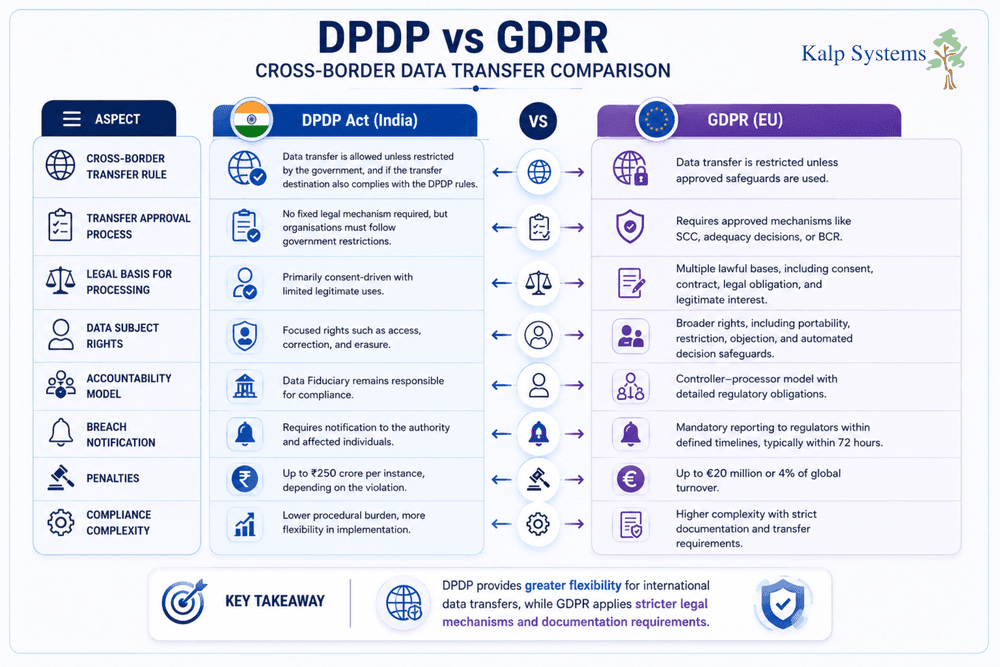
Key similarities organisations should understand
Many organisations compare the DPDP Act with GDPR because both deal with the protection of personal data beyond national boundaries. While the legal frameworks are different, the practical expectations often overlap. Businesses cannot assume that personal data becomes someone else’s responsibility simply because another company or a cloud platform is involved in processing it.
In both frameworks, organisations are expected to understand where personal data travels, who can access it, and what controls exist to prevent unauthorised use or disclosure. Vendor oversight, security safeguards, and internal governance continue to play an important role throughout the data lifecycle. These are operational responsibilities that remain relevant regardless of where the information is stored or processed.
For organisations with customers, partners, or operations in multiple countries, recognising these shared expectations can make compliance programmes easier to manage. Many of the governance practices developed for one framework, such as documenting data flows, reviewing third party providers, and maintaining security controls, also support broader data protection objectives across different regulatory environments.
Major differences that affect compliance strategies
An organisation that already complies with GDPR will probably notice that cross border transfers under the DPDP Act involve fewer procedural steps. That does not mean the two frameworks expect the same approach.
Under GDPR, international transfers are often tied to specific legal mechanisms before personal data can move outside approved jurisdictions. Organisations usually spend considerable time preparing contractual arrangements and documenting why a transfer meets regulatory requirements.
The DPDP Act is less prescriptive in this area. It generally permits international transfers unless the Government of India places restrictions on specific countries or territories. As a result, many organisations spend less time on transfer mechanisms and more time understanding how personal data is handled after it leaves India. Questions around vendor oversight, cloud infrastructure, access controls, and operational governance often become the larger part of the discussion.
Businesses operating across multiple regions rarely work to a single regulatory standard. Internal governance programmes are usually designed to satisfy the strictest obligations that apply to their operations, making it easier to manage personal data consistently across different jurisdictions rather than maintaining separate processes for each market.
Practical Steps to Achieve Cross-Border Data Transfer Compliance Under DPDP
For most organisations, cross-border compliance starts with operational visibility rather than legal documentation.
Many businesses initially underestimate how widely personal data moves through cloud systems, support platforms, analytics environments, APIs, and third-party services. Once those flows become more complex, maintaining governance becomes much harder.
Because of this, organisations are increasingly focusing on areas such as:
- Data flow mapping across cloud environments
- Access governance and monitoring
- Contractual clarity with third parties
- Retention and deletion practices
- Incident response readiness
These reviews help organisations identify operational blind spots that may otherwise remain hidden inside distributed infrastructure environments.
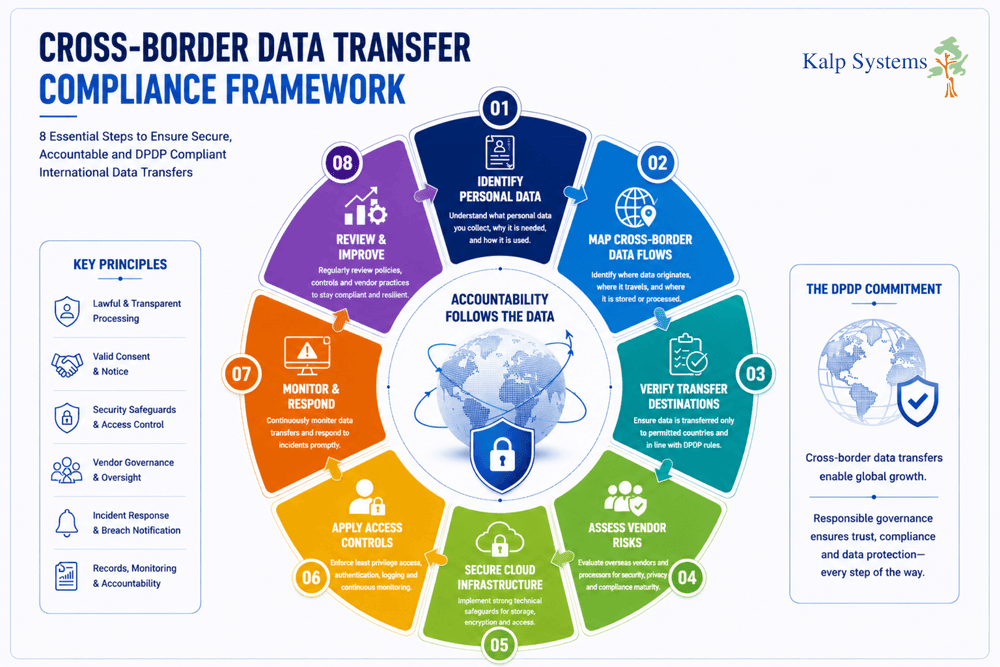
Building governance, documentation, and risk assessment processes
Many compliance gaps become visible only after an organisation maps how personal data moves through its business. Teams often know the systems they use every day, but they may not have a complete picture of where the data goes next, which vendors receive it, or how long it remains in different environments. Without that understanding, governance quickly becomes difficult as operations expand.
Good documentation creates that visibility. Maintaining records of processing activities, identifying cross-border data flows, documenting vendor relationships, and recording decisions around data handling all help build a clearer view of the organisation’s data ecosystem. These records also make it easier to review existing practices when new technologies, cloud services, or international vendors are introduced.
Risk assessments should be treated as an ongoing exercise rather than a document prepared once and filed away. Business operations change, cloud environments evolve, and third-party providers regularly update their services. Reviewing these changes helps organisations identify new risks before they become larger compliance concerns and supports more informed decisions when personal data is processed across international environments.
Monitoring international data transfers on an ongoing basis
International data flows rarely remain unchanged for long. A vendor may shift workloads to another region, a business team may adopt a new SaaS platform, or an existing application may introduce additional sub processors as part of a product update. Each of these changes can affect where personal data is processed.
That is why organisations should revisit their data flow maps and vendor records from time to time instead of treating them as one-off compliance documents. Any change to cloud infrastructure, third party services, or business operations is worth reviewing to understand whether it introduces a new cross border transfer or changes an existing one.
Routine reviews also make compliance discussions far easier. When organisations already know where personal data travels and who is responsible for handling it, responding to customer enquiries, internal audits, or regulatory requirements becomes a more straightforward exercise.
Cross-Border Data Transfer Considerations Across Different Industries
Different industries may face additional operational and regulatory expectations depending on the type of personal data being processed.
In banking and fintech environments, organisations may also need to align with RBI-related expectations because financial information is highly sensitive and often distributed across multiple operational systems.
Healthcare organisations usually require stronger governance because patient records, medical systems, and diagnostic platforms frequently involve sensitive personal information moving across vendors and cloud environments.
Technology companies and SaaS providers often face increased customer scrutiny because enterprise clients increasingly expect visibility into vendor governance, cloud architecture, and international data handling practices before onboarding service providers.
Healthcare, financial services, IT, and SaaS
Every industry approaches cross-border data transfers differently because the data itself is different.
Take healthcare as an example. A patient record rarely stays inside a single hospital system. Diagnostic platforms, teleconsultation applications, laboratory software, cloud backups, and specialist service providers may all handle parts of that information. Some of those services may even operate from outside India. Before introducing a new platform, healthcare organisations usually want clear answers about where patient data will be stored, who can access it, and how security incidents would be handled if they occur.
Financial institutions face a different challenge. A single customer transaction can pass through payment gateways, fraud monitoring systems, banking applications, messaging services, and cloud infrastructure within seconds. Even if customers never see that process, the organisation remains responsible for protecting the information moving through it. That is why banks and financial service providers often place greater emphasis on vendor due diligence, access governance, and continuous monitoring of third-party environments.
For IT companies and SaaS providers, the conversation usually starts with their customers. Enterprise clients increasingly ask where data will be hosted, whether support teams can access production systems from overseas, and which third-party providers form part of the service. These questions have become a standard part of procurement and security reviews. Organisations that can answer them with confidence often find compliance discussions much easier than those trying to trace their data flows after a customer asks for evidence.
Sector-specific compliance priorities
A common mistake organisations make is applying the same compliance approach across every business function. In reality, the priorities are rarely identical. The questions a hospital asks before transferring personal data overseas are very different from those asked by a SaaS company onboarding a global customer or a financial institution reviewing a payment platform.
Healthcare organisations often spend more time protecting patient confidentiality and controlling access to clinical systems. Financial institutions usually focus on transaction security, fraud prevention, and regulatory oversight across interconnected banking platforms. Technology companies and SaaS providers, meanwhile, are frequently expected to demonstrate where customer data is hosted, how third-party vendors are managed, and what controls are in place to secure cloud environments used to deliver their services.
These differences influence where organisations invest their time and resources. Some may need stronger vendor governance, while others place greater emphasis on access management, audit readiness, or documenting international data flows. A compliance programme becomes far more effective when it reflects the way the organisation actually operates instead of following a standard checklist.
Business Risks, Regulatory Penalties, and Operational Challenges of Non-Compliance
The DPDP Act includes significant penalties for organisations failing to meet compliance obligations. Depending on the nature of the violation, penalties can reach up to ₹250 crore per instance.
At the same time, financial penalties are often not the only concern.
For many organisations, operational disruption, customer trust issues, reputational damage, and enterprise contract risks may create equally serious long-term impacts after a major incident or compliance failure.
This is one reason organisations are now approaching cross-border governance as part of broader operational risk management rather than treating it only as a legal requirement.
Conclusion
Cross-border data transfers under the DPDP Act are designed to support global digital operations without completely restricting the movement of personal data.
The framework gives organisations more flexibility than some international privacy regulations, but that flexibility also comes with responsibility. Businesses are still expected to maintain visibility into how personal data is handled, which vendors process it, where it moves operationally, and how risks are managed across distributed environments.
For many organisations, the real challenge is no longer whether personal data can move internationally. The larger challenge is maintaining governance and operational visibility once cloud platforms, vendors, APIs, remote teams, and third-party processors become deeply interconnected.
As cloud adoption and global digital operations continue expanding, organisations that strengthen governance, vendor oversight, and operational monitoring early will be in a much stronger position to manage both compliance expectations and long-term customer trust.
Frequently Asked Questions
Is cross-border data transfer allowed under the DPDP Act?
Yes. The DPDP Act generally allows organisations to transfer personal data outside India unless the Government of India specifically restricts certain countries or territories. This approach gives businesses more operational flexibility while still expecting them to maintain responsibility for protecting personal data after transfer.
Does DPDP require strict data localisation?
No. DPDP does not currently follow a strict localisation model for most personal data. Organisations can continue using global cloud infrastructure and overseas processors, but they still need proper governance, security safeguards, and visibility into how data is handled operationally.
Why are vendors and processors becoming important under DPDP?
Modern organisations rely heavily on cloud providers, analytics platforms, SaaS tools, and external support vendors. As personal data moves across these environments, businesses are expected to maintain better oversight into who can access the data, where it is processed, and how external vendors protect it.