HomeBlogGovernance and ComplianceAudit Readiness: How to Prepare Beyond Documentation
Audit Readiness: How to Prepare Beyond Documentation

What is Audit Readiness and Why does it Matter
Audit readiness starts with a simple question: if an auditor asks how a particular control works, can the team show what actually happens?
Having a policy in place is only one part of the answer. Take access management as an example. A company may have a detailed access control policy, but the auditor can still ask for recent access reviews, approval records, evidence of user removal, or records showing how exceptions were handled. The documents describe the requirement. The records show whether it is being followed.
The same issue can appear in risk management. A risk register that was prepared during the previous assessment may still be sitting in the system, but that does not necessarily mean it reflects current risks. New applications, suppliers, cloud services, regulatory requirements, or changes to internal processes may have altered the risk profile since the last review.
This is why audit readiness needs attention throughout the year. Evidence should be created as part of normal work rather than reconstructed when an audit is approaching. Control reviews, risk assessments, employee training, incident records and corrective actions should leave a clear trail that can be checked later.
The people responsible for these activities also need to know what they own. When an auditor asks about a control, the relevant person should be able to explain how it works, how often it is reviewed, and where the supporting evidence is kept.
This applies to audits involving frameworks such as ISO 27001 and SOC 2, as well as requirements such as the Digital Personal Data Protection Act. For companies preparing for audit readiness in India, the specific controls may differ, but the practical question remains the same: can the company demonstrate that its requirements are being followed in practice?
What do Auditors Look for Beyond Documentation
An audit can reveal gaps that are difficult to see from policies and procedures alone. Auditors often look at how controls are applied, how risks are reviewed, who is responsible for important decisions, and whether the available records reflect what is actually happening. They may also examine how employees handle their responsibilities and how risks are managed when cloud services or external suppliers are involved.
Control Effectiveness and Audit Evidence
An auditor may not stop after checking whether a policy exists. The next question is usually whether the related control is being carried out and whether there is enough evidence to support it. Access reviews, approval records, system logs, incident records and monitoring reports can all help demonstrate how a control operates.
The evidence should also be consistent with the activity being reviewed. If a process is supposed to happen every month, records should show that it has been performed regularly. Gaps, unexplained exceptions or records created only shortly before the audit can make it harder to demonstrate that the control is working as intended.
Risk Management and Governance
Risk management is another area where auditors look beyond documentation. A risk register should reflect the current risk environment rather than simply remain as a record of an earlier assessment.
Changes to systems, suppliers, cloud services, regulations and internal processes can introduce new risks. Regular reviews help keep risk assessments relevant and give management a clearer view of issues that require attention.
Governance also needs visible involvement from people responsible for managing those risks. Reviews, decisions and corrective actions should have clear ownership and supporting records.
Leadership, Accountability and Employee Awareness
Audit readiness is not limited to security or compliance teams. People responsible for controls should understand their responsibilities and be able to explain how relevant processes work.
Leadership involvement matters as well. Management reviews, decisions on significant risks and follow-up on corrective actions can provide evidence that compliance responsibilities are being taken seriously rather than left entirely with operational teams.
Employees may also be asked about policies or procedures during an audit. Regular awareness sessions and role-based training can help staff understand what they are expected to do when handling information, reporting incidents or following security controls.
Third-Party and Cloud Risk
Cloud services and external suppliers can introduce additional areas for review. Auditors may want to see how suppliers were assessed, what security requirements were included in agreements, and whether their performance or risk is reviewed after onboarding.
The same applies to cloud environments. Responsibility for security may be shared between the service provider and the customer, so internal teams need to understand which controls they are responsible for and where supporting evidence is maintained.
How to Build an Effective Audit Readiness Plan
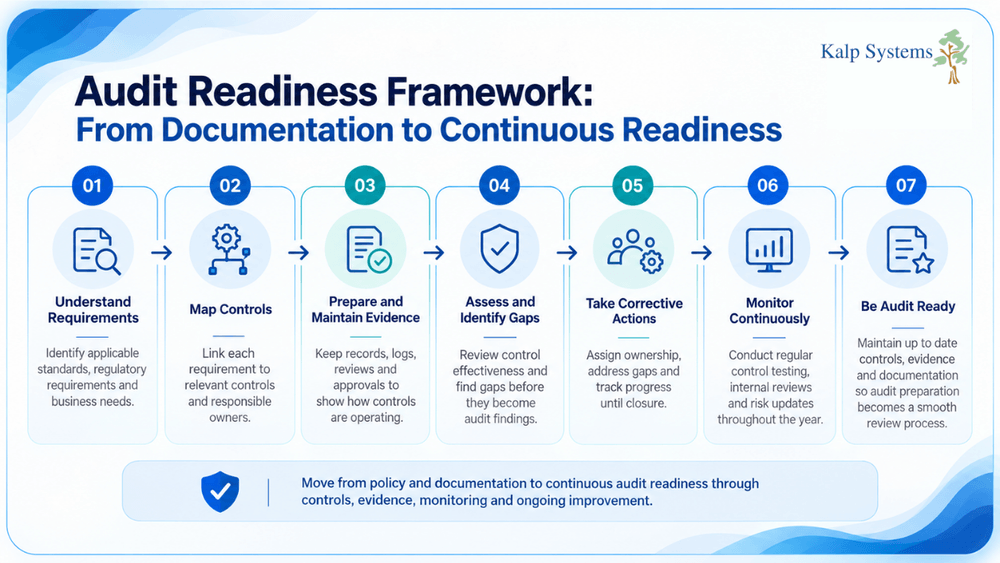
A practical audit readiness plan gives each requirement a clear place in the preparation process. It should show what needs to be reviewed, which controls apply, who is responsible for them, and what evidence is available. This makes it easier to deal with gaps before they become findings during the audit.
Define Requirements and Map Controls
Start by identifying the requirements that apply to the audit. These may come from a standard, regulation, contractual obligation or internal policy. The relevant controls can then be mapped against those requirements so that gaps are easier to spot.
This mapping also helps teams understand why a particular control exists and which evidence supports it. Where several requirements depend on the same control, that relationship should be documented rather than handled separately by different teams.
Conduct a Readiness Assessment and Gap Analysis
A readiness assessment provides a practical view of where things stand before the formal audit. Review the relevant controls, records and processes, then compare the current state with the requirements being assessed.
The review should identify missing evidence, controls that are not being performed consistently, outdated records and other weaknesses. Each gap should be recorded clearly so that the team responsible can decide what needs to be addressed before the audit.
Remediate Gaps and Assign Control Ownership
Finding a gap is only useful if someone takes responsibility for resolving it. Each significant issue should have an owner, a corrective action and a reasonable target date.
Control of ownership should also be clear before the audit begins. The person responsible for a control should know what the control involves, what evidence it produces and how often it needs to be reviewed. This avoids confusion when auditors ask questions about specific processes.
Organise and Validate Audit Evidence
Audit evidence should be easy to locate and should relate directly to the control or requirement being assessed. Access records, review logs, training records, incident reports and approval records should be stored in a consistent manner.
Before the audit, check that the evidence is complete and reflects actual activity. Missing dates, inconsistent records or documents that no longer match the current process can create unnecessary questions during the review.
How to Maintain Continuous Audit Readiness
Audit readiness can weaken between formal reviews if controls are checked only when an audit is approaching. Regular monitoring gives teams a better view of what is working, where evidence is missing, and which issues still need attention. It also reduces the amount of last-minute work needed before an external review.
Continuous Monitoring and Control Testing
Controls should be reviewed at suitable intervals to confirm that they are still operating as expected. Depending on the control, this may involve checking access reviews, system logs, security alerts, policy compliance or other records produced during normal operations.
Control testing can also reveal weaknesses that are not obvious from documentation. When a control does not work as intended, the issue can be recorded and addressed before it becomes part of an audit finding.
Internal Reviews and Mock Audits
Internal reviews provide an opportunity to examine readiness before an external auditor does. Teams can review selected controls, check supporting evidence and identify areas where the current process does not match the documented requirement.
Mock audits can take this step further. Asking people to respond to audit-style questions and locate evidence within a set time can reveal practical problems, such as unclear ownership or records that are difficult to retrieve.
Track Findings and Corrective Actions
Audit findings and internal review issues should not disappear once they have been recorded. A central record can show what was identified, who is responsible for the corrective action, what has been completed and what still requires attention.
Closing an issue should also involve checking that the corrective action has addressed the underlying problem. Simply updating a document or marking a task as complete may not be enough if the control itself is still not working properly.
Common Audit Readiness Gaps to Avoid
Some audit problems are not caused by missing policies. They come from the difference between what a process says should happen and what happens in practice. These gaps can remain unnoticed when reviews focus only on documents.
Common issues include:
- Documentation without supporting evidence: A policy may be current, but there may be little evidence that the related control is being followed.
- Outdated risk assessments: Risk information may no longer reflect changes in systems, suppliers, cloud services or regulatory requirements.
- Inconsistent control execution: A control may work in some cases but be missed in others, creating gaps in the evidence trail.
- Unresolved audit findings: Previous findings that remain open can indicate that corrective actions have not been completed or properly validated.
- Fragmented audit evidence: Records spread across emails, folders and different systems can be difficult to retrieve and verify.
- Unclear control of ownership: When no one clearly owns a control, questions about its operation, evidence or corrective actions can take longer to answer.
Identifying these issues before the formal audit gives the relevant teams time to investigate the cause, correct the problem, and retain evidence of the action taken.
Audit Readiness Checklist
Before an audit begins, a final readiness check can help identify small gaps that may otherwise surface during the review. The checklist should cover both documentation and evidence showing that relevant controls are operating as expected.
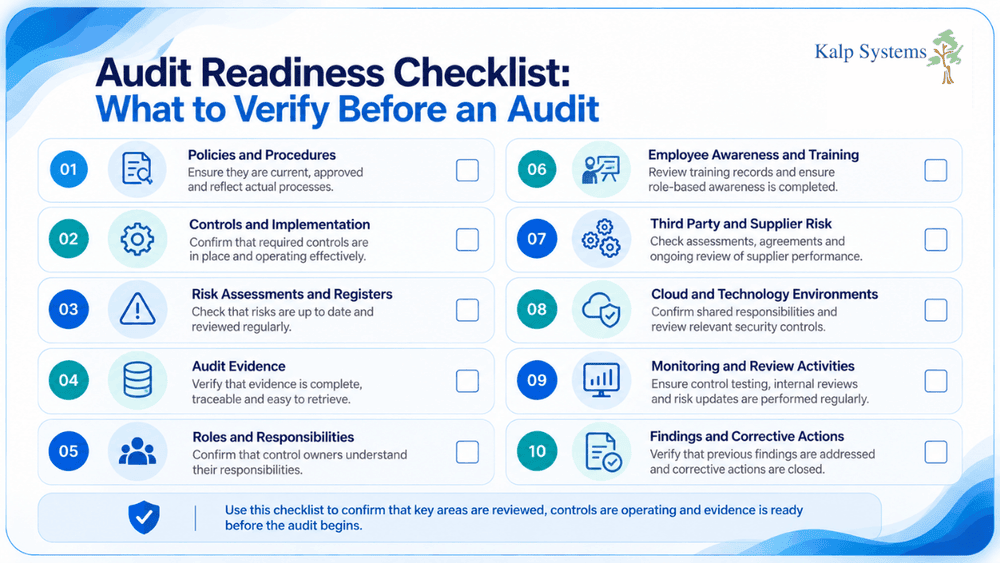
- Policies and procedures are current and reflect actual processes.
- Relevant controls have been reviewed and tested.
- Risk assessments and risk registers are up to date.
- Audit evidence is complete, traceable and easy to retrieve.
- Control owners understand their responsibilities.
- Employee training and awareness records are available.
- Third-party and cloud-related risks have been reviewed.
- Previous audit findings and corrective actions have been followed up.
- Monitoring and internal review activities are documented.
- Exceptions and unresolved gaps have been recorded with clear ownership.
A final check against these areas can help teams focus on unresolved issues instead of spending the last few days before an audit searching for missing records.
How Kalp Systems Supports Practical Audit Readiness
Kalp Systems supports audit readiness by helping teams review whether their governance and security controls are working in practice. The work can include gap assessments, readiness reviews, internal audits and governance consulting, depending on the requirements being addressed.
The focus is on identifying weaknesses before they create problems during a formal audit. This can include reviewing control effectiveness, checking available evidence, examining risk management practices and identifying areas where documented processes do not match day-to-day activities.
Kalp Systems can also help bring these findings together into a clearer remediation plan, with attention to control ownership and the actions needed to address identified gaps. This gives teams a more structured way to prepare for audits while improving the processes that support ongoing compliance.
Conclusion
Audit readiness is built through the way controls are handled throughout the year. A policy can explain what should happen, but the audit evidence needs to show that the process is actually being followed. That includes completed reviews, current risk information, control records, employee awareness, and actions taken when something does not work as expected.
The practical work is therefore in keeping these areas up to date. Teams need to know who owns each control, where its evidence is kept, which gaps are still open, and whether corrective actions have actually addressed the problem.
When these checks are part of regular compliance work, there is less need to recreate evidence or explain gaps immediately before an audit. The preparation has already happened through the normal operation and review of the controls.
Frequently Asked Questions
What is Audit Readiness?
Audit readiness means having the controls, records and supporting evidence ready to demonstrate how compliance requirements are being followed. It includes checking whether controls are actually being carried out, rather than relying only on policies and procedures.
What is an Audit Readiness Assessment?
An audit readiness assessment is a review carried out before the audit to find gaps in controls, processes or evidence. It gives the responsible teams an opportunity to address those gaps before they are raised during the formal audit.
What should be Checked before an Audit?
Check that policies and procedures are current, required controls are being performed, risk assessments have been reviewed, and supporting evidence can be retrieved. Previous findings, corrective actions, employee training records, third-party risks and control ownership should also be reviewed.
What is the Difference Between Audit Readiness and Audit Preparation?
Audit preparation is usually focused on a particular upcoming audit, including reviewing requirements and gathering evidence. Audit readiness is maintained throughout the year through regular control reviews, testing, risk assessments, evidence management and corrective actions.
How can Audit Readiness be Maintained Continuously?
Keep control reviews, evidence checks, risk assessments and internal reviews as part of regular compliance activities. When a gap or finding is identified, assign responsibility for the corrective action and check that the issue has actually been addressed.