HomeBlogNetwork SecurityIdentity Based Access Control in Healthcare: A Guide for Hospitals and Healthcare Providers
Identity Based Access Control in Healthcare: A Guide for Hospitals and Healthcare Providers

Overview
Hospitals and healthcare providers in India are undergoing rapid digital transformation. Electronic Health Records, telemedicine platforms, AI diagnostic systems, connected medical devices, pharmacy management software, and cloud-based hospital information systems are now core operational assets.
As digital expansion increases, so does exposure to identity-based attacks. Healthcare remains one of the most targeted sectors for ransomware and credential compromise. A compromised identity can give attackers access to patient records, administrative systems, or other critical resources.
Identity-based access control has therefore become an important network security strategy for hospitals and healthcare providers in India. It helps organisations control access based on verified identities and ensures that users receive access to the systems and information they are authorised to use.
What Is Identity-Based Access Control in Healthcare?
Identity-Based Access Control, or IBAC, is a security model in which access to systems, applications, and medical data is granted based on a verified digital identity rather than simply relying on network location or device.
In simple terms, every user, system, and device must prove its identity before gaining access to clinical or administrative systems.
For a hospital, this could mean giving a doctor access to patient records required for treatment, while limiting a finance employee’s access to billing systems. A third-party vendor may also receive access to a specific application without being given access to the rest of the hospital environment.
Identity-based access can also take other information into account when an access request is made. Depending on the security controls in place, factors such as the user’s role, device status, location, time, and behaviour can be used to determine whether access should be allowed.
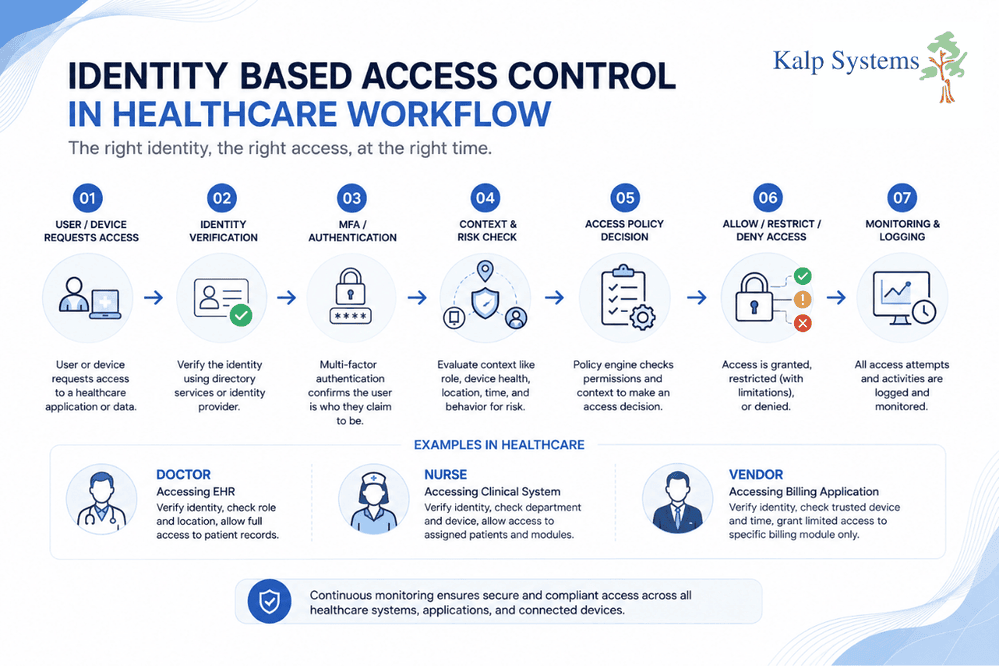
Core Concept of Identity Centric Security
Identity-Based Access Control shifts the focus of security from network boundaries to verified digital identities. Instead of trusting users because they are inside the hospital network, access decisions are based on authentication and other relevant security signals.
This is particularly important for healthcare organisations because their systems are no longer confined to a single internal network. Doctors and consultants may need remote access; hospitals may use cloud-based applications, and external vendors may connect to specific systems.
A verified identity helps the organisation decide who should have access to a resource and what level of access is appropriate.
For example, if an authorised user attempts to access a sensitive system from an unusual location or with an unfamiliar device, the organisation can apply additional authentication or restrict the request.
How Identity-Based Access Control Works
The process begins when a user, system, or device requests access to a protected resource. The identity is first verified through an authentication method such as a password, multi-factor authentication, biometric authentication, or a security key.
The access request can then be checked against the organisation’s access policies. These policies may consider the user’s identity and role along with information such as device status, location, time, and other risk signals.
Based on these checks, access can be allowed, restricted, or denied.
Once access is granted, activity can be monitored and recorded. Logs can help security teams identify who accessed a system, when the access occurred, and whether the activity was unusual.
In a healthcare environment, these controls can be applied to Electronic Health Records, cloud applications, remote access portals, administrative systems, and connected medical devices.
Why Identity-Based Access Control is Critical for Hospitals
Healthcare organisations handle highly sensitive information, including patient records, diagnostic reports, genomic data, billing information, insurance claims, and research data. Access to this information needs to be carefully controlled because a compromised account can expose large amounts of data.
Hospitals also have a different access environment from many other organisations. A doctor may need immediate access to a patient’s medical history, while a nurse may need access to clinical information related to assigned patients. Administrative staff, IT teams, consultants, and external vendors may have completely different requirements.
This makes identity and access management an important part of hospital security. The focus is not only on keeping attackers outside the network, but also on controlling what an authenticated user can access once they have entered the environment.
Protecting Sensitive Healthcare Data
Medical information is highly sensitive, and unauthorised access can affect both patients and healthcare organisations. Patient records may contain personal information alongside medical history, test results, treatment details, insurance information, and billing records.
A stolen credential can give an attacker access to systems that the legitimate user is authorised to use. Strong identity verification and access controls help reduce this risk by ensuring that access is limited according to the user’s permissions.
Identity-Based Access Control can also help hospitals maintain a clearer record of access to sensitive systems. Knowing who accessed patient information and when the access occurred can support security monitoring and investigations.
Reducing Identity-Based Cyber Risks
Credential theft, phishing, compromised accounts, and misuse of legitimate access are significant concerns for healthcare organisations. Attackers may use a stolen account to enter a hospital environment and then attempt to reach additional systems.
Identity-Based Access Control reduces this exposure by putting stronger controls around user access. Multi-factor authentication can make stolen passwords less useful, while access policies can limit what an authenticated user is able to reach.
For example, a compromised account belonging to a user with access to one hospital application should not automatically provide access to every other system. Restricting access in this way can help limit lateral movement if an account is compromised.
The same approach is useful for external users. Vendors, consultants, and other third parties may need access to hospital systems, but their access can be limited to the resources required for their work.
How Identity-Based Access Control Strengthens Healthcare Network Security
Traditional network security has largely focused on protecting the organisation’s perimeter through firewalls and other network controls. That approach becomes harder to maintain when healthcare systems are spread across cloud platforms, remote connections, third-party services, and connected medical devices.
Network access alone is not enough to determine whether a user should be trusted. A person may have a valid connection to the hospital network but still should not have access to every application or patient record.
Limitations of Perimeter Based Security
Once an attacker gets past a network perimeter, traditional security models can make it easier to move between systems if additional access controls are not in place.
In a hospital environment, this could put Electronic Health Records, billing systems, administrative applications, or connected medical devices at risk. A compromised account can become particularly dangerous when it has more access than the user actually needs.
Identity-Based Access Control adds another layer of control by checking the identity associated with an access request instead of relying only on the user’s network location.
Moving to Identity Centric Security
Identity-Based Access Control shifts security from the network boundary to the user, system, or device requesting access.
A verified identity can be combined with other information, such as device compliance, login behaviour, location, or risk signals, before access is granted. This allows a hospital to apply different controls depending on the circumstances of the request.
For example, a doctor may be authorised to access patient records from an approved device, while a third-party vendor may only be allowed to reach a specific hospital application. If an account shows unusual behaviour, additional authentication or access restrictions can be applied.
This approach can help hospitals control remote access, third-party connections, cloud-based applications, and access to critical medical systems without relying entirely on the traditional network perimeter.
Identity-Based Access Control vs Role Based Access Control
Role-Based Access Control, or RBAC, is commonly used to manage access in healthcare environments. It assigns permissions according to predefined roles, such as doctor, nurse, administrator, or IT staff.
Identity-Based Access Control takes a broader approach by using the user’s verified identity and, where required, additional information about the access request.
How Role-Based Access Control Works
With RBAC, access is linked to the responsibilities associated with a user’s role.
For example, doctors may be given access to clinical applications and patient records, while finance employees may receive access to billing and payment systems. The permissions are assigned according to the role rather than individually for every user.
RBAC can make access management easier, particularly in organisations with many employees and clearly defined responsibilities. However, the user’s role alone may not provide enough information for every access decision.
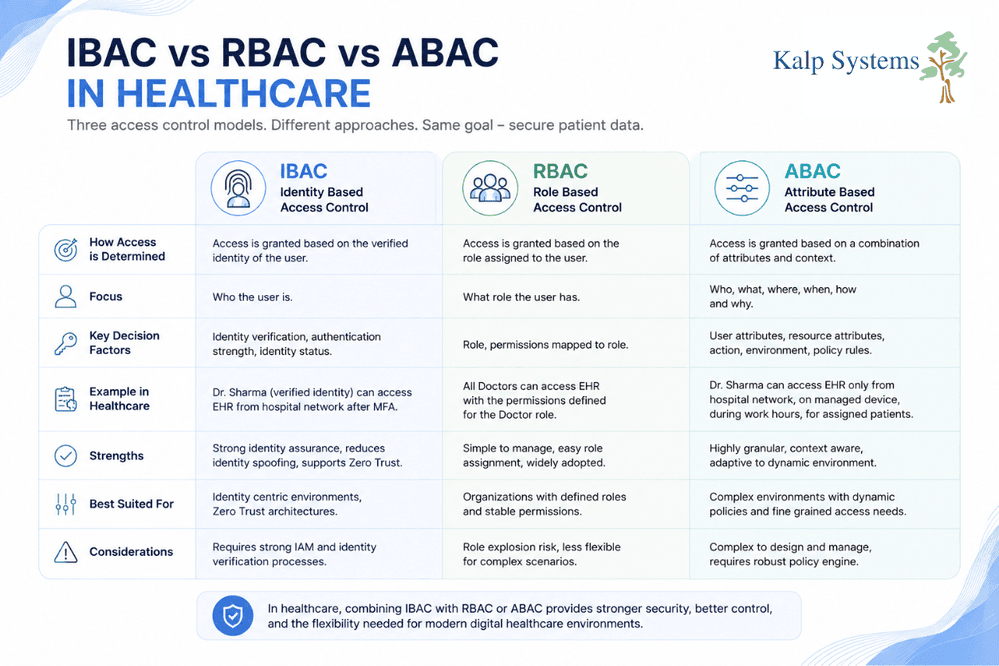
Key Differences Between IBAC and RBAC
Identity-Based Access Control considers the identity of the user when deciding whether access should be granted. It can also take additional context into account, including the device being used, location, time of access, and behaviour.
RBAC primarily uses the user’s assigned role to determine permissions.
For example, a doctor may normally have permission to access patient records. If that account attempts to access the same system from an unfamiliar location or device, an identity-based approach can use that additional context to trigger another authentication step or restrict access.
The two approaches do not necessarily need to be used separately. A healthcare organisation can use role-based permissions together with identity verification and contextual checks to create more controlled access to sensitive systems.
Core Components of Identity-Based Access Control in Healthcare
Hospitals require more than just multi-factor authentication. A mature strategy includes layered identity governance. Different users, applications, devices, and administrative accounts require different levels of access, so these controls need to work together rather than operate as separate security measures.
A healthcare organisation also needs to manage access throughout the user lifecycle. When an employee joins, changes responsibilities, or leaves the organisation, their access should be updated accordingly. At the same time, sensitive systems and privileged accounts need stronger controls and closer monitoring.
Identity and Access Management and MFA
Centralised Identity and Access Management systems integrate:
- User provisioning and deprovisioning
- Role lifecycle management
- Access approval workflows
- Automated onboarding and exit controls
This reduces orphan accounts and privilege creep.
Multi-factor authentication should protect:
- Electronic Health Records
- Remote access portals
- Administrative dashboards
- Cloud applications
- Vendor login interfaces
MFA significantly reduces credential abuse risk.
Privileged Access Management
Privileged accounts, such as IT administrators and database managers, present a higher risk.
Privileged Access Management ensures:
- Temporary privilege elevation
- Session monitoring
- Password vaulting
- Audit logging
This is essential for reducing insider and external misuse.
Zero-Trust and Continuous Monitoring
Zero-Trust Network Access validates identity continuously rather than once at login.
Access decisions are based on:
- User identity
- Device posture
- Risk signals
- Behaviour anomalies
This supports secure telemedicine, mobile access, and cross-hospital connectivity.
Identity-Based Access Control for Healthcare Compliance in India
Healthcare organisations in India are increasingly expected to have clear controls for protecting personal and sensitive information. Access to patient data and healthcare systems needs to be controlled, monitored, and properly documented.
Identity-Based Access Control can support these requirements by helping organisations establish who is allowed to access information, what they can access, and when that access takes place. It also provides a basis for maintaining access records that can be reviewed during audits.
DPDP Act and Data Protection
The Digital Personal Data Protection Act places greater emphasis on protecting personal data and maintaining accountability around its processing.
Identity-based access controls can support these efforts by limiting access to authorised users and reducing unnecessary exposure of personal information. Access logs can also help organisations maintain a record of activity involving systems that contain personal data.
However, IBAC should be treated as one part of a broader data protection and security programme, rather than as a complete compliance solution on its own.
ISO 27001, NABH and Audit Readiness
Identity-Based Access Control can also support access control and security practices associated with ISO 27001 and information security expectations in healthcare environments.
For example, hospitals can use identity-based controls to enforce least privilege, manage user permissions, monitor privileged access, and maintain records of access activity.
Auditors and security teams may need to establish who accessed patient information, when the access occurred, and whether the access was authorised. Proper identity management and audit logging make this information easier to track and review.
Emerging Trends in Healthcare Identity Security
Identity security in healthcare is changing as hospitals adopt more cloud services, connected devices, remote access, and newer authentication methods. These changes also create a need for better visibility into how users and devices access healthcare systems.
AI Driven Identity Threat Detection
Artificial Intelligence is being used to identify unusual login behaviour, impossible travel scenarios, and unexpected access patterns involving patient databases and other sensitive systems.
Behaviour analytics can help security teams identify activity that does not match a user’s normal pattern and investigate it before it develops into a larger security issue.
Passwordless Authentication and Medical IoT
Passwords remain a common target for phishing and credential theft. Biometrics, hardware security keys, and secure authentication applications are being used as alternatives to traditional password-based authentication.
At the same time, connected medical devices create another area where identity controls are important. Identity integration can help ensure that only authorised personnel can configure or access device interfaces.
This becomes particularly relevant as hospitals continue to connect more medical equipment to their wider digital environment.
Third-Party Identity and Access Governance
Healthcare organisations often work with pharmaceutical companies, research partners, billing processors, technology providers, and other external parties. These users may need access to hospital systems without requiring permanent or broad permissions.
Modern identity systems can support time-bound and risk-aware access for third parties, along with monitoring and audit records. This gives organisations greater visibility over external access and makes it easier to remove permissions when they are no longer required.
Conclusion
Healthcare organisations cannot rely only on network boundaries to control access anymore. Doctors, nurses, administrators, vendors, and other users may need access to different systems, often from different locations and devices.
Identity-Based Access Control gives hospitals a way to keep that access tied to verified identities and appropriate permissions. Combined with MFA, IAM, PAM, and Zero Trust, it can help reduce unnecessary access to patient data and critical healthcare systems.
For hospitals in India, the focus should be on knowing who has access, what they can access, and whether they still need that access.
Frequently Asked Questions
What is Identity-Based Access Control in Healthcare?
Identity-Based Access Control is a security approach that gives access to healthcare systems and information based on a verified user’s identity. It can also use factors such as role, device, location, and behaviour when deciding whether access should be allowed.
Why is Identity-Based Access Control important for hospitals?
Hospitals manage patient records and other sensitive information while supporting many different types of users. Identity-based access controls help limit access to authorised users and reduce the risk associated with stolen credentials, excessive permissions, and unauthorised access.
How does Identity-Based Access Control support DPDP compliance?
Identity-based controls can support data protection efforts by limiting access to personal data and maintaining records of access activity. However, IBAC is only one part of a wider security and compliance programme.
What is the difference between Identity-Based Access Control and RBAC?
RBAC assigns permissions mainly according to a user’s role, such as doctor, nurse, or administrator. Identity Based Access Control focuses on the verified identity of the user and can also consider other information, such as device, location, and behaviour.
Can Identity-Based Access Control protect medical IoT devices?
Yes. Identity controls can be applied to access and management interfaces for connected medical devices. This can help restrict configuration and administrative access to authorised personnel.