HomeBlogNetwork SecurityZero Trust Network Security Explained for Indian Organisations
Zero Trust Network Security Explained for Indian Organisations

What Is Zero Trust Network Security?
Traditional network security often assumed that users and systems inside the corporate network could be trusted. Zero Trust takes a different approach. It treats every access request as something that must be checked, regardless of where the request comes from.
A Zero Trust Network Security model does not automatically trust a user because they are an employee, connected through the corporate network, or have already logged in. Access decisions can take into account identity, device security, location, behaviour, and other risk signals.
The idea is commonly summarised as “Never trust, always verify.”
Access is limited to the resources a user or system actually needs. For example, an employee who needs access to one application does not necessarily need access to the wider network. This reduces unnecessary permissions and can limit the damage if an account or device is compromised.
Verification also continues beyond the initial login. If something changes during a session, such as unusual behaviour or a change in device security, access can be restricted or further verification may be required.
Why Traditional Network Security No Longer Works
Traditional network security was designed around a clear boundary. Firewalls and VPNs protected the network perimeter, while users and systems inside that boundary were often given a higher level of trust.
That model is harder to manage now. Employees access business applications from home, cloud platforms store critical data, and third parties may need access to internal systems. SaaS applications, mobile devices, and API driven services have also created more connections that sit outside the traditional corporate network.
The problem is not limited to keeping attackers out. Once an attacker gains access through stolen credentials, a compromised device, or another entry point, they may be able to move between systems if access inside the network is too broad.
This is where traditional perimeter-based security can fall short. Being connected to the network should not automatically provide access to everything within it.
Zero Trust addresses this by checking access at the resource level. A user may be allowed to access a specific application without receiving access to the wider network. Combined with least privilege and segmentation, this can reduce unnecessary access and make lateral movement more difficult after a compromise.
How Zero Trust Network Security Works
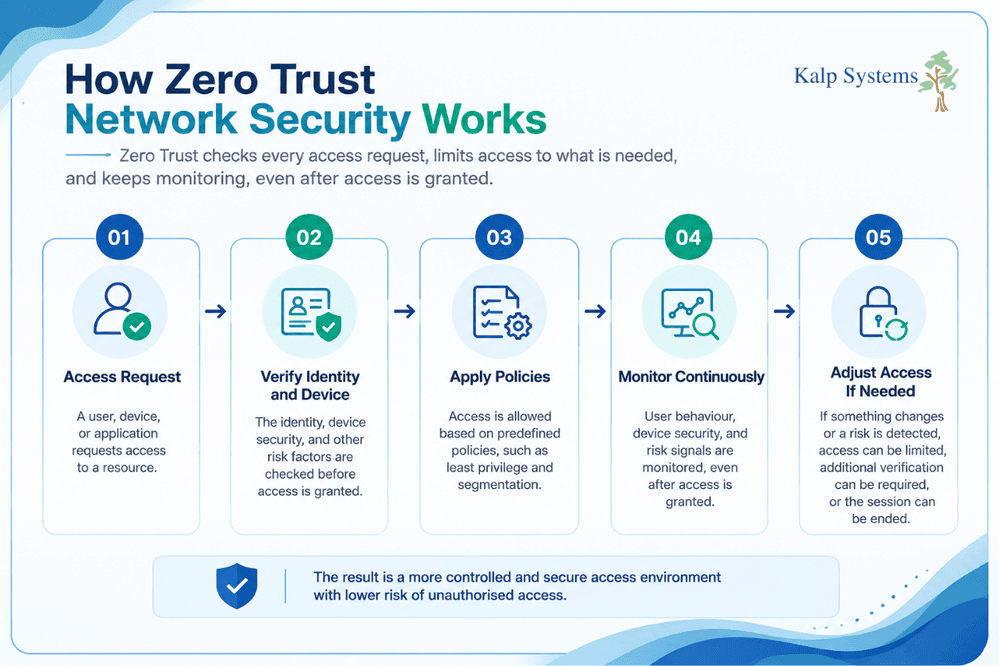
Zero Trust does not treat access as a one-time decision. Logging in successfully is only one part of the process. Access to a resource depends on who is making the request, what they are trying to access, and whether the request appears legitimate at that point.
Verify Identity and Access
The first question is straightforward: who is requesting access?
This could be an employee, a third party, an application, or a service account. Their identity needs to be verified before access is granted. For sensitive systems, multi-factor authentication may also be required.
The important difference is that a successful login does not automatically mean unrestricted access.
Apply Least Privilege and Segmentation
Users should have access to what they need, rather than everything they might potentially use.
For instance, someone working with a particular business application may need access to that application but not to other systems on the network. Limiting permissions in this way reduces the amount of unnecessary access available.
Segmentation works alongside this approach. Critical systems can be separated so that gaining access to one part of the environment does not automatically open the door to others. If an account is compromised, this can make it harder for an attacker to move further.
Continuously Monitor Access
A session can change after access has been granted. A device may become non-compliant, a user may behave unusually, or the request may suddenly come from an unexpected location.
Zero Trust allows these changes to be considered while access is still active. Depending on the level of risk, the organisation can ask for additional verification, limit access, or end the session.
Key Components and Benefits of Zero Trust
Zero Trust is not a single product that can be installed. It is an approach that brings together different security controls to make access decisions more carefully and limit unnecessary exposure.
Identity, Devices, and Access Control
Identity plays a central role in Zero Trust. Security teams need to know who is requesting access and whether that request meets the required security conditions.
This usually involves identity and access management, multi-factor authentication, and access policies. Device security also matters. A legitimate user may be denied or restricted if the device being used does not meet the required security standards.
Segmentation and Zero Trust Network Access
Traditional network access often gives users access to a broader network after connecting through a VPN. Zero Trust takes a more limited approach.
With Zero Trust Network Access, or ZTNA, users can be given access to specific applications rather than the entire network. Segmentation further separates critical systems and resources, reducing the chances of unrestricted movement after a compromise.
Improved Security, Visibility, and Compliance
By limiting access and checking requests more closely, businesses can reduce unnecessary exposure to critical systems and data. It can also provide better visibility into who is accessing resources and under what conditions.
For businesses operating in India, these controls can also support broader security and compliance requirements related to access management, data protection, and accountability.
Why Zero Trust Matters for Indian Organisations
Indian organisations are dealing with a changing mix of security challenges. As more business operations move to cloud platforms and employees connect from different locations and devices, the traditional idea of protecting a single network perimeter becomes less practical.
Rising Cyber Threats and Hybrid Work
Stolen credentials, compromised devices, ransomware, and unauthorised access can give attackers a way into business systems. Once inside, broad internal access can make it easier to move between applications and systems.
Hybrid work adds another challenge. Employees may access business resources from home networks, personal devices, or public locations. Zero Trust does not assume that a connection is safe simply because it comes from a familiar user. Each request can be checked based on the circumstances at that time.
Cloud Adoption and Regulatory Requirements
Cloud applications and SaaS platforms have changed where business data and applications are located. Access is no longer limited to systems sitting within a corporate network, which makes identity and access controls more important.
Businesses operating in India also need to consider requirements around data protection, cybersecurity, and access accountability. Controls such as least privilege, strong authentication, and access monitoring can support these broader security and compliance efforts.
Zero Trust vs Traditional Network Security
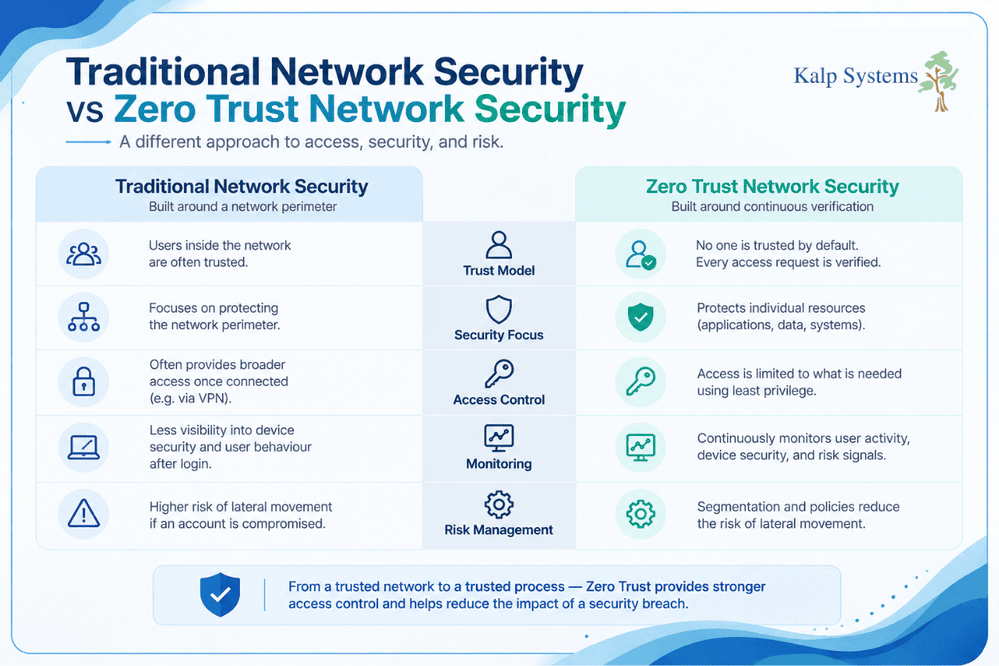
Traditional network security mainly focuses on keeping threats outside the network. Firewalls and VPNs protect the perimeter, but once someone gets inside, they may have access to more systems than they actually need.
Zero Trust does not work on that assumption. Being connected to the company network does not automatically make a user or device trustworthy. Access is checked before a person or system can reach a resource.
The graphic below shows the difference between the two approaches.
How Indian Organisations Can Start Their Zero Trust Journey
Indian organisations do not need to implement Zero Trust across the entire environment at once. A practical starting point is to look at the systems and data that carry the highest risk, along with the people and devices that can access them.
From there, security teams can strengthen identity controls, introduce multi-factor authentication, and review whether users have more access than they actually need. Critical applications can then be separated to reduce unnecessary access between systems.
The approach can be expanded gradually as security requirements and infrastructure change. Regular reviews of access permissions, user activity, and security policies are important because Zero Trust is not a one-time implementation. It needs to evolve as systems and security risks change.
Conclusion
The idea behind Zero Trust is straightforward: access should not be granted simply because a user or device is already inside the network.
This matters as businesses rely on cloud applications, remote access, third party connections, and systems that sit beyond the traditional network perimeter. A single security boundary is no longer enough to control access across all of these environments.
Businesses in India can start small by reviewing existing access, strengthening identity controls, and limiting permissions around critical systems. The approach can then develop over time based on the organisation’s infrastructure and security priorities.
Frequently Asked Questions
What is Zero Trust Network Security?
Zero Trust Network Security means that access is not based on whether someone is inside or outside the company network. A user or device must meet the required security checks before accessing a system or application.
How does Zero Trust Network Security Work?
When someone requests access, the security system checks whether that request should be allowed. This can include verifying the user’s identity, checking the device, and limiting access to the specific resource required. Access may also be reviewed if the situation changes.
What is Zero Trust Network Access, ZTNA?
ZTNA is one way of applying Zero Trust to remote access. Rather than connecting a user to the whole network, it can give them access to a particular application. This is useful when employees or third parties only need to reach certain business systems.
Is Zero Trust Only Suitable for Large Enterprises?
No. A complete rebuild of the existing security environment is not necessary to start applying Zero Trust principles. Reviewing user access, adding multi-factor authentication, and protecting critical applications can be practical first steps.
Can Zero Trust Replace a VPN?
It can, but not always. ZTNA is often used instead of a traditional VPN for application access. Whether it can replace a VPN completely depends on how the organisation’s systems are set up and what users need to access.