
A New Era of Digital Accountability Under the DPDP Act
The Digital Personal Data Protection (DPDP) Act, reinforced by the final DPDP Rules 2025, marks a major shift in India’s digital governance framework. More than just a compliance mandate, DPDP represents a fundamental rethinking of how personal data is collected, secured, processed, and governed across organisations of all sizes.
As outlined in the DPDP Compliance Handbook 2025 published by Kalp Systems, the Act enforces structured responsibilities for organisations, establishes strong rights for individuals, and introduces deeper accountability across digital systems.
But the impact is not uniform.
DPDP affects individuals, startups, SMEs, and large enterprises differently in terms of expectations, responsibilities, risks, and strategic outcomes.
This article breaks down DPDP from multiple points of view and explains how businesses can turn compliance into a long-term trust and growth advantage.
What Is the DPDP Act and Why Does It Matter?
A customer wants their account deleted. HR receives a request to correct employee information. A vendor asks whether personal data is protected in line with the DPDP Act before signing a contract.
Questions like these are becoming part of everyday business. They also expose something many teams don’t realise until they start looking closely. Personal data is rarely stored in one place.
Customer details may sit in a CRM. Employee records stay in HR applications. Marketing platforms collect contact information. Finance systems retain invoices. Cloud storage, collaboration tools, support portals, backups, and third-party applications all hold pieces of the same picture. Without a clear understanding of where that information exists and why it is being retained, privacy quickly becomes difficult to manage.
The Digital Personal Data Protection Act changes that expectation. It introduces a framework for handling digital personal data responsibly; from the moment it is collected until it is deleted.
Compliance is only one part of the story. Decisions around application design, vendor selection, cloud adoption, cybersecurity, customer onboarding, and data governance now influence how well an organisation can meet its privacy obligations. Teams that already have structured governance in place usually adapt faster. Others often discover gaps that have been hidden for years.
Understanding the Digital Personal Data Protection Act
The DPDP Act is India’s data protection law for digital personal data. Its purpose is straightforward. If personal information is collected, there should be a valid reason for collecting it. People should know how that information will be used, appropriate safeguards should protect it, and it should not remain in company systems forever.
Although the legislation is centred on India, its reach extends beyond national borders. A business operating overseas may still need to comply if it offers products or services to individuals in India or processes their digital personal data. That brings SaaS providers, technology companies, outsourcing partners, and multinational businesses into the conversation.
The Act also introduces two important roles. A Data Fiduciary decides why personal data is collected and how it will be used. A Data Processor handles that information on behalf of the Data Fiduciary. The distinction matters because responsibilities differ, even though both contribute to protecting personal data.
Privacy is no longer something that sits with legal teams alone. IT manages infrastructure. HR handles employee records. Marketing collects customer information. Procurement works with external vendors. Development teams build the applications that process personal data every day. Meeting DPDP requirements depends on these functions working together rather than operating independently.
Key objectives of the DPDP Act and DPDP Rules
One of the biggest changes introduced by the DPDP framework is greater visibility into how personal data is handled.
People should be able to understand what information is being collected, why it is required, and what happens after they share it. Privacy notices and consent requests are expected to communicate this clearly instead of being treated as documents that nobody reads.
The framework also encourages stronger accountability across the business. That starts with answering a few practical questions.
Where is personal data stored?
Who has access to it?
Why was it collected?
How long should it be retained?
Can it be located if someone requests its deletion?
Those questions sound straightforward. During compliance assessments, however, they often uncover duplicate records, inconsistent retention practices, forgotten databases, and third-party systems that were never properly documented.
The DPDP Rules add further guidance on areas such as consent notices, grievance handling, breach reporting, and additional responsibilities for entities that may be classified as Significant Data Fiduciaries. Together, the Act and the Rules help translate legal requirements into day-to-day operational practices.
Understanding the DPDP Act from the Perspective of Individuals, Startups, and Businesses
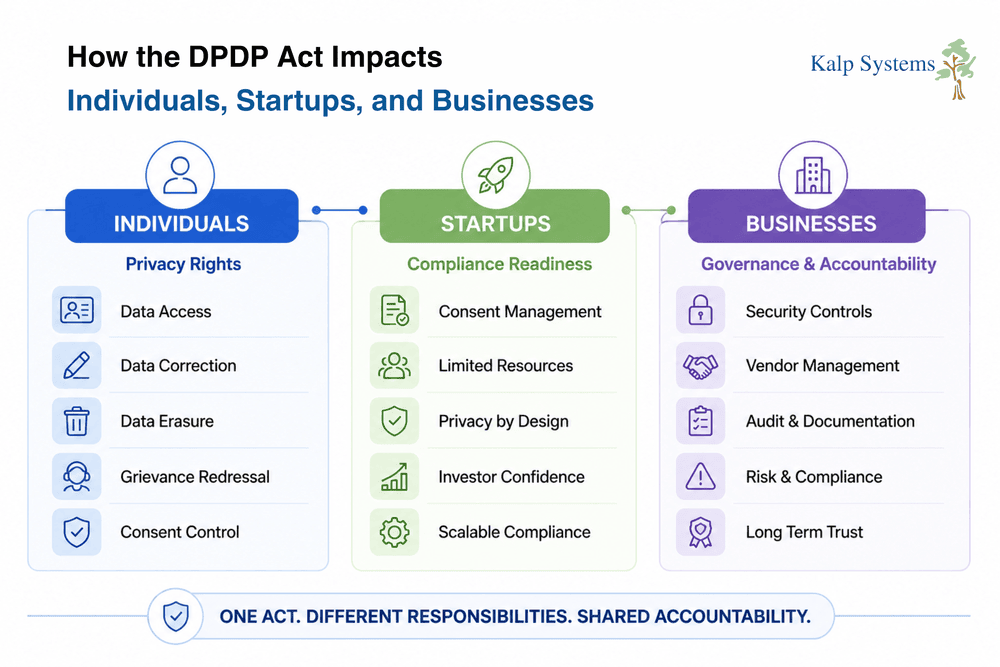
1. How the DPDP Act empowers Data Principals
For individuals, DPDP is a major win. It gives clear, enforceable rights to every citizen, including:
- Right to Notice
- Right to Access
- Right to Correction
- Right to Erasure
- Right to Withdraw Consent
- Right to Nominate a representative
- Right to Grievance Redressal within 7 days
Individuals benefit through greater transparency, stronger data protections, reduced misuse of personal data, and predictable mechanisms to resolve grievances.
Impact Summary for Individuals:
- More control over personal data
- Reduced risk of misuse
- Stronger grievance mechanisms
- Clear visibility into how companies use data
2. How startups can prepare for DPDP compliance
Startups – often lean, fast-moving, and tech-driven – face unique challenges under DPDP:
Challenges:
- Limited internal legal/compliance teams
- Cost pressure of implementing audits, logs, encryption & MFA
- Need to redesign onboarding, app flows & consent collection
- Early-stage companies may not have structured data maps
Opportunities:
- Build trust early with privacy-first product design
- Improve investor confidence (DPDP compliance is quickly becoming a due diligence requirement)
- Reduce future rework and compliance debt
- Leverage consent transparency as a UX differentiator
For startups, DPDP compliance is best approached as a strategic foundation, not a regulatory burden.
3. How enterprises should strengthen governance and accountability
Enterprises handle vast volumes of personal data, often across multiple regions, business units, and third-party processors.
DPDP impacts them at scale in the form of:
- Mandatory audit logs retained for one year
- Advanced security safeguards (MFA, RBAC, encryption)
- Strict breach notifications
- Grievance redressal infrastructure
- Structured retention & erasure mechanisms
Large organisations may also be designated as Significant Data Fiduciaries (SDFs) – requiring a Data Protection Officer (DPO), independent audits, and Data Protection Impact Assessments (DPIAs).
Impact Summary for Enterprises:
- Higher stakes, higher penalties
- Mandatory governance frameworks
- More detailed, auditable documentation
- Complex vendor and cross-border compliance
4. Why every business handling personal data must comply
Regardless of size, every organisation must follow core obligations listed in the DPDP Handbook, including:
- Lawful, purpose-limited processing
- Bilingual privacy notices
- Consent verification and logs
- Data minimisation & accuracy
- Breach notification
- Retention & deletion compliance
- Contracts with DPDP clauses
- Annual audits & training
DPDP is ultimately about trust, transparency, and accountability.
How the DPDP Act Changes Responsibilities for Individuals and Organisations
DPDP creates a balanced ecosystem where:
Individuals gain rights,
While
Businesses gain responsibilities.
Rights of Data Principals
Most people don’t think about privacy rights until they need to use one.
An old account still contains personal information years after it was abandoned. Marketing emails continue arriving long after consent was withdrawn. Correcting inaccurate records turns into a lengthy support request.
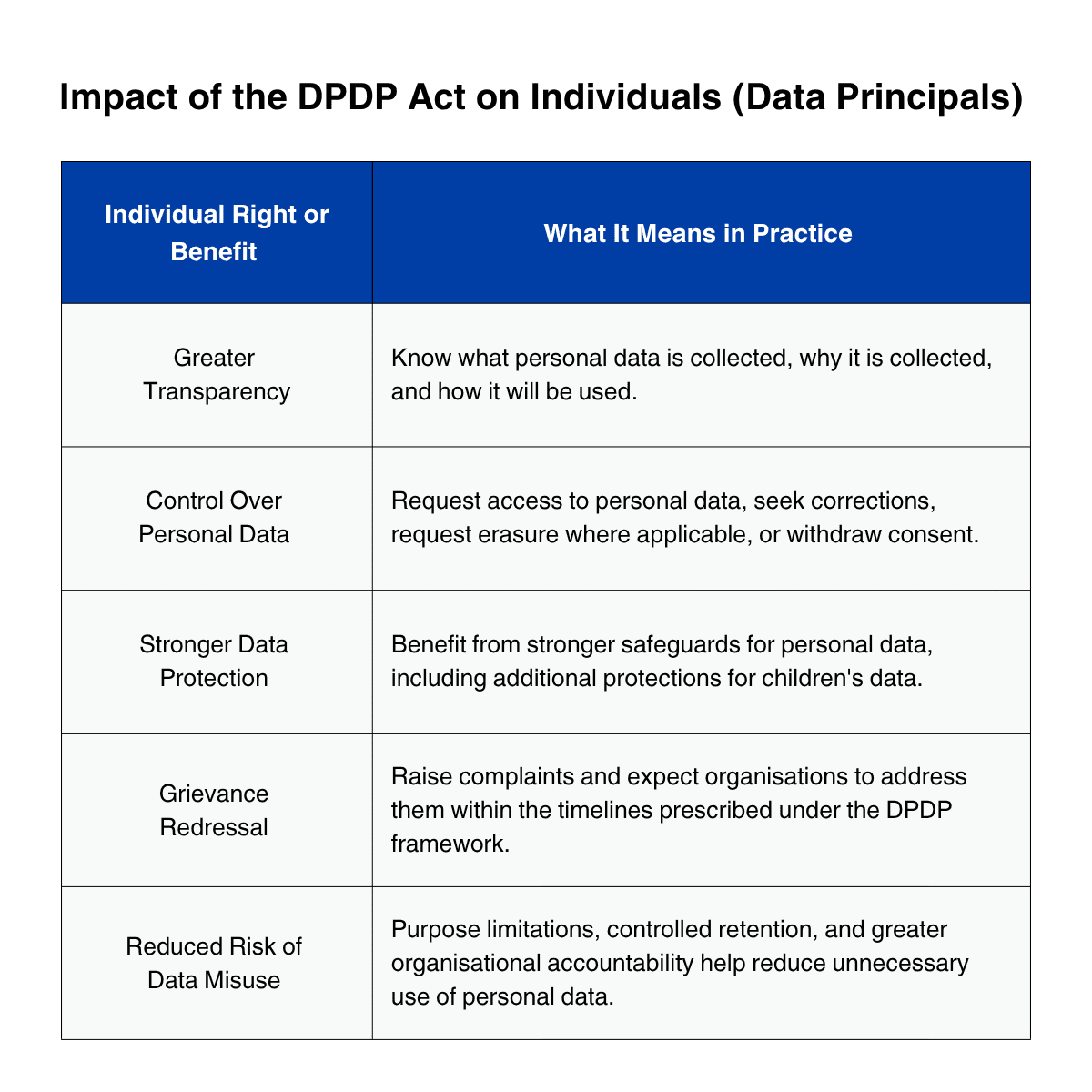
The DPDP Act gives individuals, known as Data Principals, greater control over situations like these.
Clear information should be available before personal data is collected. Individuals should understand why the information is needed and how it will be used. Depending on the circumstances and the applicable provisions of the Act, they may also request correction of inaccurate information, seek erasure where permitted, withdraw consent, or raise a grievance if they believe their rights have not been respected.
Handling these requests sounds straightforward until data is spread across multiple systems. Customer records may exist in marketing tools, support platforms, CRM applications, archived backups, and cloud services at the same time. Without accurate data inventories and defined internal processes, responding within the required timelines becomes much harder than expected.
Responsibilities of Data Fiduciaries and Data Processors
Every business that handles personal data has responsibilities under the DPDP framework. Those responsibilities depend on the role it performs.
A Data Fiduciary decides why personal data is collected and how it will be processed. That includes establishing a lawful purpose, providing clear privacy notices, implementing reasonable security safeguards, addressing grievances, and ensuring information is not retained longer than necessary.
A Data Processor carries out processing activities on behalf of the Data Fiduciary. Cloud hosting providers, payroll partners, managed service providers, software vendors, and customer support platforms are common examples. Processing must follow the instructions provided by the Data Fiduciary while protecting the personal data entrusted to them.
Another area deserves close attention. Personal data rarely stays within one application. It moves between internal systems, cloud environments, payment gateways, communication platforms, analytics tools, and external service providers. Every transfer introduces another point where security, governance, and contractual controls should be reviewed.
Successful DPDP compliance depends on coordination across the business. Privacy decisions made by IT, HR, procurement, security, customer support, and leadership often affect one another. Bringing those teams together creates a far stronger foundation than treating privacy as the responsibility of a single department.
Startups vs Enterprises: Comparing DPDP Compliance Requirements
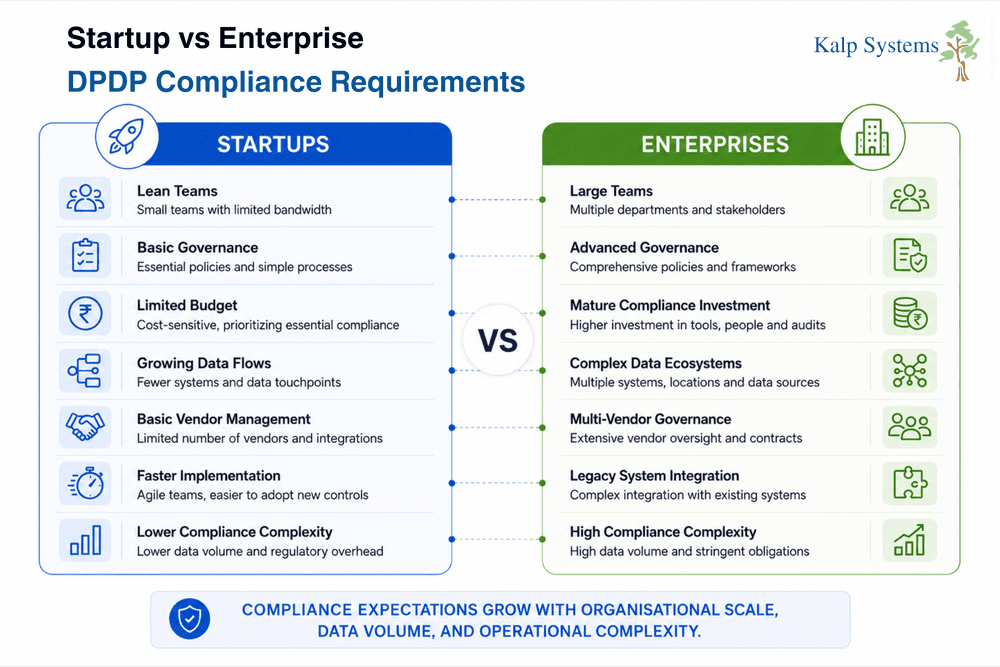
1. Compliance complexity and organisational readiness
Startups usually operate with fewer systems and smaller teams, making DPDP compliance easier to organise during the early stages. Enterprises, on the other hand, manage personal data across multiple departments, applications, and business units. Coordinating compliance across these environments requires stronger governance, well-defined processes, and continuous oversight.
2. Cost, governance, and resource considerations
Budget constraints often influence how startups approach compliance, leading them to prioritise scalable solutions that can grow with the business. Larger enterprises typically invest more in upgrading legacy systems, strengthening governance, and meeting additional compliance obligations such as audits, risk assessments, and formal privacy programmes.
3. Technology, security, and operational maturity
Modern technology stacks give many startups the flexibility to introduce privacy controls and consent management with relatively fewer changes. Enterprises usually face different challenges. Existing IT infrastructure, HR platforms, CRM systems, and third-party integrations must work together while maintaining consistent security controls and data governance across the organisation.
Key DPDP Compliance Requirements Every Organisation Should Understand
Reaching compliance with the DPDP Act is rarely a one-time exercise. Most businesses already have personal data spread across applications, departments, cloud services, and external vendors. The challenge is bringing those practices under a single governance framework without disrupting day-to-day operations.
Progress usually starts with a simple question. Do you know what personal data you hold, why you hold it, and who is responsible for it?
If the answer is unclear, the first step is to build that visibility. Once there is a clear understanding of data flows, it becomes much easier to introduce processes that support compliance and reduce operational risk.
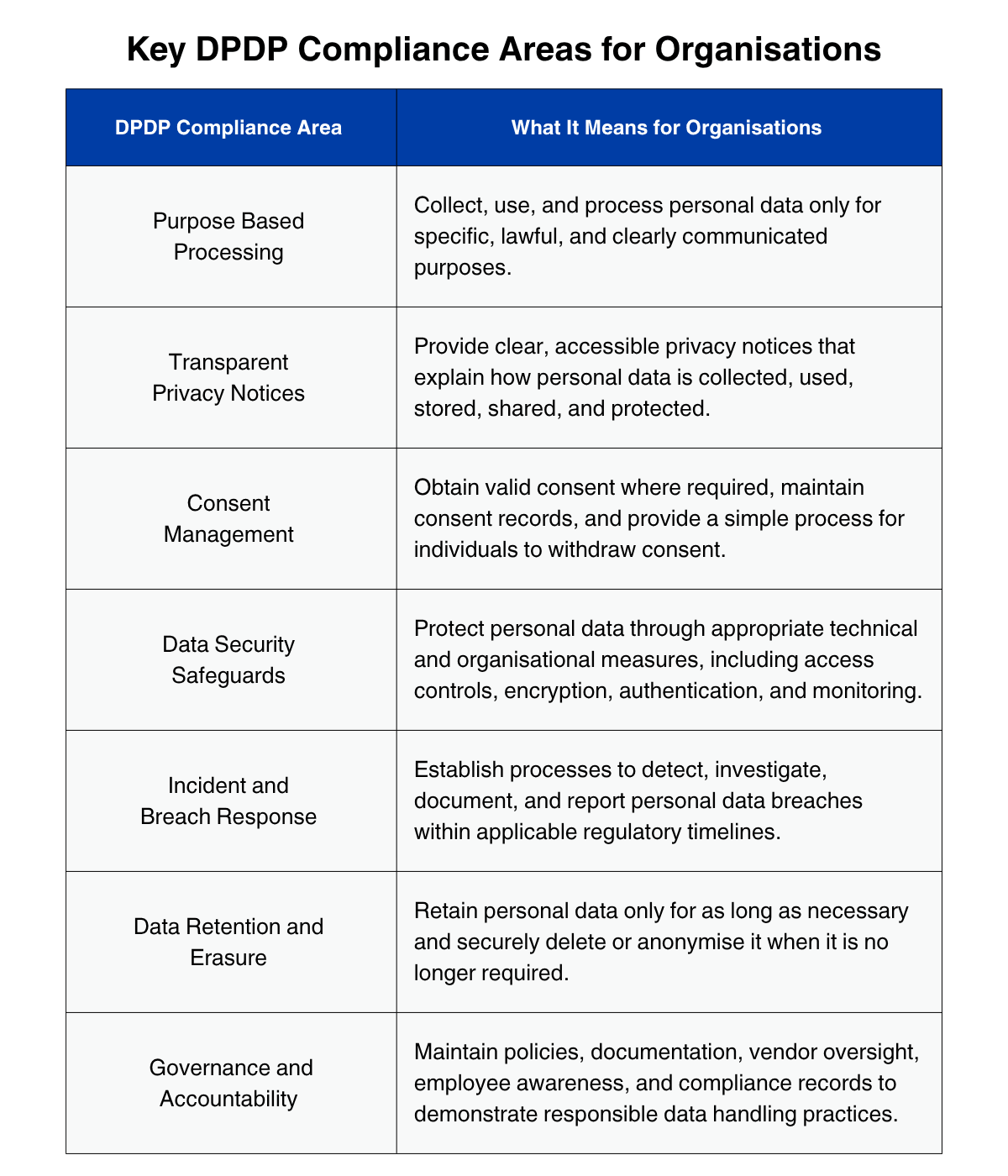
Consent management and lawful processing
Consent sits at the heart of the DPDP Act, but collecting consent is only one part of the process. Equal attention should be given to how consent is recorded, managed, and updated over time.
Every request for personal information should explain why the data is required and how it will be used. Vague statements or blanket permissions create confusion and make it difficult to demonstrate compliance later.
Business processes also need to respect changes in an individual’s decision. Someone who withdraws consent should not continue receiving marketing communications simply because their details remain in another application. Keeping systems synchronised becomes just as important as obtaining consent in the first place.
Periodic reviews also help identify information that no longer serves a business purpose. Collecting less data often reduces both compliance effort and security risk.
Data retention, breach notification, and grievance redressal
Personal data should not remain in business systems indefinitely. Every category of information should have a defined retention period based on legal, regulatory, or operational requirements.
Without retention policies, duplicate records accumulate, outdated information remains accessible, and storage environments become unnecessarily complex. Over time, this increases both compliance and cybersecurity risks.
Preparation for security incidents is equally important. A breach response plan should define how incidents are identified, investigated, contained, documented, and reported. Waiting until an incident occurs usually leads to delayed decisions and unnecessary confusion.
Grievance handling also deserves attention. Individuals should have a straightforward way to raise privacy-related concerns, while internal teams should know who is responsible for investigating and responding within the timelines prescribed under the DPDP framework.
Significant Data Fiduciary (SDF), Data Protection Officer (DPO), and DPIA requirements
Some entities may be designated as Significant Data Fiduciaries based on factors defined under the DPDP framework. This designation brings additional compliance responsibilities beyond the baseline obligations that apply to all Data Fiduciaries.
Depending on the applicable requirements, these responsibilities may include appointing a Data Protection Officer, conducting Data Protection Impact Assessments (DPIAs), implementing stronger governance measures, and maintaining additional oversight of data processing activities.
Preparation becomes much easier when governance structures are already in place. Clear documentation, defined ownership, regular risk assessments, and consistent privacy practices reduce the effort required if an organisation falls within the SDF category.
Why DPDP Compliance Creates Long-Term Business Value Beyond Regulatory Compliance
Beyond compliance, DPDP unlocks measurable business value:
- Stronger Customer Trust
Privacy-first communication builds confidence and increases brand loyalty.
- Competitive Differentiation
Companies that demonstrate transparent data handling stand out in crowded markets.
- Investor Confidence
VCs and global investors now require privacy readiness as part of their due diligence.
- Reduced Risk Exposure
Proactive compliance reduces the chances of breaches, penalties, and reputational damage.
- Future-Proofing the Business
DPDP aligns Indian organisations with global data protection standards, preparing them for collaborations with GDPR and international markets.
Building customer trust through privacy
Privacy has become a business expectation as much as a regulatory requirement. Customers, partners, and vendors increasingly want reassurance that their personal information will be handled responsibly.
Trust grows when privacy practices are visible rather than hidden. Clear notices, transparent communication, timely responses to privacy requests, and responsible handling of personal data demonstrate that privacy is treated as an operational priority instead of a legal formality.
These practices also support stronger business relationships. Procurement reviews, customer due diligence, and vendor assessments increasingly include questions about privacy and data protection. Demonstrating mature governance can simplify these discussions and strengthen confidence among stakeholders.
Strengthening governance and operational resilience
Strong governance creates consistency across the business. Policies define expectations, but day to day activities determine whether those expectations are actually followed.
Regular reviews of data inventories, access controls, vendor relationships, retention practices, and security measures help identify issues before they become compliance problems. Small gaps are much easier to address when they are discovered early.
Operational resilience also improves when privacy becomes part of existing governance activities instead of being managed through separate projects. Security reviews, internal audits, risk assessments, and change management processes all provide opportunities to strengthen compliance without creating unnecessary duplication.
Common DPDP Compliance Challenges for Startups and Enterprises
- Unclear or outdated data flow mapping
- Integrating age verification for minors
- Redesigning consent collection UX
- Vendor management and cross-border visibility
- Implementing structured retention & deletion
- Establishing real-time grievance redressal
- Setting up breach registers and 72-hour reporting systems
- Conducting annual audits and staff training
These challenges require structured support, not just checklists.
Operational and technical challenges
Moving towards DPDP compliance often reveals practical challenges that are difficult to see from policy documents alone.
Personal data may exist across legacy applications, cloud platforms, collaboration tools, spreadsheets, archived backups, and third-party services. Some systems contain duplicate records, while others have little documentation explaining why the information was collected or who owns it.
Technical limitations can create additional complexity. Older applications may not support automated deletion, consent updates, or detailed audit trails. Integrating newer privacy requirements into existing infrastructure often requires careful planning rather than quick fixes.
Understanding these constraints early allows businesses to prioritise improvements based on risk, available resources, and operational impact.
Governance and compliance gaps
Compliance assessments often uncover issues that have developed gradually over several years.
Data inventories are incomplete. Vendor agreements no longer reflect current processing activities. Retention schedules exist on paper but are rarely followed. Different departments manage similar information using different processes, creating unnecessary inconsistency.
Closing these gaps starts with visibility rather than technology. A clear understanding of existing practices makes it easier to prioritise improvements, assign ownership, and develop a practical roadmap towards compliance.
The strongest DPDP programmes are rarely built through one large project. They develop through steady improvements, regular reviews, and ongoing collaboration across business, technology, security, and compliance teams.
A Practical DPDP Compliance Checklist and Implementation Roadmap
Reading the DPDP Act is one thing. Turning its requirements into day-to-day business practices is another.
One business may already have security controls, documented policies, and governance processes in place. Another may still be relying on spreadsheets, disconnected applications, and manual approvals. Both need a roadmap, but the starting point is different.
Trying to address every requirement at once often creates confusion. A phased approach is usually more practical. It allows teams to identify the biggest risks first, assign ownership, and build compliance into existing operations instead of treating it as a standalone initiative.
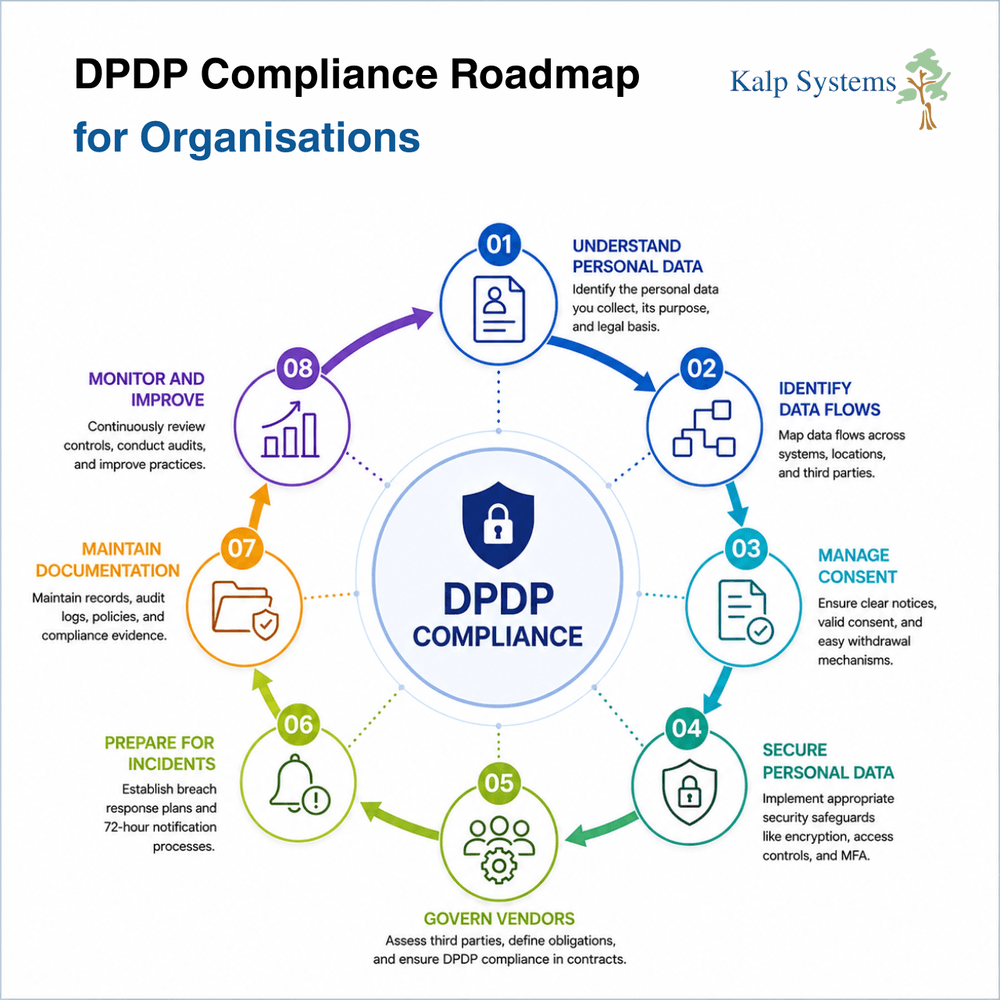
Preparing for DPDP implementation
Preparation begins with understanding how personal data moves across the business. Before introducing new policies or investing in technology, it helps to answer a few basic questions.
What personal data is collected?
Where is it stored?
Who can access it?
Why is it required?
How long is it retained?
Which external vendors receive it?
These answers form the foundation of every compliance programme. Without them, even simple requests, such as locating customer information or deleting outdated records, can become difficult.
Once the current state is understood, the next step is identifying gaps between existing practices and DPDP requirements. A structured DPDP Compliance Gap Assessment helps highlight areas that need attention before implementation begins.
The following checklist can help guide that process.
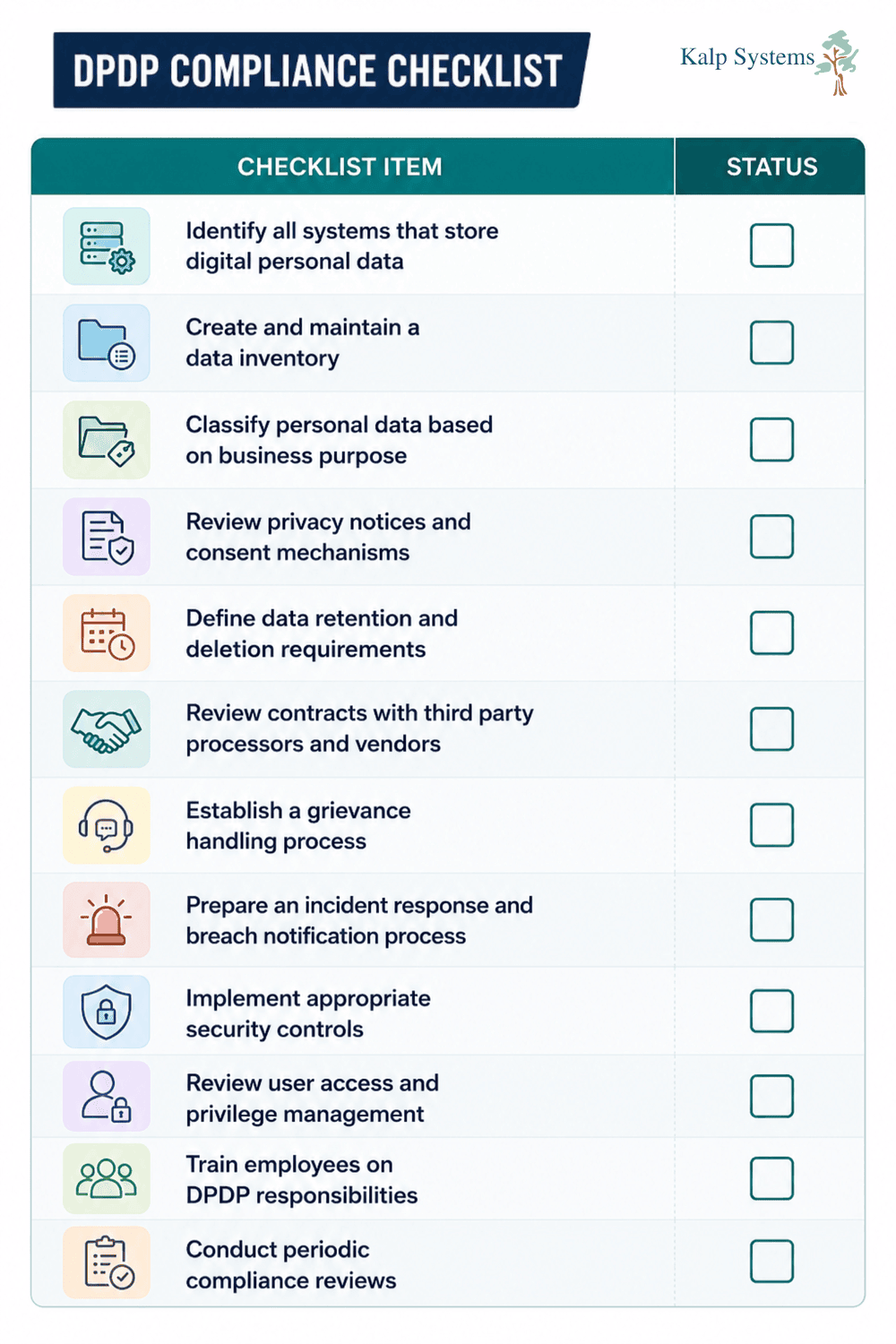
Completing the checklist should not be seen as the end of the process. It provides a clear picture of what has already been addressed and where additional work is required.
Implementation also becomes easier when responsibilities are clearly assigned. Security teams cannot deliver compliance on their own. Legal, HR, IT, procurement, customer support, business leaders, and application owners all influence how personal data is collected, processed, shared, and protected.
Breaking the work into manageable phases helps maintain momentum while reducing disruption to ongoing business operations.
Continuous monitoring and compliance improvement
Compliance does not stop once policies have been approved or controls have been implemented.
Business processes change. New applications are introduced. Vendors are replaced. Teams collect different categories of personal data as services evolve. Every change has the potential to introduce new privacy risks if it is not reviewed.
Regular monitoring helps keep compliance aligned with these changes. Internal audits, access reviews, vendor assessments, policy updates, and periodic data inventory reviews all contribute to maintaining an effective privacy programme.
Employee awareness also deserves continuous attention. Technology alone cannot prevent every privacy issue. Simple mistakes, such as sending personal data to the wrong recipient or retaining information beyond its intended purpose, remain common causes of compliance failures. Regular training helps reduce these risks and encourages consistent handling of personal data across the organisation.
The strongest privacy programmes continue to evolve after implementation. Rather than reacting to audits, customer complaints, or regulatory enquiries, successful organisations review their practices regularly and make improvements before issues become larger problems.
Viewed over the long term, DPDP compliance becomes part of everyday governance rather than a separate project. That approach strengthens privacy, supports operational resilience, and makes future regulatory changes easier to manage.
How Kalp Systems Supports DPDP Compliance for Organisations
The About Kalp Systems section of your handbook clearly outlines your expertise in:
- Compliance audits & assessments
- Compliance roadmaps
- Policy & process integration
- Ongoing support and advisory
Kalp Systems helps organisations with:
- DPDP Readiness Assessments
Identify gaps in governance, security, notices, consent, and operational workflows.
- Custom Compliance Roadmaps
Clear timelines, responsibilities, and milestones for every business type.
- Policy, Process & Technology Alignment
Turning DPDP rules into actionable, auditable systems.
- End-to-End Implementation Support
Privacy notices
Consent systems
Data flow mapping
Retention & erasure
Security safeguards
Breach workflows
Audit preparation
- Ongoing Advisory & Regulatory Updates
Ensuring sustained compliance, not one-time certification.
Conclusion
DPDP Is Not Just Compliance, It’s Digital Governance for the Future
The DPDP Act 2025 marks a critical moment in India’s digital journey. It empowers individuals, reshapes organisational responsibilities, and pushes businesses to adopt transparent, ethical data practices.
Whether you’re a startup, SME, or enterprise, compliance is no longer optional.
It’s an opportunity to build trust, strengthen governance, and differentiate in a privacy-conscious market.
Start Your Compliance Journey with Kalp Systems
Kalp Systems helps organisations navigate evolving data protection requirements with clarity, structure, and confidence.
Download the DPDP Compliance Handbook 2025
Contact: www.kalpsystems.com
Frequently Asked Questions
What is the DPDP Act in simple terms?
The Digital Personal Data Protection (DPDP) Act is India’s data protection law that regulates how digital personal data is collected, processed, stored, shared, and deleted. It gives individuals greater control over their personal information while requiring organisations to handle that data responsibly and implement appropriate safeguards.
Who needs to comply with the DPDP Act?
The Act applies to organisations that process digital personal data in India. It can also apply to businesses located outside India if they offer goods or services to individuals in India or process their digital personal data. This includes startups, enterprises, SaaS companies, financial institutions, healthcare providers, eCommerce businesses, and technology service providers.
What are the key responsibilities of a Data Fiduciary under the DPDP Act?
A Data Fiduciary is responsible for determining why and how personal data is processed. Key responsibilities include providing clear privacy notices, obtaining valid consent where required, implementing reasonable security safeguards, addressing grievances, retaining data only for as long as necessary, and complying with other obligations prescribed under the DPDP Act and DPDP Rules.
How can an organisation prepare for DPDP compliance?
Preparation usually begins with understanding what personal data is collected, where it is stored, who has access to it, and why it is processed. A DPDP Compliance Gap Assessment helps identify areas that need improvement. From there, organisations can strengthen consent management, review vendor relationships, define retention policies, improve security controls, and establish governance processes to support ongoing compliance.
Why is a DPDP Compliance Gap Assessment important?
A DPDP Compliance Gap Assessment compares existing data handling practices with the requirements of the DPDP Act. It helps identify compliance gaps, prioritise remediation efforts, reduce implementation risks, and create a practical roadmap for achieving and maintaining DPDP compliance. For many organisations, it is the first step towards building a structured and sustainable privacy programme.