HomeBlogEnterprise SecurityIdentity and Access Management Case Study: Solving SaaS Access and User Lifecycle Challenges
Identity and Access Management Case Study: Solving SaaS Access and User Lifecycle Challenges

Overview
Modern organisations rarely adopt SaaS applications through a single transformation initiative. Most environments evolve gradually as departments introduce platforms to solve specific business problems. Human Resources adopts one system, Sales introduces another, Finance selects specialised tools, and Engineering teams implement cloud services that support development and operations. Each decision may be justified individually, yet over time the organisation inherits a fragmented identity landscape that becomes increasingly difficult to govern.
This case study examines how a growing enterprise addressed identity and access management challenges across its SaaS ecosystem. The engagement focused on understanding how access was being managed, identifying governance gaps, evaluating architectural alternatives, and implementing a more scalable model for identity governance, lifecycle automation, and access control.
Rather than treating identity and access management as an authentication problem, the project team approached it as a governance challenge that affected operational efficiency, security visibility, compliance readiness, and long-term scalability. The project ultimately led to the design and implementation of a centralised identity management architecture built around Microsoft Entra ID, HR driven lifecycle management, RBAC standardisation, automated provisioning, and policy-based access governance.
Why the Organisation Started Reassessing Its Identity and Access Management Architecture
The reassessment began when leadership recognised that SaaS growth was creating operational constraints that could no longer be solved through incremental administrative improvements. While the environment continued to function, the effort required to manage user access was increasing significantly. IT teams were spending more time handling onboarding requests, access modifications, offboarding activities, and audit related inquiries. At the same time, business units expected faster access delivery and more flexible collaboration across departments.
Several security and governance reviews highlighted a common pattern. Identity information existed in multiple systems, access decisions were distributed across different stakeholders, and lifecycle processes relied heavily on manual coordination. Although individual applications had their own security controls, there was no consistent mechanism for governing identities across the entire SaaS environment.
Leadership concluded that identity and access management had become a foundational governance capability rather than a technical support function. This shift in perspective influenced every decision made during the transformation programme.
For organisations facing similar challenges, many of the foundational principles discussed here align closely with broader Cloud Identity and Access Management Best Practices.
The Existing SaaS Environment and Identity Landscape
The business operated a growing collection of SaaS platforms supporting core business functions, including collaboration, project management, customer relationship management, finance, human resources, customer support, and software development. Most applications had been introduced independently by business units over several years, resulting in an environment where identity management practices varied significantly between systems.
An HRMS platform served as the primary employee record system and maintained information relating to hires, department assignments, reporting structures, and employment status. However, this information was not consistently integrated with downstream applications. Some SaaS platforms supported federation and synchronisation capabilities, while others relied on local account administration. As a result, identity data frequently existed in multiple locations, creating inconsistencies between systems.
New employee onboarding demonstrated the extent of the fragmentation. When an employee joined the organisation, access requests were submitted separately for different applications. Individual administrators were responsible for creating accounts, assigning permissions, enabling MFA settings, and communicating credentials. The process varied depending on the application being requested and the department involved.
Offboarding activities followed a similar pattern. Human Resources would notify relevant stakeholders when an employee left, after which administrators were expected to manually revoke access from each platform under their responsibility. In practice, completion times varied considerably and validating that every account had been removed required significant effort.
The review revealed limited visibility into overall access governance. Security teams could review permissions within individual applications, but obtaining a consolidated view of access across the organisation required manual data collection from multiple sources. As the SaaS footprint expanded, this lack of centralised identity visibility became increasingly problematic.
Operational Challenges Identified During the IAM Assessment
The discovery phase focused on understanding how identities moved through the organisation and how access decisions were made throughout the employee lifecycle. Rather than concentrating solely on technical controls, the assessment examined governance processes, approval workflows, provisioning methods, and operational dependencies.
Manual provisioning emerged as a major operational dependency. Account creation depended on administrators receiving requests, validating approvals, and manually configuring user access. This process introduced delays during onboarding and created inconsistent user experiences across departments. Employees frequently received access to some systems immediately while waiting days for access to others, even when all approvals had already been granted.
Role changes created additional complexity. Employees moving between departments often retained permissions associated with previous responsibilities because entitlement reviews were not consistently performed. Access modifications depended on multiple teams coordinating updates across different platforms, increasing the likelihood of discrepancies.
Manual deprovisioning presented another operational challenge. Access removal activities were distributed across several administrators and application owners. The process relied on timely communication and procedural compliance rather than automated controls. While most offboarding requests were eventually completed, the existing operating model lacked a reliable mechanism for verifying that all related accounts had been disabled.
The assessment also uncovered fragmented approval processes. Different applications used different request methods, approval chains, and documentation standards. Some approvals were captured in ticketing systems, others through email conversations, and some through application specific workflows. This inconsistency made access traceability difficult and complicated governance reporting activities.
The broader implication was that identity governance had become operationally fragmented. While individual teams performed their responsibilities diligently, there was no unified framework connecting lifecycle management, access governance, approval workflows, and audit visibility.
Many of these challenges mirror issues discussed in Audit Readiness: Preparing Beyond Documentation, particularly where governance processes exist but lack centralised visibility and enforcement.
Security and Governance Risks Created by Fragmented Identity Management
The architecture review identified several risks that extended beyond administrative inefficiency. As the SaaS environment expanded, weaknesses in lifecycle governance created conditions that increased both security exposure and compliance concerns.
Orphaned accounts represented a significant risk. Since deprovisioning relied on manual action, there was always a possibility that an account could remain active after an employee departure. Even where access was eventually removed, delays created unnecessary exposure windows that security teams found difficult to monitor.
Stale entitlements were equally concerning. Employees who changed departments or assumed new responsibilities frequently accumulated permissions over time. Without automated access recalculation or periodic entitlement validation, access footprints tended to grow rather than remain aligned with current business requirements. This phenomenon was particularly noticeable among managers, project leads, and employees involved in cross functional initiatives.
The assessment also highlighted inconsistent MFA enforcement across the SaaS estate. Some applications required strong authentication controls, while others relied on local security configurations managed independently by application owners. This created uneven security standards and made policy enforcement difficult to validate.
Audit visibility emerged as another major concern. During compliance reviews, security teams struggled to answer seemingly straightforward questions regarding user access, entitlement ownership, and access approval history. Information existed within the environment, but it was scattered across multiple systems and administrative processes.
Delayed onboarding introduced business risks as well. Employees unable to access required applications immediately often sought temporary workarounds, including shared credentials, manual data transfers, or reliance on colleagues to perform tasks on their behalf. These behaviours increased operational inefficiency and introduced additional governance concerns.
Taken together, these findings demonstrated that the identity and access management challenges extended far beyond authentication. The core issue involved governance maturity, lifecycle consistency, and the ability to maintain control as SaaS adoption continued to accelerate.
Why the Existing IAM Model Could Not Scale Across the SaaS Environment
Following the assessment phase, the project moved into architecture evaluation. The objective was not to identify technology deficiencies alone but to determine whether the existing operating model could support future growth. The analysis revealed that the existing governance approach had evolved organically around business requirements rather than being designed as a scalable identity framework.
While the model functioned adequately when the SaaS portfolio was smaller, increasing application diversity, workforce growth, and cross departmental collaboration exposed structural limitations. The challenge was no longer whether users could authenticate successfully. The challenge was whether access governance could remain accurate, efficient, and auditable at scale.
Challenges with Department Head Driven Access Governance
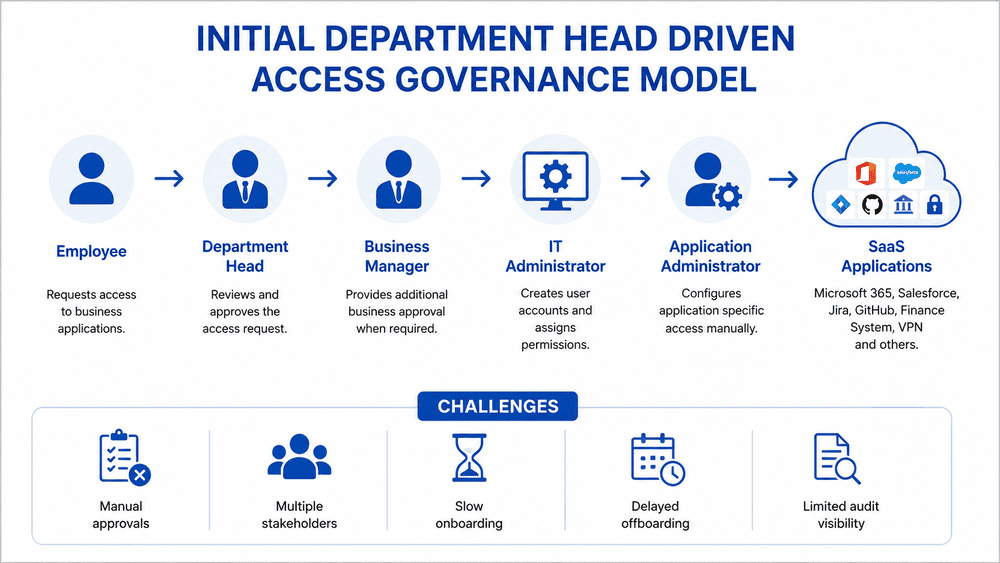
The initial governance model relied heavily on department heads to approve and coordinate access assignments. Figure 1 illustrates the original governance structure, where access decisions flowed through departmental management before reaching IT administrators responsible for implementation.
This model offered clear business ownership because department leaders understood the responsibilities of their teams. However, operational efficiency declined as the business expanded. Access requests often required multiple approvals, particularly when employees needed permissions spanning several departments or project teams.
Cross functional collaboration introduced further complexity. Employees participating in strategic initiatives frequently required access to applications outside their primary department. Determining appropriate approvals became increasingly difficult, and administrators often needed clarification from multiple stakeholders before proceeding.
As request volumes increased, department heads became operational bottlenecks. Approvals accumulated, onboarding timelines lengthened, and governance consistency became dependent on the availability and responsiveness of individual managers. While the model supported business oversight, it lacked the scalability required for a growing SaaS environment.
Why Department Based Static Groups Created Governance Complexity
To reduce approval overhead and improve consistency, the team explored department-based group governance. Users were assigned to predefined groups aligned with organisational functions, and applications consumed these groups when determining access permissions.
Initially, this approach appeared attractive because it reduced individual access assignments and simplified administration. However, the evaluation identified several operational limitations that became increasingly significant as business requirements evolved.
Static groups struggled to accommodate role changes. Employees rarely fit neatly into a single departmental category, particularly in organisations where collaboration across business units was common. Project-based responsibilities, temporary assignments, and matrix reporting structures created access requirements that extended beyond standard departmental boundaries.
Group maintenance also became resource-intensive. Administrators were responsible for adding users, removing users, managing exceptions, and validating group accuracy. Over time, groups accumulated nested permissions and special cases that made governance more difficult rather than simpler.
The review team observed a pattern of privilege accumulation within the group model. Employees often received additional access to support temporary responsibilities, but those permissions were not consistently removed when circumstances changed. Without automated lifecycle controls, entitlement cleanup remained dependent on manual reviews.
The evaluation ultimately concluded that department-based groups improved administration compared to purely manual access assignments, but they did not provide the flexibility or governance maturity required for long-term scalability.
Scalability and Licensing Constraints Identified During Evaluation
The architecture team also evaluated operational scalability from a platform perspective. Several proposed solutions depended heavily on manual group administration, synchronisation services, and premium platform capabilities. While technically feasible, these approaches introduced additional dependencies that required careful consideration.
Identity synchronisation mechanisms offered valuable automation capabilities but often depended on Microsoft Entra Premium licensing. Stakeholders needed to evaluate whether licensing investments would support long-term governance objectives or merely automate existing inefficiencies.
The team also assessed how governance processes would perform as application counts increased. A model that worked effectively for twenty applications might become difficult to manage across fifty or one hundred integrations. Scalability therefore became a governance consideration rather than simply a technical performance metric.
The evaluation highlighted a broader architectural principle: successful identity governance depends on reducing operational complexity, not merely automating existing manual processes.
Why Authentication Alone Was Not Sufficient for Governance
A key finding emerged during discussions surrounding SSO federation and MFA enforcement. Several stakeholders initially believed that broader SSO adoption would resolve most identity management challenges. While federation delivered significant security and user experience benefits, the evaluation demonstrated that authentication controls alone could not address underlying governance issues.
Users could authenticate through a centralised platform and still retain excessive permissions. Employees could complete MFA challenges successfully while holding stale entitlements from previous roles. Access approvals could remain fragmented even when authentication became centralised.
During the evaluation, it became clear that authentication represented only one component of effective identity and access management. Sustainable governance requires visibility into entitlements, automated lifecycle management, policy-based access control, consolidated reporting, and continuous validation of access decisions.
This conclusion became a key design principle during the next phase of the programme, where the focus shifted from authentication infrastructure toward comprehensive identity governance architecture.
Organisations pursuing similar initiatives often encounter related challenges when implementing Zero Trust strategies, many of which are explored in Zero Trust Networks Explained for Indian Organisations.
Researching and Designing a Centralised IAM Governance Architecture
The architecture redesign phase was driven by a clear objective: create a governance model that could support continued SaaS growth without increasing operational complexity. Earlier assessment activities had already shown that fragmented identity management was increasing administrative effort, limiting governance visibility, and creating avoidable security risks. The next step involved defining an operating model that could govern identities consistently as the number of applications, users, and access dependencies continued to grow.
Rather than selecting a technology platform immediately, the team first defined the governance outcomes they wanted to achieve. These included consistent onboarding and offboarding, centralised visibility into user access, standardised access governance processes, policy-driven access control, reduced administrative effort, and improved audit readiness. Every design decision was evaluated against these objectives to ensure the future architecture addressed root causes rather than symptoms.
Using HRMS as the Identity Source of Truth
One of the earliest architectural decisions involved identifying an authoritative source for identity information. During the assessment, it became clear that user data existed across multiple systems, creating inconsistencies that affected provisioning, entitlement management, and lifecycle governance.
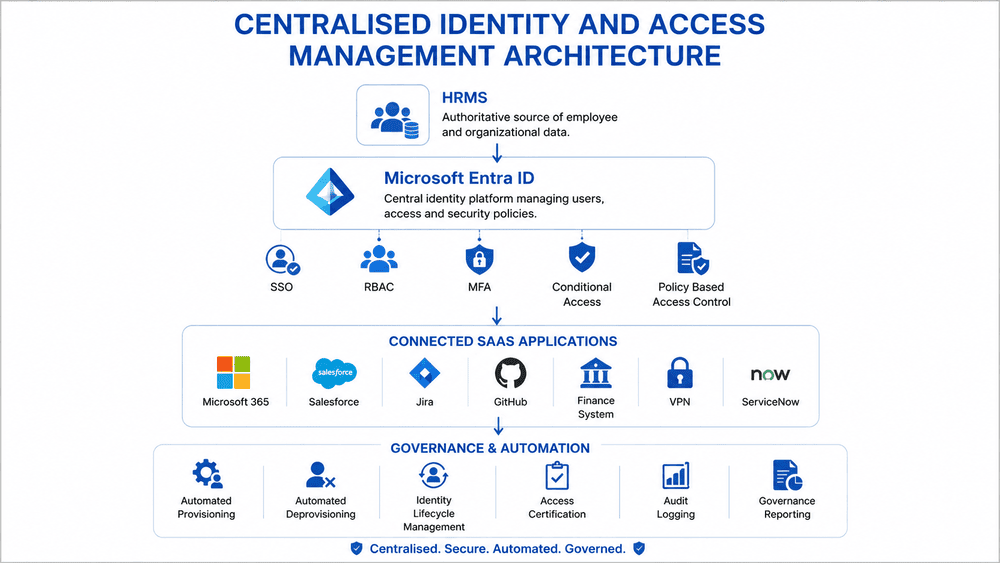
The HRMS was ultimately selected as the authoritative identity source because it represented the most reliable system for employee lifecycle events. Human Resources already maintained employee records, reporting structures, department assignments, job roles, employment status, and organisational changes. These attributes were directly relevant to access governance and could be used to drive identity lifecycle decisions.
The design team recognised that many access related issues originated from inconsistent identity data rather than technical limitations within individual applications. When departments maintained separate user records, discrepancies emerged. By standardising identity creation and updates through HR managed data, the programme established a foundation for more consistent governance.
Joiner, Mover and Leaver events became central to the design approach. Employee onboarding, departmental transfers, promotions, role changes, and terminations could now be treated as governance triggers rather than administrative notifications. This allowed identity lifecycle management processes to become event-driven and significantly reduced the dependency on manual intervention.
The decision also improved attribute consistency across the environment. Department names, job titles, reporting relationships, and employment status could now be synchronised from a single trusted source, reducing the risk of conflicting identity information appearing in downstream systems.
Centralising Identity Governance Through Microsoft Entra ID
With the HRMS established as the authoritative identity source, the programme required a centralised platform capable of enforcing identity governance across the SaaS environment. Several options were evaluated based on integration capabilities, lifecycle management support, policy enforcement features, and long-term scalability.
Microsoft Entra ID was selected as the central identity control layer because it provided a combination of authentication services, identity synchronisation capabilities, access governance features, and security policy enforcement mechanisms. More importantly, it offered a platform through which governance could be standardised across applications rather than managed individually within each system.
The architecture positioned Microsoft Entra ID as the central authority for authentication and identity governance. SaaS applications integrated with Entra ID through SSO federation, enabling users to access approved applications through a consistent authentication experience. This reduced credential sprawl and simplified access management across the environment.
The platform also enabled centralised MFA enforcement. Instead of relying on individual application owners to configure authentication controls, security policies could be managed centrally and applied consistently across integrated services. This addressed one of the key concerns identified during the assessment phase, where authentication standards varied significantly between applications.
Conditional access policies provided additional governance capabilities. Security teams could enforce controls based on user identity, device status, location, risk signals, and application sensitivity. These controls strengthened security while supporting operational flexibility for employees working across different environments.
One of the most valuable outcomes was improved visibility. By centralising authentication, access governance, and identity synchronisation within a single platform, security teams gained a consolidated view of identity activity that had previously been distributed across multiple systems.
Evaluating Group Based Governance Models During Solution Design
The design phase included a detailed evaluation of several governance models. The objective was not simply to identify what worked technically but to determine which model could support governance consistency and operational scalability over the long term.
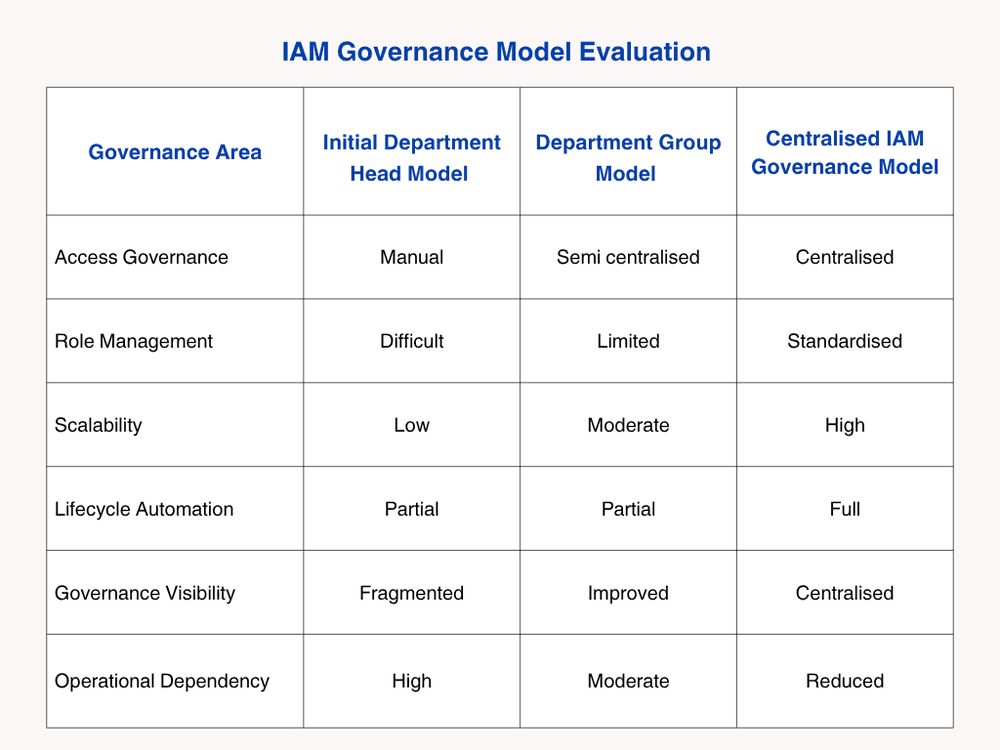
The first model examined was the existing department head managed approach. This model offered strong business ownership because access decisions remained closely aligned with departmental leadership. However, the assessment had already demonstrated that the model created approval bottlenecks, administrative overhead, and scalability challenges as the organisation grew.
The second model involved department-based group governance. This approach simplified some administrative activities by assigning users to groups aligned with organisational functions. While this reduced the number of individual access assignments, it introduced maintenance challenges and struggled to accommodate complex access requirements spanning multiple departments.
The team also evaluated application specific role structures. These offered greater granularity but required each application to maintain its own entitlement model. Governance visibility remained fragmented, and lifecycle consistency depended on individual application owners maintaining role definitions accurately over time.
After reviewing these alternatives, the architecture team concluded that none of the approaches adequately addressed the underlying governance limitations. Each model relied heavily on manual administration, fragmented entitlement management, or application specific controls that limited visibility and scalability.
The preferred approach combined centralised governance with policy-based access control and standardised RBAC. This model allowed access decisions to be governed centrally while still supporting the flexibility required by different business functions.
Designing a More Scalable Identity Governance Model
The final architecture focused on creating a governance framework capable of supporting growth without introducing additional operational complexity. Rather than managing identities through isolated application processes, the programme adopted a centralised lifecycle management approach built around policy driven governance.
RBAC became the foundation of entitlement management. Roles were defined according to business responsibilities rather than application specific permissions. This enabled access assignments to be standardised across departments while reducing the need for manual entitlement administration.
Identity orchestration capabilities connected HR lifecycle events to access governance workflows. Employee onboarding, role changes, and departures triggered automated processes that provisioned, modified, or revoked access according to approved governance policies.
Automated provisioning workflows reduced the need for administrators to create accounts manually. Access assignments could be generated dynamically based on employee attributes such as department, role, location, and employment status. This approach improved consistency while reducing administrative workload.
The architecture also introduced centralised governance visibility. Security teams could review access assignments, entitlement ownership, lifecycle events, and policy enforcement activities through a unified management layer rather than collecting information from multiple systems.
Most importantly, the design supported scalability. New SaaS applications could be onboarded into an existing governance framework without requiring entirely new identity management processes. This ensured that future growth would not recreate the governance concerns that had prompted the transformation initiative.
Implementing the Enterprise IAM Lifecycle Architecture
Once the target architecture was approved, the programme moved into implementation planning. The programme adopted a phased deployment strategy to reduce disruption and allow governance improvements to be introduced progressively. Rather than attempting a large-scale migration in a single phase, the team focused on establishing governance foundations before expanding automation capabilities.
The implementation approach followed four major stages: discovery and assessment, architecture planning, platform deployment, and lifecycle integration. Each phase contributed to the overall objective of creating a centralised identity governance framework that could operate consistently across the SaaS environment.
Discovery and IAM Assessment Phase
Although an initial assessment had already identified several governance obstacles, the implementation phase required a more detailed understanding of the existing environment. The team conducted a comprehensive inventory of SaaS applications, identity repositories, authentication mechanisms, access models, and integration capabilities.
Every application was evaluated to determine how identities were created, how access was assigned, and whether lifecycle events could be automated. Particular attention was given to applications supporting SCIM provisioning, federation protocols, API based integrations, and existing synchronisation mechanisms.
The assessment also examined role governance structures. In many cases, permissions had evolved organically over time, resulting in entitlement models that lacked clear ownership or documentation. Understanding these dependencies was essential before introducing RBAC and automated lifecycle management.
Security reviews focused on orphaned accounts, stale permissions, privileged access assignments, MFA coverage, and audit visibility. These findings helped prioritise implementation activities and informed the sequencing of future integrations.
IAM Architecture Design and Governance Planning
The planning phase translated assessment findings into a practical implementation roadmap. Governance responsibilities were clearly defined, entitlement ownership models were established, and role definitions were standardised across business functions.
RBAC planning involved close collaboration with business stakeholders. Rather than replicating existing access assignments, the team analysed how employees actually performed their responsibilities and designed role structures accordingly. This reduced unnecessary complexity and improved alignment between business functions and access governance.
Provisioning workflows were designed around HR driven lifecycle events. The team mapped onboarding, role changes, and departures to corresponding IAM actions, ensuring that access governance would remain consistent throughout the employee lifecycle.
Application onboarding standards were also created during this phase. These standards defined integration requirements, authentication methods, provisioning approaches, and governance controls for future SaaS deployments.
Policy enforcement planning focused on MFA requirements, conditional access policies, privileged access controls, and audit logging standards. Establishing these requirements early ensured consistency throughout subsequent implementation activities.
IAM Platform Deployment and SaaS Integration
The deployment phase began with the implementation of the central identity repository and governance platform. Microsoft Entra ID was configured to support authentication, federation, lifecycle management, and access governance requirements identified during the design process.
SSO federation was implemented across priority applications, reducing reliance on application specific credentials and simplifying authentication experiences for end users. At the same time, centralised MFA enforcement policies were introduced to standardise security controls across the environment.
Provisioning services were configured to automate identity creation and entitlement assignments wherever supported by application integrations. Each SaaS platform underwent validation testing to confirm synchronisation accuracy, authentication functionality, role assignments, and lifecycle processing behaviour.
The onboarding process for new applications also changed significantly. Instead of introducing isolated identity management processes, applications were integrated into the common governance framework from the outset. This prevented fragmentation from re-emerging as the SaaS environment continued to grow.
Integrating HRMS with IAM Lifecycle Management
The final stage of implementation connected HR lifecycle events directly to identity governance processes. This integration transformed identity management from a reactive administrative activity into a structured lifecycle management capability.
Employee data synchronisation enabled the IAM platform to receive updates whenever new employees joined, existing employees changed roles, or employment status changed. These events triggered governance workflows automatically, reducing delays and eliminating many manual processes.
Joiner Mover Leaver integration became one of the most significant operational improvements delivered by the programme. Instead of relying on email notifications and manual coordination, lifecycle events could now drive provisioning, entitlement updates, and deprovisioning activities directly through the IAM platform.
Real-time synchronisation improved consistency across applications while reducing the likelihood of identity discrepancies. The organisation gained a centralised mechanism for processing lifecycle events, enforcing governance policies, and maintaining accurate access records throughout the employee journey.
Automating Joiner Mover Leaver Workflows Across SaaS Applications
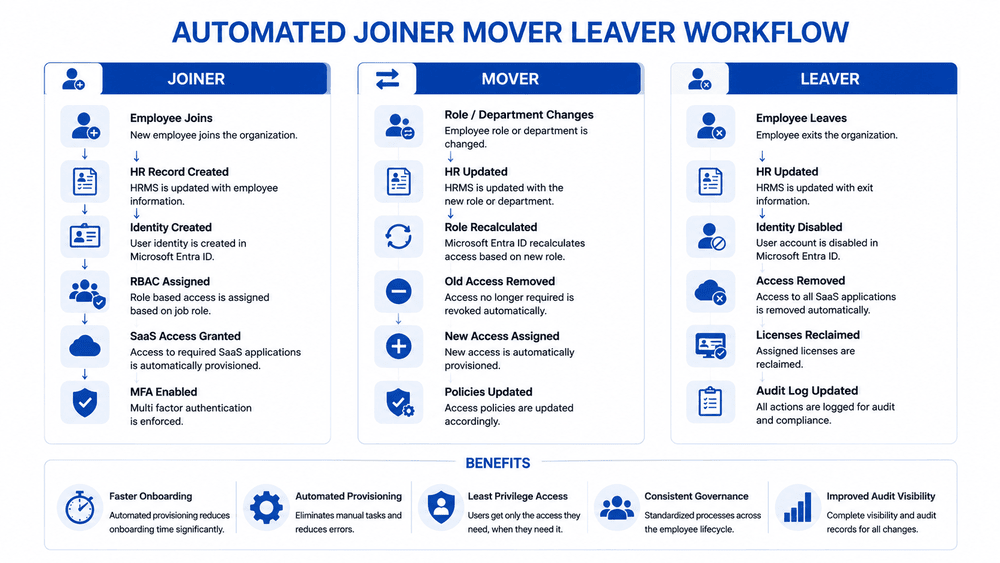
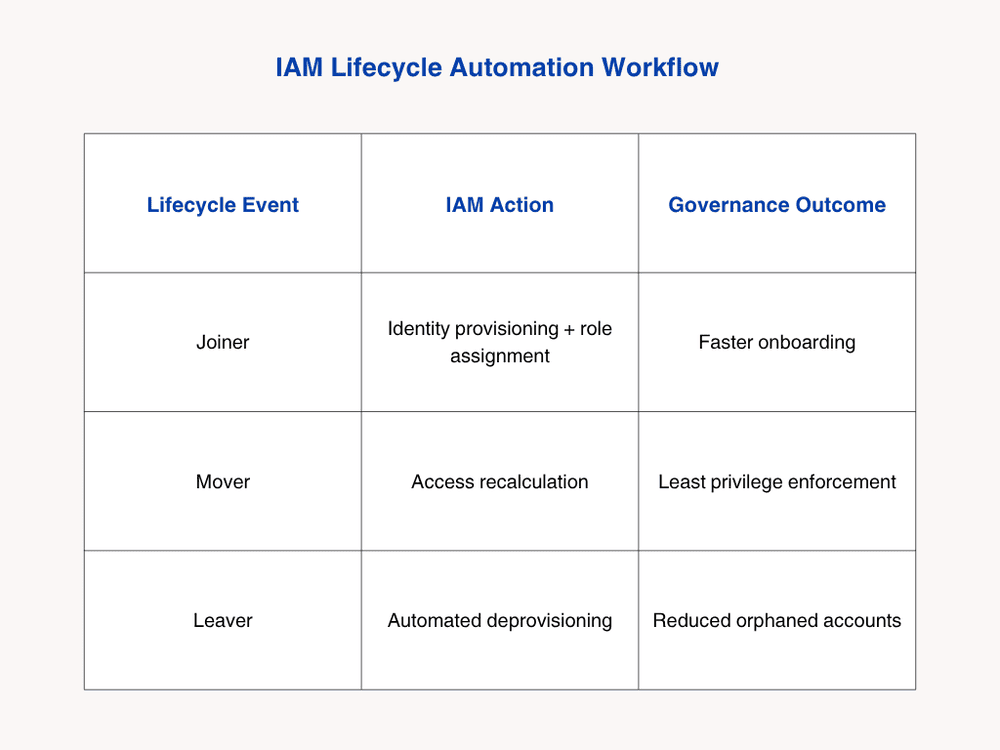
The implementation of centralised identity governance created the foundation for automating one of the programme’s most critical operational processes: Joiner Mover Leaver (JML) lifecycle management. Prior to the transformation, onboarding, role changes, and offboarding activities depended on emails, tickets, spreadsheets, and manual coordination between multiple teams. While these processes had evolved over time to support business growth, they lacked consistency and were difficult to govern across an expanding SaaS estate.
The new architecture connected HR driven lifecycle events directly to identity governance workflows. This allowed employee status changes to trigger automated actions across integrated applications, reducing administrative effort while improving governance consistency. More importantly, it ensured that identity lifecycle management could be enforced through policy rather than relying solely on procedural compliance.
Automating Joiner Workflows
Employee onboarding was one of the first areas targeted for automation because delays in access provisioning had a direct impact on productivity. Under the previous model, new hires often waited for individual administrators to create accounts, assign permissions, and configure authentication settings across multiple systems. The onboarding experience varied depending on departmental processes, application ownership, and administrator availability.
The new IAM architecture introduced a workflow in which employee creation within the HRMS automatically triggered identity provisioning activities. As soon as an approved employee record was entered into the system, the IAM platform generated a corresponding digital identity and evaluated applicable governance policies. Access assignments were then determined based on predefined RBAC mappings, department attributes, reporting structures, and employment type.
This approach enabled birthright access to be assigned automatically. Employees received access to the applications and services required for their role without the need for separate requests or manual intervention. SSO federation ensured that authentication could be managed centrally, while MFA enforcement policies were applied automatically during account activation.
The result was a significantly more predictable onboarding experience. New employees could begin working with the necessary tools from their first day, while governance teams retained confidence that access assignments remained aligned with approved policies.
Automating Mover Workflows
Role transitions often create some of the most challenging governance issues within enterprise environments. Employees frequently move between departments, assume additional responsibilities, participate in cross functional projects, or receive promotions that alter their access requirements. In fragmented environments, these changes can lead to entitlement accumulation because new permissions are granted while obsolete permissions remain active.
The new lifecycle management framework addressed this challenge through automated access recalculation. When changes to department, role, reporting structure, or employment status were detected within the HRMS, the IAM platform reassessed the employee’s access profile against current governance policies.
This process enabled dynamic entitlement updates. Permissions associated with previous responsibilities could be removed while new permissions were assigned based on the employee’s updated role. Rather than relying on administrators to remember which access rights should be revoked, governance decisions were driven by policy and lifecycle data.
The implementation also supported least privilege access objectives. Since access assignments were recalculated during role changes, entitlement growth could be controlled more effectively. Employees retained access that supported their current responsibilities while outdated permissions were systematically reviewed and removed.
From a governance perspective, teams gained greater confidence that access rights reflected actual business requirements rather than historical assignments accumulated over time.
Automating Leaver Workflows
Employee departures represent one of the highest risk lifecycle events within identity governance programmes. Delays in deprovisioning can result in orphaned accounts, unnecessary licence consumption, and ongoing access to sensitive systems after employment has ended.
Prior to the transformation, offboarding activities relied on administrators manually revoking access from individual applications. Completion times varied and validating that every account had been removed often required extensive effort. As the SaaS environment expanded, maintaining confidence in offboarding completeness became increasingly difficult.
The centralised IAM architecture introduced automated deprovisioning workflows triggered directly by employment status changes within the HRMS. When an employee departure was recorded, the IAM platform initiated a sequence of actions designed to revoke access consistently across the environment.
Identity accounts were disabled centrally, application access was revoked, VPN permissions were removed, and SaaS licences became available for reassignment. Since these activities were coordinated through a centralised platform, governance teams gained greater visibility into the offboarding process and could verify completion through reporting and audit records.
This approach significantly reduced the risk of orphaned accounts and improved operational confidence in lifecycle governance controls.
Strengthening Governance Through RBAC, Access Requests, and Policy Enforcement
While lifecycle automation addressed many operational challenges, it became clear that sustainable identity governance required more than automated provisioning and deprovisioning. Governance maturity depends on controlling how access is granted, how permissions are reviewed, and how security policies are enforced across the environment.
The transformation therefore introduced a governance framework centred around RBAC, centralised approval workflows, access certification processes, and policy-based security controls. Together, these capabilities improved consistency, visibility, and accountability across the SaaS ecosystem.
Standardising Access Through RBAC
Role-based access control became the foundation of the enterprise access governance model. During the assessment phase, entitlement management had been identified as one of the most fragmented aspects of the environment. Different applications maintained different permission structures, and access assignments frequently depended on administrator interpretation rather than standardised governance rules.
The RBAC design effort focused on aligning access rights with business responsibilities. Rather than assigning permissions individually, users were associated with predefined roles that reflected operational functions within the organisation. These roles served as governance containers that determined which applications, permissions, and resources employees could access.
The standardisation delivered several benefits. Access assignments became more predictable, entitlement management became easier to audit, and onboarding activities could be automated more effectively. RBAC also supported policy-based access governance by ensuring that access decisions followed approved organisational standards rather than ad hoc administrative actions.
Most importantly, RBAC improved the programme’s ability to enforce least privilege access principles. Since permissions were tied to defined business roles, governance teams could review and refine entitlement structures systematically as requirements evolved.
Centralising Access Request and Approval Workflows
One of the recurring findings from the assessment involved fragmented approval processes. Different applications relied on different request methods, creating inconsistencies that affected governance visibility and auditability.
The centralised IAM architecture introduced a unified access request framework through which employees could request additional permissions, temporary access, or application access. Instead of relying on emails and informal communication channels, requests were routed through structured workflows governed by predefined approval rules.
Approval routing was configured according to access sensitivity, business ownership, and governance requirements. Managers, application owners, and security stakeholders could participate in approval decisions while maintaining complete visibility into workflow status and decision history.
Additional controls were introduced for temporary access assignments. Permissions granted for projects, investigations, or short-term business requirements could be configured with predefined expiry dates, reducing the likelihood of unnecessary long term access retention.
From an audit perspective, centralised workflow tracking provided a significant improvement. Governance teams could review who requested access, who approved it, when it was granted, and whether it remained justified. This level of traceability had been difficult to achieve under the previous fragmented model.
Improving Access Governance Through Certification Reviews
Access governance requires continuous validation. Even well designed RBAC structures can drift over time if entitlements are not reviewed regularly. Access certification processes were introduced as part of the broader governance framework.
Certification reviews provided managers and entitlement owners with an opportunity to validate whether users still required assigned access rights. Rather than relying solely on provisioning logic, the organisation introduced periodic governance checkpoints that examined entitlement accuracy across applications.
These reviews proved particularly valuable for identifying stale access and exception-based permissions that had accumulated over time. Access rights granted for temporary projects, business initiatives, or historical responsibilities could be reassessed and removed where appropriate.
The certification process also strengthened governance accountability. Managers became active participants in entitlement validation, while security teams gained greater confidence in the accuracy of access records maintained within the IAM platform.
Over time, access certification became an important mechanism for maintaining governance maturity and ensuring that entitlement structures continued to reflect business realities.
Enforcing Centralised Security Policies Across SaaS Applications
The final component of the governance framework involved centralised policy enforcement. While authentication controls already existed within parts of the environment, they had previously been managed independently across applications, resulting in inconsistent security standards.
The new architecture allowed security policies to be defined centrally and enforced consistently across integrated SaaS platforms. MFA enforcement became a baseline requirement rather than an application-specific configuration. This ensured that authentication standards remained uniform regardless of which application a user accessed.
Conditional access policies introduced additional layers of control. Access decisions could be influenced by user location, device posture, authentication risk signals, and application sensitivity. These controls allowed the organisation to balance security requirements with operational flexibility while maintaining a consistent governance model.
The architecture also supported risk-based authentication and continuous identity monitoring. Suspicious sign-in activity, unusual access patterns, and policy violations could be detected more effectively because identity activity was centralised within a single governance framework.
Policy standardisation produced benefits beyond security. Governance teams gained confidence that controls were being applied consistently, auditors could review enforcement activities more easily, and application owners no longer needed to manage authentication policies independently.
For organisations evaluating similar initiatives, many of these controls align closely with established IAM Security Best Practices, particularly in environments where SaaS adoption continues to expand and governance consistency becomes increasingly important.
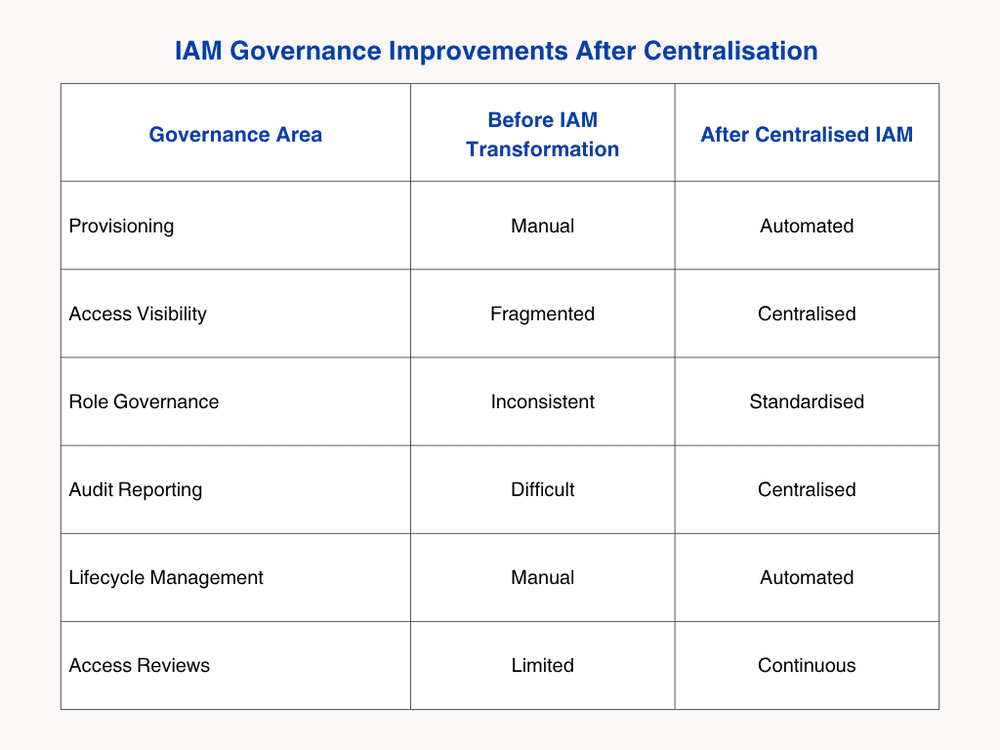
Improving Audit Visibility, Governance Reporting, and Operational Scalability
A common misconception during IAM transformation programmes is that automation alone delivers governance maturity. While lifecycle automation significantly improved operational efficiency, security and governance teams recognised that governance effectiveness ultimately depends on visibility. Without reliable reporting, traceability, and audit evidence, security teams struggle to validate whether access controls are functioning as intended.
The centralised IAM architecture addressed this challenge by creating a single governance layer across the SaaS environment. Instead of collecting information from multiple applications during audits or security reviews, governance teams could access consolidated identity data, entitlement information, lifecycle records, and policy enforcement activities through a central platform.
This shift fundamentally changed how governance teams approached audit readiness, compliance reporting, operational oversight, and future scalability.
Centralising Access Visibility Across Applications
Before the transformation, answering simple governance questions often required significant manual effort. Security teams could not easily determine which applications a user could access, what permissions had been assigned, who approved those permissions, or whether access remained appropriate. Information existed across multiple systems, but it was fragmented and difficult to analyse collectively.
The centralised IAM model introduced a unified view of identity governance across the SaaS estate. Security administrators gained visibility into user identities, application assignments, entitlement ownership, authentication activity, and lifecycle status through a single management layer.
This visibility improved operational decision-making. When access reviews were required, teams could evaluate entitlements across multiple applications without gathering information manually from different administrators. Investigations involving access anomalies became more efficient because identity activity could be traced centrally.
Security and governance teams benefited from improved entitlement tracking. Instead of managing permissions as isolated application configurations, access rights became part of a broader governance framework where relationships between users, roles, applications, and approvals could be understood more clearly.
As SaaS adoption continued to grow, this centralised visibility became increasingly valuable because governance complexity no longer increased at the same rate as application growth.
Strengthening Audit and Compliance Reporting
Audit preparation had historically been one of the most resource-intensive governance activities. Internal reviews, compliance assessments, and customer security questionnaires frequently require evidence relating to user access, authentication controls, access approvals, and account lifecycle management.
Under the previous model, generating this evidence often required collecting reports from multiple systems and reconciling data manually. The process was time-consuming and occasionally exposed inconsistencies that required further investigation.
The centralised IAM architecture significantly improved reporting capabilities by consolidating lifecycle and governance data within a common platform. Access review outcomes, provisioning activities, deprovisioning events, authentication records, policy enforcement actions, and approval histories could now be accessed through standardised reporting mechanisms.
Dormant account visibility improved considerably because inactive identities could be identified centrally rather than through application-specific reviews. Failed authentication reporting became more consistent, and privileged access activities could be monitored more effectively across integrated platforms.
From a compliance perspective, Audit and compliance teams moved from reactive evidence collection to continuous governance reporting. This reduced audit preparation effort while increasing confidence in the accuracy and completeness of governance records.
Reducing Operational Dependency Through Lifecycle Automation
A clear improvement was observed in the reduction of manual administrative effort. Prior to the transformation, identity management activities depended heavily on individual administrators performing repetitive tasks across multiple systems.
Provisioning, entitlement updates, role changes, and deprovisioning all require varying levels of manual intervention. As the SaaS environment expanded, the administrative workload increased proportionally.
The implementation of automated lifecycle management changed this operating model significantly. Many routine activities became event-driven and policy-governed. Employee onboarding could be completed more quickly, role transitions required less manual coordination, and offboarding processes became more predictable.
This reduction in operational dependency produced benefits beyond efficiency. Governance consistency improved because automated workflows were executed according to defined policies rather than relying on individual interpretation. Human error risks were reduced, and service delivery became more predictable for business users.
IT teams were able to redirect effort away from repetitive administrative work and focus on governance improvement initiatives, security enhancement activities, and strategic technology projects.
Building a More Scalable IAM Governance Model
Scalability was one of the primary objectives of the transformation programme. It was clear that SaaS adoption would continue to grow and that governance processes needed to support future expansion without requiring proportional increases in administrative effort.
The centralised architecture achieved this by separating governance from individual application administration. Instead of creating unique identity management processes for each new platform, applications could be onboarded into an established governance framework that already supported authentication, provisioning, policy enforcement, and lifecycle management.
This approach reduced operational complexity while enabling governance controls to scale consistently across the environment. New applications inherited existing policies, lifecycle workflows, and reporting standards, reducing the effort required to maintain governance maturity.
The result was a governance model capable of supporting continued organisational growth while maintaining visibility, consistency, and operational control.
Key Lessons Learned from the IAM Transformation
The project delivered technical improvements, governance enhancements, and operational efficiencies. More importantly, it provided several practical lessons that influenced how similar enterprises can approach identity governance initiatives.
IAM Must Function as a Governance Layer, Not Just an Authentication Layer
One of the most significant lessons involved recognising the distinction between authentication and governance. Existing authentication controls were already in place across several applications, yet governance challenges persisted because identity lifecycle management remained fragmented.
Authentication verifies identity. Governance determines whether access remains appropriate throughout the user’s lifecycle. Sustainable IAM programmes require both capabilities working together within a unified framework.
Lifecycle Automation Requires Centralised Governance Standards
Automation delivers consistent outcomes only when governance rules are clearly defined. During the planning phase, the team discovered that automating inconsistent processes simply accelerates inconsistency.
Successful lifecycle automation depended on establishing standardised role definitions, approval models, entitlement ownership structures, and policy enforcement requirements before workflow automation was introduced.
HR Driven Identity Governance Improves Lifecycle Consistency
The decision to use HRMS data as the authoritative identity source proved fundamental to the programme’s success. Employee lifecycle events already existed within HR processes. Integrating those events directly with IAM workflows improved accuracy, reduced manual effort, and strengthened governance consistency across the enterprise.
Without a trusted source of lifecycle data, automation initiatives often struggle to maintain reliability over time.
Manual Group Based Governance Does Not Scale Efficiently
The evaluation phase confirmed that static group management approaches eventually create administrative complexity as organisations grow. While groups remain useful components of access governance, relying on manual group administration as the primary governance model introduces scalability limitations.
Centralised policy-based governance and RBAC provided greater flexibility while reducing operational overhead.
Centralised Visibility Is Critical for SaaS Governance and Audit Readiness
Governance maturity improved significantly after access visibility was centralised. Security teams gained greater confidence in entitlement accuracy, audit preparation became more efficient, and governance reviews became more effective.
Visibility ultimately became one of the most valuable outcomes of the transformation because it enabled informed decision making across every aspect of identity governance.
Enterprise IAM Governance Validation Checklist
The following checklist can help organisations evaluate the maturity of their current identity governance programme.
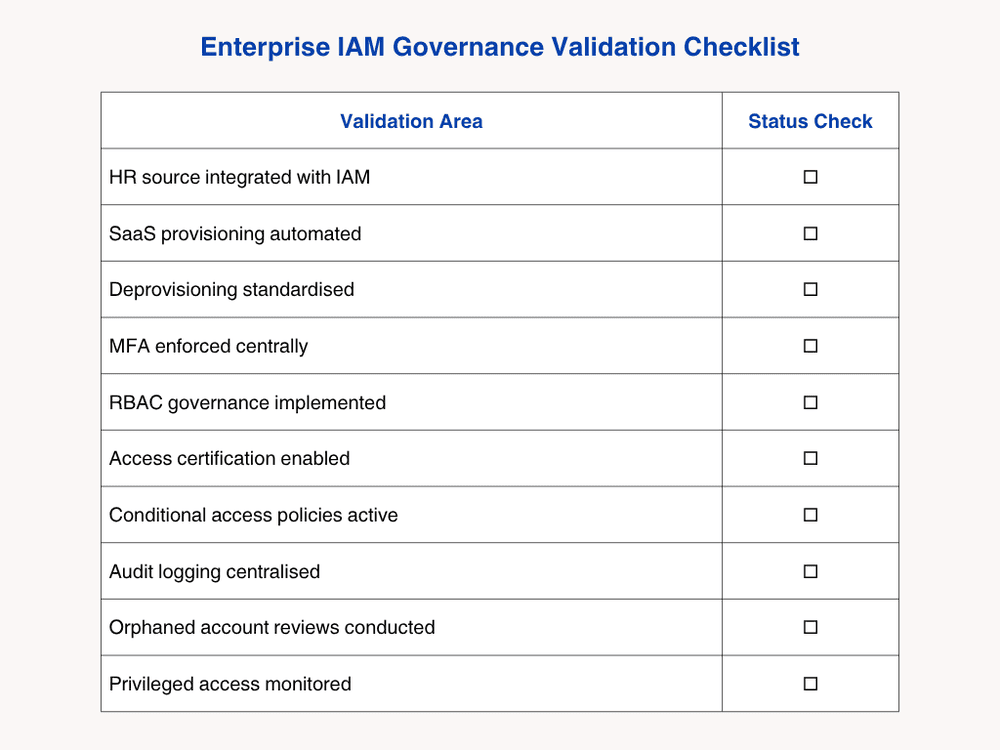
Organisations that identify gaps across multiple areas should consider whether identity management is operating as a collection of administrative activities rather than a coordinated governance capability.
Conclusion
This IAM transformation began with a relatively common challenge: a growing SaaS environment supported by fragmented identity management processes. Over time, manual provisioning, inconsistent access governance, fragmented approval workflows, and limited visibility created operational inefficiencies that became increasingly difficult to manage.
The assessment demonstrated that the primary issue was not authentication. Existing authentication mechanisms were already in place across the environment. The challenge involved governing identities consistently throughout their lifecycle while maintaining visibility, accountability, and operational scalability across an expanding SaaS ecosystem.
By establishing the HRMS as the authoritative identity source, centralising governance through Microsoft Entra ID, implementing RBAC, automating Joiner Mover Leaver workflows, and introducing policy-based access governance, the programme created a more sustainable identity operating model.
The transformation improved lifecycle consistency, reduced administrative dependency, strengthened audit readiness, and provided a foundation capable of supporting future growth without recreating the governance challenges of the past.
The most important lesson from the engagement remains clear:
You cannot effectively govern enterprise SaaS access when identity management remains fragmented across disconnected applications.
Centralised identity and access management provides the visibility, governance consistency, lifecycle automation, and operational scalability required to support modern SaaS environments.
For organisations evaluating broader cloud governance strategies, Cloud Security in 2026: Shared Responsibility Explained Clearly provides additional context on how identity controls fit within modern cloud security operating models.
Frequently Asked Questions
Most organisations struggle to identify orphaned accounts when identity information is distributed across disconnected applications. A centralised IAM platform improves visibility by maintaining a consolidated record of user identities, lifecycle status, and application assignments. Automated deprovisioning workflows further reduce the likelihood of orphaned accounts by revoking access immediately when employment status changes occur.
The most common challenges involve inconsistent identity data, poorly defined role structures, fragmented approval processes, legacy applications with limited integration capabilities, and unclear entitlement ownership. Successful implementations typically begin with governance standardisation before introducing automation.
A transition should be considered when onboarding delays become common, offboarding activities require extensive manual effort, audit preparation becomes difficult, access reviews reveal entitlement inconsistencies, or SaaS adoption begins expanding across multiple business functions. These indicators often suggest that manual processes are approaching their operational limits.
Microsoft Entra ID can serve as a centralised identity governance layer that supports SSO federation, MFA enforcement, conditional access policies, lifecycle automation, provisioning, deprovisioning, identity synchronisation, and governance reporting. When integrated with HR systems and SaaS platforms, it provides a foundation for centralised access governance.
Organisations should evaluate identity data quality, HR process maturity, role governance structures, entitlement ownership, application integration capabilities, approval workflows, and policy requirements. Automating poorly governed processes often introduces additional complexity rather than improving efficiency.
Effective cloud IAM audits typically combine access certification reviews, entitlement analysis, privileged access monitoring, role validation exercises, dormant account reviews, and consolidated reporting. The objective is to verify that access remains aligned with current business requirements while identifying excessive permissions and governance gaps.
SSO and MFA improve authentication security but do not automatically address entitlement governance, lifecycle management, access certification, approval workflows, or role governance. Organisations often discover that governance limitations remain even after authentication has been centralised because the underlying access management processes have not been modernised.
Priority should generally be given to centralised identity management, HR driven lifecycle governance, RBAC implementation, MFA enforcement, conditional access policies, automated provisioning and deprovisioning, access certification reviews, privileged access monitoring, and centralised audit reporting. Together, these controls provide a strong governance foundation as SaaS environments continue to grow.