
Overview of Healthcare Data Security and DPDP Compliance in India
India’s healthcare sector is going through a rapid digital shift. Hospitals are adopting electronic health records, patients are using mobile health apps, diagnostics are becoming more data-driven, and telemedicine is now part of everyday care. All of this has made healthcare more accessible, but it has also quietly increased how much personal data is being handled across systems.
With the Digital Personal Data Protection Act, 2023 now in force, this data is no longer just an operational asset. It has become a regulated responsibility. Healthcare providers, pharmaceutical companies, and health tech platforms are expected to be far more deliberate in how they collect, use, store, and protect patient information.
What is changing in reality is not just compliance on paper. Teams are now asking more grounded questions, like where the data actually sits, who can access it at any point, and how prepared they are if something goes wrong.
Understanding How the DPDP Act Applies to Healthcare Organisations in India
The DPDP Act introduces a structured legal framework for handling digital personal data in India. In healthcare, this becomes especially important because most of the information handled is sensitive by nature.
Patient data is not limited to names or contact details. It includes medical history, prescriptions, lab reports, insurance information, and sometimes even behavioural or genetic data. When all of this sits across multiple systems and vendors, the responsibility does not get divided. It stays with the organisation that decides why and how the data is used.
This is where many healthcare organisations misjudge the situation. Even if processing is outsourced, accountability does not move with it.
In practice, this means teams need visibility beyond their own systems, especially when vendors or external platforms are involved.
Why Healthcare Data Is Considered Highly Sensitive Under the DPDP Act
Healthcare data tends to have a longer life than most other types of data. A leaked password can be reset. A leaked credit card can be blocked. Medical data does not work that way. Once exposed, it can be reused in different contexts for years.
That is one of the reasons attackers target healthcare systems. Ransomware incidents, data theft, and insider misuse are all more impactful in this sector.
In India, the risk is slightly uneven. Larger hospitals may have stronger controls, but smaller clinics, labs, and digital health platforms often operate with limited security maturity. That gap tends to create easy entry points rather than sophisticated attack paths.
As more services move online, these differences are becoming more visible, especially in how incidents are detected and handled.
Healthcare Data Security Challenges Facing Hospitals and Healthcare Organisations in India
If you look at how things are evolving, medical data security in India is no longer treated as just a backend IT concern. It is slowly becoming part of compliance discussions, board-level reviews, and even patient trust.
Healthcare organisations are now expected to show that they have reasonable safeguards in place, not just assume they do.
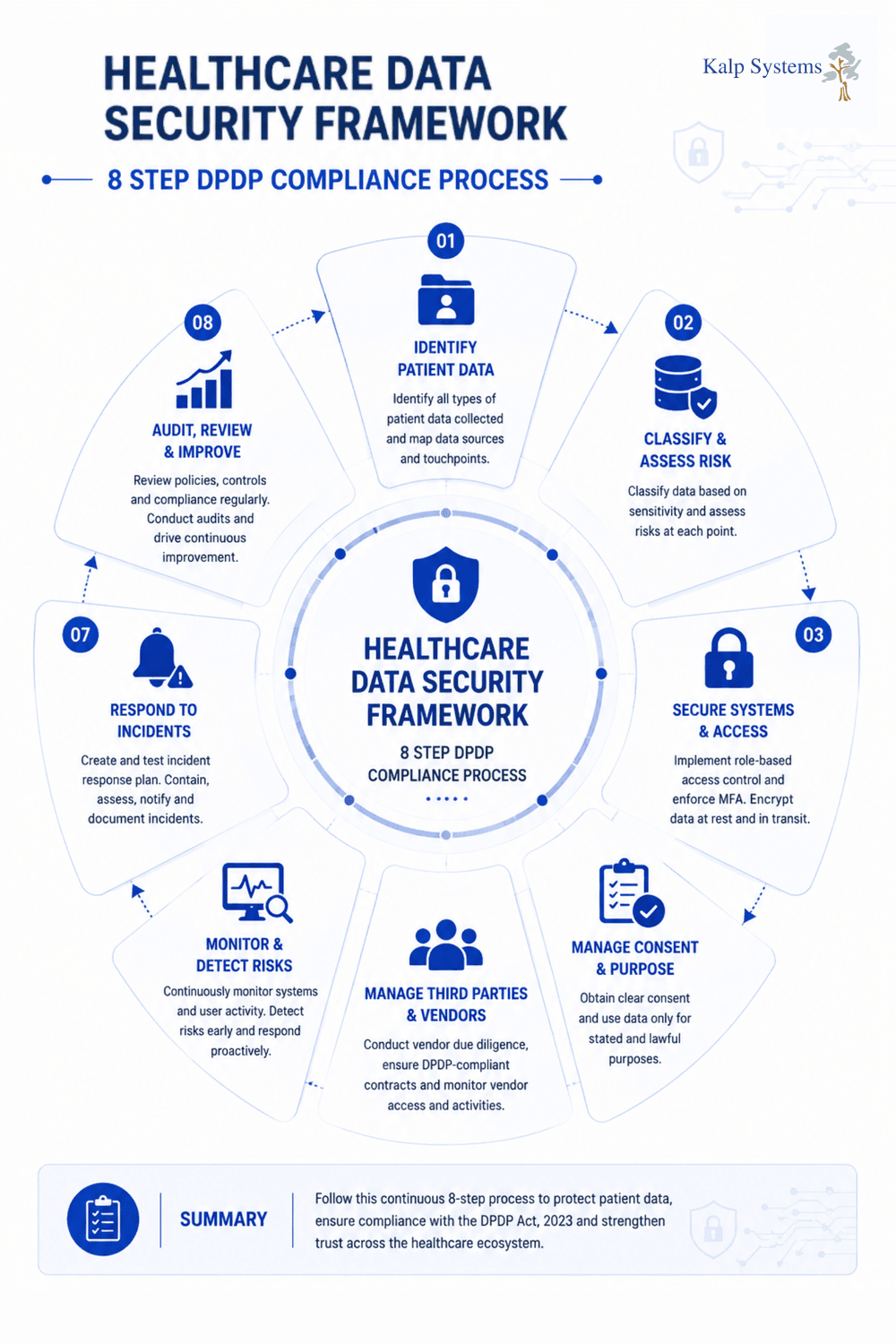
Why India's healthcare sector is a prime target for cyber attacks
The mix of high-value data, legacy systems, and multiple integration points makes healthcare environments easier to exploit compared to more controlled industries.
In many cases, even a small gap, like shared credentials or delayed updates, can be enough to create exposure.
Growing regulatory expectations for healthcare data protection
With DPDP enforcement, organisations are expected to justify their controls. It is not enough to say “we are secure”. There has to be evidence, process, and accountability behind it.
This is pushing organisations to document their practices more clearly, especially when audits or incidents come into the picture.
Major Healthcare Cybersecurity Risks That Impact Patient Data Protection
Healthcare systems rarely operate in isolation. A typical setup includes hospital management systems, diagnostic platforms, third-party vendors, cloud infrastructure, and connected devices. All of these need to work together, which creates multiple points where something can go wrong.
Maintaining consistent security across such an environment is not easy, especially when different systems are built at different times with different standards.
Legacy systems and unpatched healthcare infrastructure
Many healthcare institutions still rely on older systems that were never designed for current security expectations. These systems may not support strong authentication, encryption, or even regular updates.
From a DPDP perspective, this becomes a problem because the law expects organisations to implement reasonable safeguards. Outdated systems make that difficult.
In reality, replacing these systems is not always immediate, so teams often have to work around them while still trying to maintain basic security controls.
Cloud adoption, data sharing, and medical data security challenges
Cloud platforms have made it easier to scale operations, but they also introduce confusion around responsibility. Many breaches happen not because the cloud itself is insecure, but because of misconfigurations or weak access control.
In practice, organisations often assume the provider handles everything, which is rarely the case.
Clarity around who is responsible for what usually makes the biggest difference in avoiding gaps.
Managing Patient Consent, Purpose Limitation, and Healthcare Data Privacy
Consent is a central concept under DPDP. Organisations are expected to collect and use data only for a clear purpose and with proper user awareness.
On paper, this sounds simple. In reality, it gets complicated very quickly once multiple systems are involved.
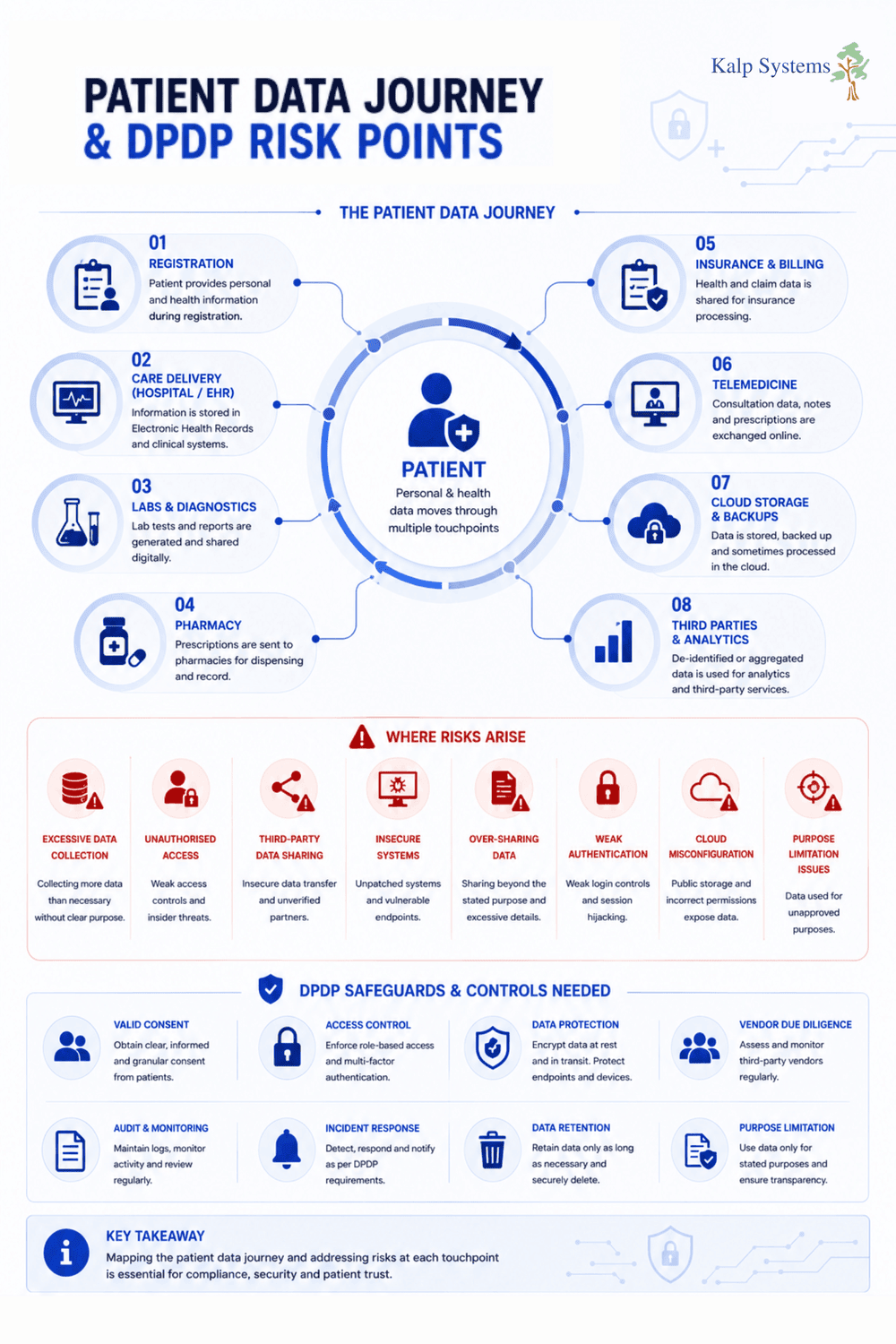
Consent challenges across fragmented patient journeys
Patients interact with healthcare systems through hospitals, laboratories, pharmacies, insurers, mobile apps, and teleconsultation platforms. Each interaction involves data sharing, often across organisational boundaries.
This makes it difficult to ensure that data is always used within the original purpose.
When these systems are not fully aligned, tracking how data moves becomes harder than expected.
Data retention, deletion, and compliance obligations
Healthcare data often needs to be retained for medical or legal reasons. At the same time, DPDP expects data to be deleted once it is no longer needed.
Balancing these two is not always clean, and organisations often end up over-retaining data just to be safe.
Clear internal guidelines usually help teams make these decisions with more confidence instead of guesswork.
Managing Third Party and Vendor Risks Across the Healthcare Ecosystem
Most healthcare organisations depend on external vendors at some level. This could be for cloud hosting, diagnostics, analytics, or software systems.
The challenge is that every additional vendor increases exposure.
Supply chain risks affecting patient data security
A single weak vendor can become an entry point. There have been multiple cases where the breach did not start inside the hospital but through a connected partner.
This is why vendor checks cannot be treated as a one-time activity, they need periodic review.
Improving visibility into healthcare data movement
In many setups, organisations do not have a clear picture of how data flows between systems and vendors.
Without that visibility, even basic control measures become difficult to enforce.
When teams map these flows properly, they often discover dependencies they were not aware of earlier.
Preparing for DPDP Incident Response and Healthcare Data Breach Management
This is one of the areas where organisations usually realise gaps only after something happens.
Preventive controls get attention, but response readiness is often less developed.
Key incident response requirements under DPDP
Incident response is not just about fixing a technical issue. It includes identifying the breach, understanding its impact, containing it, and communicating appropriately.
Under DPDP, this also involves notifying authorities and affected individuals when required.
How quickly this is done often makes a noticeable difference in both impact and perception.
How healthcare organisations should respond to security incidents
- An unusual activity is detected, sometimes late
- Teams try to isolate affected systems
- There is often confusion around what data is impacted
- Decisions on notification take time
- Communication becomes reactive instead of planned
Organisations that have predefined processes handle this much better than those reacting in real time.
Regular drills or simulations tend to make these responses more structured when a real incident occurs.
Strengthening Governance, Accountability, and Healthcare Data Privacy Compliance
Compliance is not only about tools or systems. It depends heavily on how responsibilities are defined and managed internally.
In many healthcare organisations, the challenge is coordination between teams rather than lack of technology.
Aligning security, privacy, and healthcare operations
Security controls should not disrupt clinical workflows. If they do, staff tend to bypass them, which creates new risks.
Finding that balance usually requires input from both technical teams and operational staff.
Reducing insider risks through awareness and training
Human error continues to be one of the most common causes of data exposure.
Even small improvements in awareness can reduce a large number of incidents.
Over time, consistent training tends to shape behaviour more effectively than one-time sessions.
DPDP Compliance Requirements Every Healthcare Organisation Should Prioritise
When you break it down, compliance usually comes down to doing a few things consistently rather than doing everything perfectly.
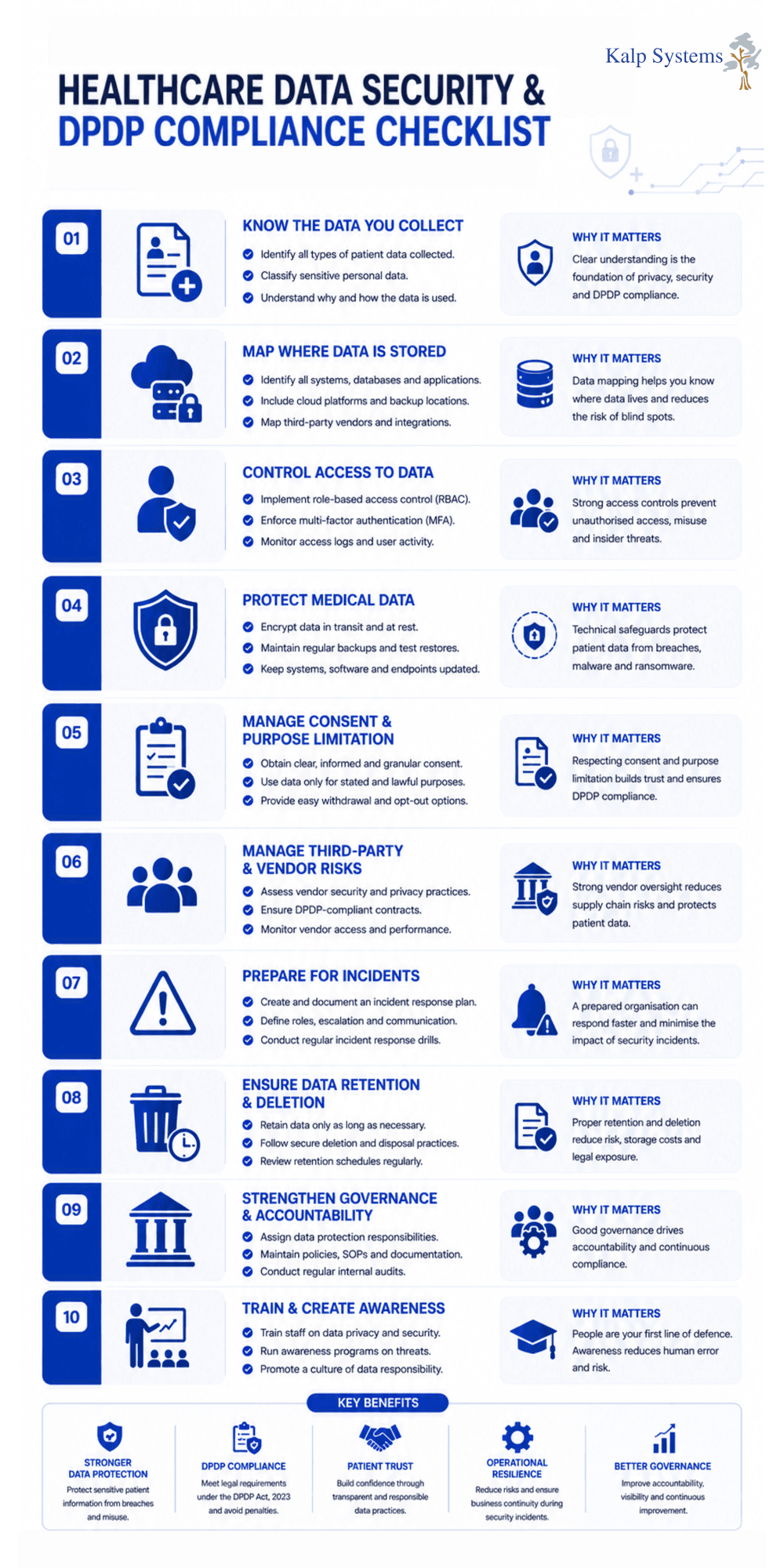
Technical, operational, and governance requirements
- Understanding where data is stored and processed
- Ensuring access is controlled and monitored
- Checking whether vendors follow basic safeguards
- Keeping policies and notices updated
Maintaining ongoing healthcare compliance in India
- Reviewing systems and access controls
- Monitoring changes in data flow
- Testing how well teams respond to incidents
Consistency in these areas often matters more than one-time implementation.
A Practical Healthcare Data Security Checklist for DPDP Compliance
Most teams prefer something practical rather than theoretical frameworks.
Getting started with healthcare data protection
- Map your data
- Identify who has access
- Review existing controls
Maintaining continuous compliance and security
- Monitor systems regularly
- Train staff periodically
- Review vendor relationships
This kind of approach helps teams stay aligned without making the process unnecessarily complex.
Future Trends Shaping Healthcare Data Security and DPDP Compliance in India
Healthcare organisations are gradually moving toward more structured approaches.
Zero Trust security for healthcare
Access is verified continuously. This approach reduces reliance on assumptions and focuses more on verification.
Privacy by Design in healthcare systems
Security is built into systems early. It often makes long-term maintenance easier compared to fixing issues later.
The growing role of AI and regulatory oversight
Leadership is more involved in data decisions. This is gradually improving accountability across teams.
Conclusion
The DPDP Act is changing how healthcare organisations think about data.
The shift is subtle but important. It is moving from “we have systems in place” to “we can explain and justify how we handle data.”
Organisations that take a steady, practical approach to compliance will be in a better position to manage both regulatory expectations and real-world risks.
Over time, this tends to reflect in how confidently organisations handle incidents and communicate with stakeholders.
Frequently Asked Questions
What is DPDP incident response in healthcare?
It refers to how organisations detect, manage, and report data breaches involving personal data.
How should hospitals handle data breaches?
They should identify the issue, contain it, assess the impact, and inform the relevant parties.
Having a clear internal process usually reduces delays during such situations.
What data is covered under DPDP?
Any personal data that can identify a patient, directly or indirectly. This can range from basic identifiers to detailed medical records, depending on the context.