HomeBlogApplication SecurityAPI Security Risks Most Organisations Miss
API Security Risks Most Organisations Miss

What Are API Security Risks?
Application Programming Interfaces, commonly known as APIs, have become the backbone of modern digital applications. From mobile apps and SaaS platforms to cloud native systems and third-party integrations, APIs enable data exchange and functionality across different environments.
As businesses rely on more APIs, the security risks associated with them have also increased. APIs can expose sensitive data and application functions when authentication, authorisation, input validation or other security controls are not properly implemented.
An API security issue can take different forms. A user may gain access to resources they should not be able to access. An API may return more information than required. An outdated endpoint may still be publicly accessible, or an undocumented API may exist without the security team’s knowledge.
These risks can be difficult to identify because APIs often operate behind the applications people use every day. At the same time, they may provide direct access to backend systems, data and business functions.
This has made API security an important part of application security. As cloud native systems, microservices and third-party integrations continue to increase the number of APIs businesses use, maintaining visibility and appropriate security controls becomes increasingly important.
Why API Security Has Become a Critical Business Risk
APIs were originally designed to support functionality and communication between systems. Over time, they began handling a much wider range of activities, including access to personal information, payment details, authentication tokens and business-critical workflows.
Several factors have increased API security risks:
- Rapid adoption of microservices and cloud native architectures
- Growth of mobile applications and partner integrations
- Increased use of third-party APIs and open platforms
- Lack of visibility into shadow or undocumented APIs
- Compliance requirements related to personal and sensitive data
The growing number of APIs has also increased the number of possible entry points into an application environment. Some APIs are publicly available by design, while others may have been developed for internal use, testing or older versions of an application and remain accessible.
Attackers actively look for these weaknesses. Poor access controls, exposed endpoints and unmanaged APIs can provide opportunities to access data or misuse application functionality.
For businesses, the consequences can go beyond a technical security issue. A vulnerable API may result in unauthorised data access, operational disruption, compliance concerns and reputational damage.
Common API Security Risks Organisations Often Miss
API security problems are often linked to basic controls that have been missed, incorrectly implemented or not reviewed as applications change. The following risks are among the areas businesses should examine when assessing their API security posture.
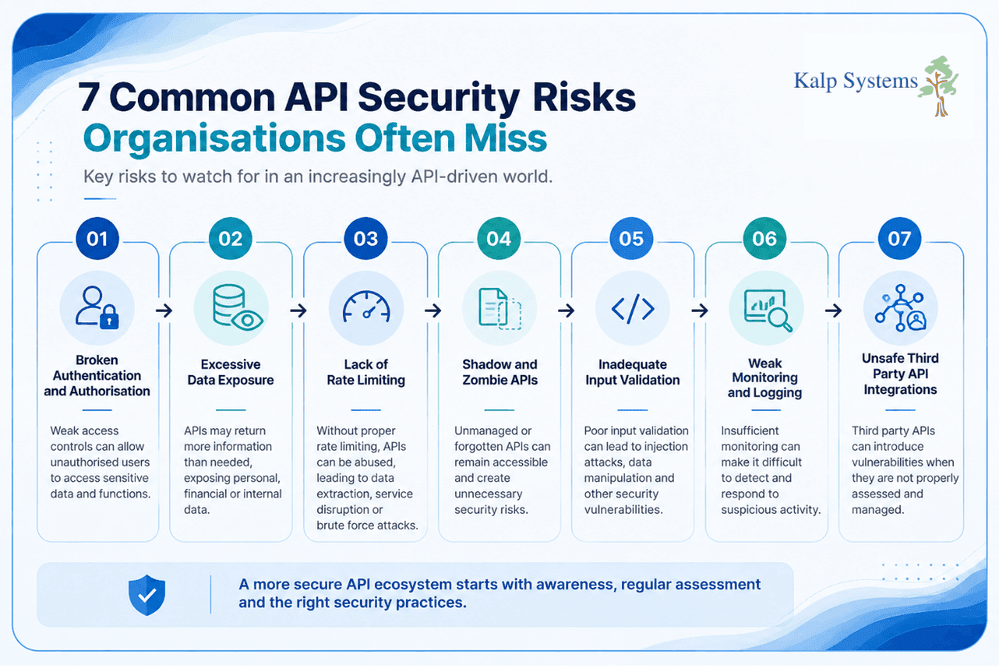
Broken Authentication and Authorisation
One of the most common API security risks is improper authentication and authorisation.
Many APIs rely on API keys, tokens or session identifiers to verify users and control access. Problems arise when these mechanisms are poorly implemented or when the API does not properly check whether a user is authorised to access a particular resource.
For example, an authenticated user may be able to change an object ID in an API request and access another user’s information if proper authorisation checks are missing.
Common issues include:
- Reuse of static API keys without regular rotation
- Missing checks for user roles and permissions
- Trusting client-side parameters for access decisions
- Insecure storage of tokens in mobile or web applications
Broken authorisation can lead to unauthorised data access, privilege escalation and compliance issues. Where APIs handle personal, financial or other sensitive information, the impact can be significant.
Excessive Data Exposure
APIs sometimes return more information than an application actually needs. Developers may expose an entire object in the API response and rely on the application to display only the required fields.
The data is still available in the response.
This can expose information that was never meant to be shared with the user. The problem becomes more serious when API responses include personal data, internal information or other sensitive fields.
Common reasons include:
- APIs designed for internal use later being exposed externally
- Lack of data minimisation
- Poor response filtering
- Changes to applications without reviewing the data returned by existing APIs
API responses should contain only the information required for the specific request. Regular reviews can help identify fields that are being exposed unnecessarily.
Lack of Rate Limiting and API Abuse Protection
APIs are designed to accept requests, but unrestricted access can make them easier to abuse. Without appropriate rate limiting, an attacker may repeatedly send requests to perform brute-force attempts, scrape data or consume system resources.
Rate limits should also reflect how an API is being used. An internal API and a public-facing API may require different controls.
Risks that security teams often overlook include:
- No request throttling based on IP address, user or token
- The same limits applied across different types of APIs
- No controls against automated requests
- Limited monitoring of unusual API usage
Unchecked API abuse can affect application availability, increase infrastructure costs and degrade performance for legitimate users.
Shadow and Zombie APIs
One of the more difficult API security risks to manage is the presence of APIs that security teams do not know about or no longer actively maintain.
Shadow APIs are typically undocumented or unmanaged APIs that may have been created during development, testing or through changes to an application. Zombie APIs are older or outdated API versions that remain accessible even after a newer version has been deployed.
These APIs can easily be overlooked because they may not appear in the current API inventory.
Common reasons include:
- Rapid development cycles and frequent application changes
- Multiple teams creating and deploying APIs independently
- Lack of a centralised API inventory
- Poor API lifecycle management
The risk increases when these APIs are not monitored or regularly reviewed. An older endpoint may still use outdated authentication methods, while an undocumented API may not receive the same security checks as actively managed APIs.
Attackers can discover exposed endpoints through scanning and other techniques. Once found, an unmanaged API may provide an easier way to access an application or its data.
Inadequate Input Validation and Security Misconfiguration
APIs regularly accept structured input, including JSON, XML and other request parameters. If the API does not properly validate this input, attackers may attempt to send malicious or unexpected data to affect backend systems.
Common attack risks include:
- SQL injection through API parameters
- Command injection in backend services
- Mass assignment vulnerabilities
- Object-level manipulation
Input validation should ensure that the API accepts only the expected data and rejects invalid or unexpected requests.
Security misconfiguration can create similar problems. For example, an API endpoint may be exposed unnecessarily, use insecure default settings or have permissions that are broader than required.
Traditional security controls may not always identify these issues. Some web application firewalls are primarily configured for browser-based traffic and may not inspect API requests in enough detail.
Weak Monitoring and Logging
Many businesses monitor APIs for availability and performance but do not collect enough information to identify suspicious activity.
Without useful logs, unusual behaviour can be difficult to spot. Repeated failed authentication attempts, unexpected changes in API usage or requests for unusual resources may go unnoticed.
Common gaps include:
- Lack of contextual API logs
- No clear connection between API activity and user identity
- Limited alerting for unusual usage patterns
- Insufficient retention of security-relevant logs
These gaps can also create problems during an incident. If a security team cannot determine which API was affected, who accessed it or what data was involved, investigating the issue becomes more difficult.
Good monitoring and logging help security teams understand what is happening across their APIs and provide useful information when suspicious activity needs to be investigated.
Unsafe Third-Party API Integrations
Many applications rely on third-party APIs for services such as payments, analytics, identity verification and communication. These integrations can save development time, but they also introduce dependencies outside a company’s direct control.
A third-party API may have its own security weaknesses, experience an outage or handle data in ways that create additional risk. The permissions given to the integration can also become a problem. For example, an API token with broad access may expose more data or functionality than the application actually requires.
Some risks that are often overlooked include:
- Third-party APIs with weak security controls
- Over-permissioned API keys or access tokens
- Limited visibility into how third-party APIs access or process data
- Lack of regular security reviews for existing integrations
Third-party integrations should also be reviewed when applications change. An API that was originally given broad access may no longer need the same level of permission.
A compromise involving a third-party service can affect connected applications and lead to data exposure or service disruption. This is one reason why third-party APIs should be included in regular security and vendor risk assessments.
How AI and Automation Are Changing API Security Risks
AI and automation are making it easier to analyse large amounts of information and perform repetitive tasks. Attackers can use the same capabilities when looking for weaknesses in APIs.
Automated tools can scan applications for exposed API endpoints and test large numbers of requests much faster than a manual process. AI can also support reconnaissance and help identify patterns that may point to weaknesses in authentication, API parameters or application behaviour.
Some areas of concern include:
- Automated API endpoint discovery
- Faster testing of API parameters and inputs
- Credential stuffing against API authentication flows
- Automated attempts to abuse application functionality
Business logic is also an important area to consider. An API may have strong technical controls but still allow a legitimate feature to be used in an unintended way.
As automated attacks become easier to carry out, regular API security testing and monitoring become increasingly important.
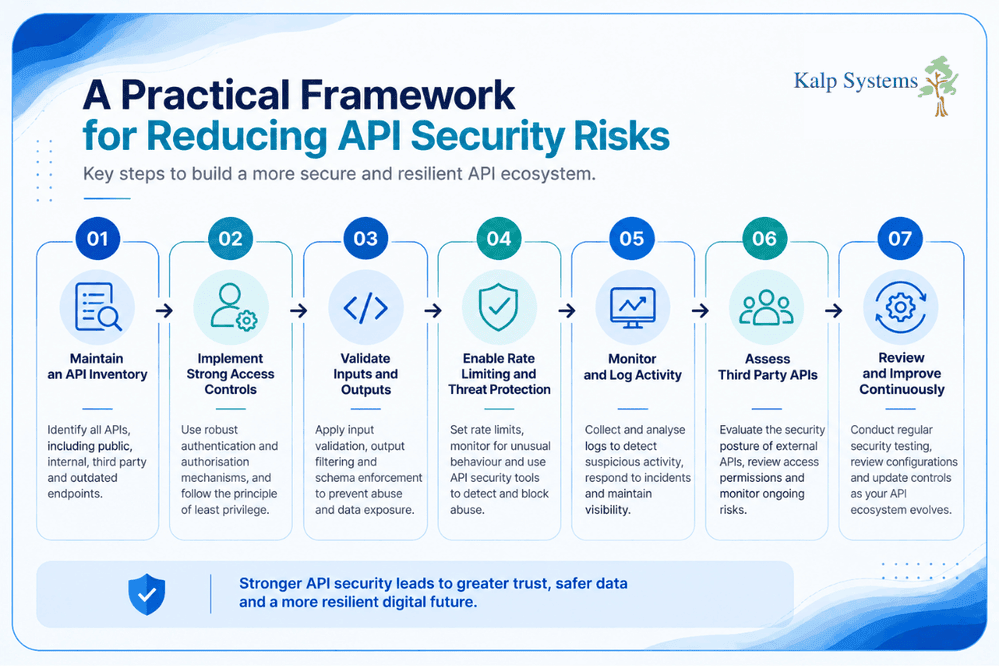
How Organisations Can Reduce API Security Risks
Securing APIs requires attention throughout their lifecycle. An API can be secure when it is first deployed and still create problems later if it is changed, forgotten or left running after it is no longer needed.
A complete API inventory is therefore useful. Security teams need to know which APIs exist, who manages them and whether they are internal, public-facing, or connected to a third-party service. This can help identify shadow APIs and older versions that may still be accessible.
Access controls also need to be checked carefully. Strong authentication helps verify the identity of users or applications, while authorisation controls what they can access. Permissions should match the access required for a particular user, service or integration.
Some key practices include:
- Maintain a centralised inventory of all APIs
- Enforce strong authentication and granular authorisation
- Validate API inputs and filter unnecessary data from responses
- Apply rate limiting to control repeated or automated requests
- Monitor API activity and investigate unusual behaviour
- Review third-party APIs and the permissions given to them
- Include API security testing in the development process
API security testing should not be limited to the final stage of development. Including security checks in DevSecOps pipelines can help teams identify issues while applications and APIs are still being developed or updated.
Regular reviews are also important. New API versions, application changes and third-party integrations can introduce risks that were not present earlier. An older API may also need attention if it continues to remain accessible.
For APIs that handle personal or sensitive data, security controls should also support relevant compliance requirements. Access controls, data handling and logging may all be reviewed during security assessments and audits.
Conclusion
API security risks are often hidden in areas that receive less attention during development and ongoing application management. An outdated endpoint, weak authorisation check or third-party integration with unnecessary permissions can create exposure even when other security controls are in place.
The risks discussed in this article, from excessive data exposure to shadow APIs and weak monitoring, show why APIs need regular security reviews. As applications change, APIs change with them. New integrations are added, older versions remain active, and access requirements can shift over time.
A clear API inventory, appropriate access controls, regular testing and ongoing monitoring can help teams identify these issues earlier and reduce unnecessary exposure.
For businesses using APIs across cloud environments, applications and third-party services, API security should remain part of the wider application security process.
Frequently Asked Questions
What are the most common API security risks?
Broken authentication and authorisation are common problems. Excessive data exposure, missing rate limits and poor input validation are also frequent risks. Security teams should also watch for shadow APIs, outdated API versions and third-party integrations that have more access than they need.
What is broken object level authorisation in API security?
An API may confirm that a user is logged in but fail to check whether that user can access a specific resource.
For example, changing a customer ID in an API request should not give access to another customer’s information. If it does, the API has failed to enforce object level authorisation.
What is a shadow API and why is it dangerous?
Shadow APIs are usually missing from the official API inventory. They may have been created for testing, developed by another team or left behind after changes to an application.
That creates a security problem because the API may never be included in regular testing or monitoring. An exposed endpoint that nobody is actively managing can easily be missed.
How can organisations reduce API security risks?
Start by identifying the APIs already in use. Unknown and outdated APIs should be reviewed alongside active ones.
Then look at access controls, API responses, input validation, rate limits and monitoring. Third party integrations also need regular reviews, especially when they have access to sensitive data.
Are third party APIs a security risk?
They can introduce additional risk because another service becomes part of the application’s data flow.
The API itself may be secure, but excessive permissions or poor control over access can still create exposure. Reviewing what the third party can access is therefore important, particularly when personal or sensitive information is involved.