HomeBlogCyber Security AwarenessCybersecurity in India 2026: Current State, Key Trends, Regulations and Emerging Threats
Cybersecurity in India 2026: Current State, Key Trends, Regulations and Emerging Threats
Overview
A few years ago, cybersecurity was often treated as something businesses dealt with after a problem appeared. A system was compromised, data was exposed, or an audit raised concerns. Security would then become a priority.
That approach is becoming harder to maintain.
Businesses in India now depend on digital systems for everyday operations. Payments move instantly; employees work across cloud platforms; data passes through multiple applications, and third-party services are part of routine business processes. The number of systems involved has grown quickly and so has the number of places where something can go wrong.
Security has had to keep up with that change. In 2026, cybersecurity is tied closely to day-to-day operations, data management, employee access and incident response.
The bigger issue is that digital growth has often moved faster than security maturity. Many companies have adopted new platforms and tools quickly, while the processes needed to secure them have taken longer to develop.
The Current State of Cybersecurity in India
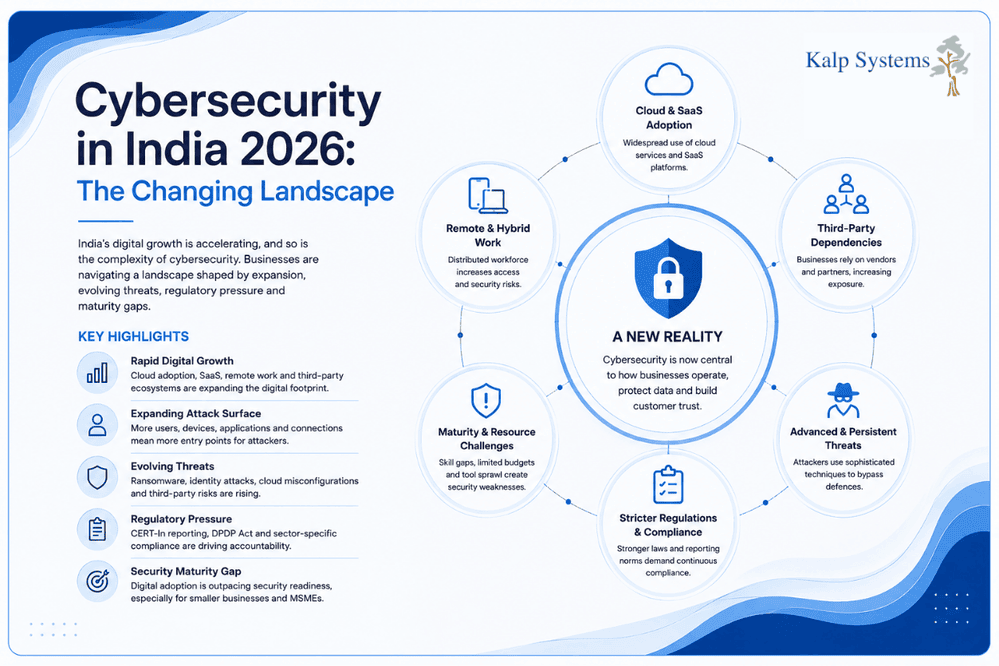
India’s cybersecurity situation reflects the speed at which the country has adopted digital technology. Businesses are dealing with larger and more connected environments than they were a few years ago.
That has made security more difficult to manage.
Digital Growth and the Expanding Attack Surface
Cloud platforms, SaaS tools, remote access and third-party systems have made work easier in many ways. They have also changed where security risks can appear.
A company may have a well-protected internal network, but a poorly configured cloud environment or a compromised vendor account can still create a problem. User accounts have become particularly important because access to one system can sometimes lead to access elsewhere.
The attack surface is no longer limited to company-owned infrastructure. It can include cloud services, employee devices, APIs, vendors and other connected systems.
The Gap Between Digital Growth and Security Maturity
The same pattern appears across different businesses. Technology adoption moves ahead, while security processes catch up later.
The gaps are often basic. Access permissions are broader than necessary. Systems are not monitored consistently. A configuration is set up once and then left unchanged. Incident response plans exist, but teams have not always tested how they would work during an actual incident.
Larger and heavily regulated companies generally have more structured security programmes because regulatory requirements have pushed them in that direction. Smaller businesses and MSMEs can face different problems. They understand that cybersecurity matters, but limited resources and expertise can make consistent implementation difficult.
This difference in security maturity remains one of the important parts of the cybersecurity landscape in India.
Cybersecurity Regulations and Compliance in India
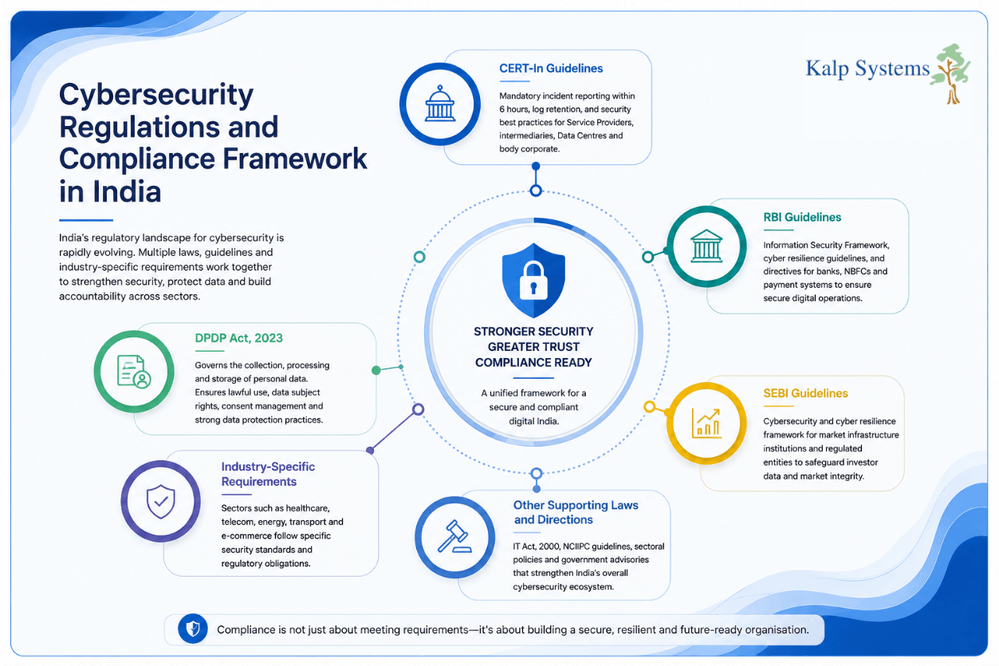
Cybersecurity requirements in India have become more visible in recent years. For many businesses, compliance is no longer something handled only when an audit is approaching. Regulations are affecting how incidents are reported, how data is handled, and how security responsibilities are managed.
The requirements also vary by industry. Financial institutions listed entities and businesses handling sensitive data may need to follow different rules. This has made it important for businesses to understand which requirements apply to them instead of treating cybersecurity compliance as one standard checklist.
CERT-In and Cyber Incident Reporting
CERT-In plays a central role in India’s cybersecurity ecosystem. Its directions have also changed how companies think about incident reporting and response.
The six-hour reporting requirement is a good example. On paper, six hours may sound manageable. During an actual incident, however, the affected business first needs to understand what has happened, assess the affected systems, involve the right teams and begin containment.
That requires preparation.
If monitoring is weak or internal escalation is unclear, valuable time can be lost before the incident even reaches the people responsible for responding to it. This is one reason incident response readiness has become closely connected with compliance.
DPDP Act and Data Protection
The Digital Personal Data Protection Act has also increased attention around how companies handle personal data.
Businesses need to have a clearer understanding of what data they collect, where it moves and who can access it. From a cybersecurity perspective, this brings greater attention to access controls, data protection and accountability.
The practical challenge is that data rarely stays in one place. It may move between internal applications, cloud platforms and third-party service providers. Businesses therefore need visibility into their data environment and the controls surrounding it.
RBI, SEBI and Industry Specific Requirements
Regulated sectors have faced cybersecurity requirements for some time. Banking and financial services, for example, operate under stricter expectations because a security incident can have an immediate operational and financial impact.
RBI and SEBI requirements have helped push cybersecurity into regular business and governance discussions within their respective regulated environments.
This has also created a wider effect. Businesses outside these sectors are increasingly facing security expectations from customers, partners and auditors. As a result, cybersecurity investment is often being influenced by both risk and compliance requirements.
Emerging Cybersecurity Threats and Challenges in India
The threat landscape has also changed. Many attacks are more deliberate, with attackers spending time understanding their target before taking action.
Companies are also dealing with risks from several directions at once. A compromised account, vulnerable third-party system or poorly secured cloud environment can all become an entry point. This makes it harder to identify where an attack may begin.
Targeted Attacks and Ransomware
Ransomware remains a serious concern because the impact can extend beyond encrypted systems. Attackers may first take sensitive data and later use it to pressure the company.
This has changed the nature of many ransomware incidents. Businesses may have backups and still face a difficult situation if confidential data has already been taken.
Targeted attacks can also take longer to detect. Once attackers gain access, they may move through systems quietly and look for valuable information or additional access. By the time unusual activity is noticed, the incident may already involve more than one system.
Identity, Cloud and Third-Party Risks
Identity has become a common path into business systems. A compromised employee account can provide access to applications, data and services, depending on the permissions attached to that account.
Cloud environments bring another set of challenges. Misconfigurations, excessive permissions and services that are not regularly reviewed can leave unnecessary exposure.
Third-party relationships add further complexity. Businesses often share systems and data with vendors, service providers and partners. Even when internal security controls are strong, a weakness in a connected third-party environment can create indirect risk.
For many businesses, managing these risks requires a better understanding of who has access to what systems are connected and where sensitive data is moving.
Key Cybersecurity Trends in India for 2026
Technology is evolving quickly, but adoption is not always straightforward.
Many companies are adding new security tools while still dealing with older systems, existing processes and limited security teams. The issue is often not whether a particular technology is available. It is whether it is being used properly and whether it works with the rest of the security environment.
AI, Automation and Advanced Security Tools
AI is becoming part of cybersecurity discussions across India. It is being used to help analyse large amounts of security data and identify activity that may need further attention.
Security teams can receive a large number of alerts, and reviewing everything manually takes time. Automation can help with repetitive tasks and give teams more information to work with.
Endpoint detection and response tools are also becoming more common. The aim is to spot suspicious activity earlier, before an incident affects more systems.
Still, adding more tools can create its own problems. Some businesses end up with several security solutions that do not fully work together. That can leave teams switching between platforms without getting a complete view of what is happening.
Zero Trust and Identity Security
Identity is getting more attention because access can open the door to several systems at once.
A compromised account may give an attacker access to applications, cloud services or sensitive information. The actual impact depends on how much access that account has.
Zero Trust is influencing how businesses approach this problem. Access needs to be checked more carefully instead of being assumed to be safe simply because a user is already connected to the company network.
For many businesses, practical work still comes back to basic questions. Who has access? Do they still need it? Has their role changed? Are permissions broader than they should be?
Continuous Security and Compliance
Security reviews used to happen mainly around audits or certification requirements. That approach is becoming less practical as systems change more frequently.
A new cloud service may be added; an employee may change roles, or a vendor may gain access to part of the environment. These changes can create security gaps after an earlier review has already been completed.
This is leading more businesses to review security and compliance on an ongoing basis.
Some are also turning to managed security providers or virtual CISO services when maintaining a large internal security team is difficult. For smaller companies in particular, external expertise can provide support where internal resources are limited.
Cybersecurity Challenges Across Indian Businesses
Cybersecurity challenges are not the same for every business. The level of risk often depends on the industry; the type of data being handled and how heavily the business depends on digital systems.
Banking and financial services are generally further ahead because cybersecurity requirements have been stricter for years. The cost of an incident can also be immediate, affecting transactions, customer trust and business operations.
Technology and SaaS companies face different kinds of pressure. Their customers often expect them to demonstrate that security controls are in place, particularly when they handle customer data or provide services to businesses in other regions.
Sector Specific Security Gaps
Some sectors have invested heavily in cybersecurity, while others are still developing their security practices.
Manufacturing, healthcare and other industries are becoming more connected, which brings systems together that were previously managed separately. Older infrastructure, new cloud services and third-party technologies can all exist within the same environment.
This makes consistency difficult. One part of the business may have strong controls, while another has not been reviewed for some time.
MSMEs and Limited Security Resources
MSMEs face their own challenges. Many understand the importance of cybersecurity, but building a dedicated security team or investing in multiple security tools is not always possible.
The problem is also not limited to the budget. Smaller businesses may not know where to start or which risks need attention first.
Basic gaps can remain for longer than they should. Access may not be reviewed regularly; systems may go without proper monitoring, or employees may not know how to recognise suspicious activity.
For these businesses, improving cybersecurity often starts with getting the basics right and building from there.
What Businesses Should Focus on in 2026
Security priorities will differ from one business to another. A financial institution, a SaaS company and a manufacturing business will not face the same risks. But some of the gaps that cause problems are surprisingly common.
Access is one of them. Over time, permissions can become broader than they need to be. An employee changes roles but keeps previous access. A vendor is given access for a specific requirement, and nobody reviews it afterwards.
Monitoring is another area that needs attention. If companies have limited visibility into what is happening across their systems, identifying an incident early becomes difficult. This can create additional pressure when a quick response is required.
Third party risk also deserves closer attention. Businesses now depend on cloud providers, SaaS platforms, vendors and external service providers. Even when internal systems are well protected, a connected third party can introduce risk.
Incident response is where these gaps often become obvious. A documented process is useful, but during an actual incident, teams need to know who takes responsibility, how the issue is escalated and what needs to happen first.
In 2026, businesses do not necessarily need to start by adding more security tools. In many cases, reviewing what already exists and finding where it is not working properly can be more useful.
Conclusion
Cybersecurity in India has changed because the way businesses operate has changed.
More systems are connected. Data moves through cloud platforms and third-party services. Employees need access to multiple applications. At the same time, companies are working under greater regulatory pressure and dealing with attacks that can affect more than one part of the business.
The gaps are not always complicated. Sometimes it comes down to access that was never reviewed, a system that is not being monitored properly or an incident response process that exists but is not followed in practice.
Regulations will continue to evolve, and threats will continue to change. Businesses will need to respond to both.
Those that keep cybersecurity as an ongoing part of their operations will be in a better position to deal with that change.
Frequently Asked Questions
What is the current state of cybersecurity in India?
It is becoming harder to manage because businesses are using more connected systems than before. Cloud platforms, SaaS tools and third-party services have expanded the environment that businesses need to secure. At the same time, regulations are placing more responsibility on them.
What are the main cybersecurity trends in India in 2026?
AI is getting more attention, particularly for handling large amounts of security data. Zero Trust and identity security are also becoming more common. Another noticeable change is how companies approach compliance. Instead of looking at it only before an audit, many are trying to stay prepared throughout the year.
What are the biggest cybersecurity threats in India?
Ransomware is still a major issue. In many cases, attackers are not only encrypting systems. They are taking data first and using it as leverage. Compromised accounts, cloud misconfigurations and third-party systems can also become starting points for an attack.
How does the DPDP Act affect cybersecurity in India?
It has pushed businesses to look more closely at how personal data moves through their systems. That includes knowing where the data is stored, who can access it and how access is being managed.
What is the CERT-In incident reporting requirement?
Certain cyber incidents must be reported within six hours. The difficult part is not simply sending the report. Businesses first need to detect the incident, understand what has happened and get the right people involved quickly.
How are ransomware and phishing attacks affecting Indian businesses?
Ransomware and phishing continue to pose significant cybersecurity threats to Indian businesses. The wider threat landscape is substantial. CERT-In reported 29,44,248 cybersecurity incidents in 2025, compared with 20,41,360 in 2024.