HomeBlogCloud SecurityCloud ERP and Supply Chain Security: Risks and Best Practices
Cloud ERP and Supply Chain Security: Risks and Best Practices
Overview
ERP and supply chain systems support a large part of day-to-day business operations. Finance teams rely on them for financial and procurement data. Manufacturing teams use them to manage production and inventory. Supply chain teams depend on connected systems to work with suppliers, distributors and logistics partners.
As these systems move to the cloud, cloud ERP security becomes a wider concern than protecting the ERP platform alone. An ERP system may interact with cloud databases, supplier portals, APIs and other business applications. Employees and administrators need access, while vendors and third parties may also connect to specific parts of the system. Managing these users, applications and connections is an important part of cloud-based ERP security.
The data stored in these systems can also be highly sensitive. Financial records, supplier contracts, pricing information, production plans and Bills of Materials may all sit within the same environment. In pharmaceutical and healthcare settings, additional information related to production, quality and regulated processes may also be involved.
A security issue in one part of the environment can have wider consequences. A poorly configured cloud resource may expose data. A compromised account may give an attacker access to business systems. An insecure integration can create an entry point through a third party.
This is why cloud ERP and supply chain security need to consider the entire environment rather than the ERP platform alone. Access management, cloud configuration, data protection, integrations and monitoring all need attention as businesses expand their use of cloud-based systems.
Why Cloud ERP and Supply Chain Systems Are High Value Targets
ERP and supply chain systems bring together information that would otherwise sit across different departments and applications. That makes them valuable to the business, but it also makes them attractive targets for attackers. Access to one critical system can potentially expose financial information, operational data and connections to external partners.
Sensitive Business and Operational Data
ERP systems often contain financial records, pricing information, procurement contracts and revenue data. They can also support manufacturing activities through production schedules, inventory records and Bills of Materials.
In pharmaceutical and advanced manufacturing environments, the information can be particularly sensitive. Production processes, formulations and quality-related records may be connected to ERP and supply chain systems. Unauthorised access or changes to this information can create financial, operational and compliance concerns.
Third-Party and Vendor Ecosystems
Supply chain operations depend on constant interaction with external parties. Suppliers, distributors, logistics providers and other vendors may connect through APIs, EDI connections or supplier portals.
These connections extend the environment beyond internal users and systems. A third-party account with unnecessary access, a poorly secured API or a compromised vendor connection can introduce risks into the wider ERP and supply chain environment.
Key Cloud ERP and Supply Chain Security Risks
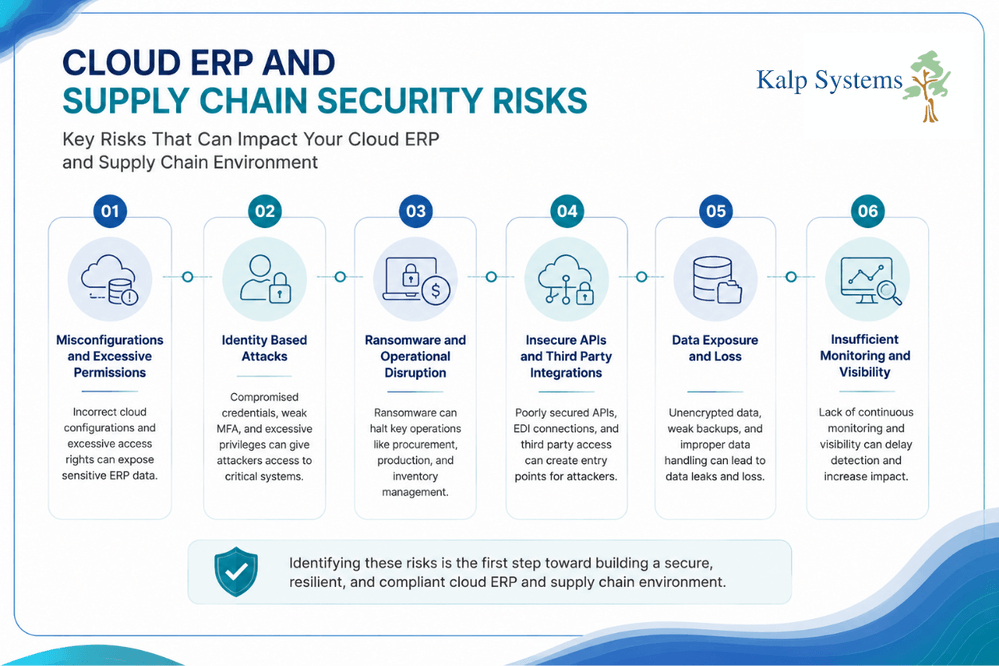
Moving ERP and supply chain systems to the cloud does not create one single security problem. Cloud ERP security risks can come from several areas, including cloud configurations, user access, connected applications and third-party relationships. A small weakness in one area can affect systems that support finance, procurement, production or logistics.
Misconfigurations and Excessive Permissions
Cloud misconfigurations remain a common source of security exposure. Publicly accessible storage, incorrectly configured databases, or poorly secured backup repositories can expose sensitive ERP data to unauthorised access.
Access permissions can create similar problems. ERP environments often have many users, roles and administrators, and access requirements can change over time. Without regular reviews, employees or third parties may retain permissions that are no longer necessary.
Identity-Based Attacks
Attackers often target user credentials because a legitimate account can provide a direct route into business systems. Weak multi-factor authentication policies, shared accounts and poor control over privileged access can make this easier.
Once an account is compromised, the level of access attached to that identity becomes important. An account with unnecessary permissions may allow an attacker to access sensitive data or make changes across the ERP environment.
Ransomware and Operational Disruption
A ransomware attack on an ERP environment can quickly affect day-to-day operations. If procurement or production scheduling systems become unavailable, the impact can extend beyond the IT team and into physical operations.
Backups are an important part of recovery, but they also need protection. Backup repositories should be separated from the primary environment, protected from unauthorised changes and tested regularly. Recovery plans should also consider how quickly critical ERP functions can be restored.
Insecure APIs and Third-Party Integrations
Supply chain systems depend on connections with suppliers, distributors and logistics partners. APIs, EDI connections and supplier portals allow information to move between these systems, but every connection adds another point that needs to be secured.
Weak authentication, excessive access or poor visibility into third-party activity can create unnecessary exposure. Businesses need clear control over who can connect to their systems, what information they can access and how those connections are monitored.
Essential Cloud ERP and Supply Chain Security Best Practices
Cloud ERP and supply chain environments usually involve several layers of technology working together. From an ERP cloud security perspective, the main ERP application is only one part of the environment. It may sit alongside cloud databases, backup systems, APIs and applications used by suppliers or logistics partners. Security controls need to account for these connected systems as well.
Access management, data protection, monitoring and integration security are all part of the same environment. A weakness in any one of these areas can affect systems that support procurement, production, inventory or other business operations.
Strengthen Identity and Access Controls
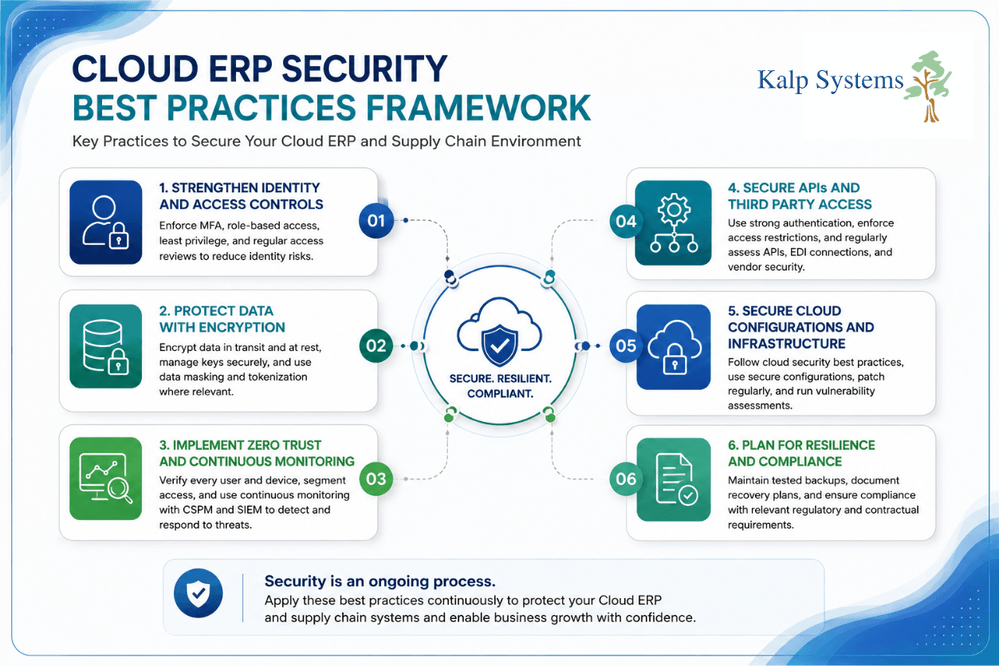
User access is one of the first areas that businesses need to manage carefully. ERP systems often have different users across finance, procurement, manufacturing and administration, and those users do not require the same level of access.
Role-based access control can help assign permissions according to a user’s responsibilities. Access reviews are also necessary because roles change. An employee may move to another department; a contractor may complete a project, or a third party may no longer require access to the system. Permissions that remain in place unnecessarily can increase exposure.
Multi-factor authentication provides another layer of protection when credentials are compromised. Privileged accounts require additional attention because they can be used to make changes across critical systems. Monitoring privileged sessions and unusual access activity can help identify issues that would otherwise go unnoticed.
Protect Data with Encryption and Secure Backups
ERP and supply chain systems can contain financial information, supplier contracts, production data and other sensitive business records. ERP data security depends on understanding where this information is stored, how it moves between systems and who can access it. This becomes particularly important when data is shared between cloud applications, databases and connected third-party systems.
Encryption should be used for sensitive data at rest and in transit. Encryption keys also need to be managed properly, with access limited to authorised users. In non-production environments, data masking or tokenisation may be appropriate where real business data is being used for testing or development.
Backup planning is equally important. A backup is of little value if it can be altered or encrypted during the same incident that affects the main environment. Cloud-based backup repositories should therefore be segregated and protected from unauthorised changes. Recovery testing helps confirm whether critical ERP data and applications can actually be restored when needed.
Implement Zero Trust and Continuous Monitoring
Traditional security approaches often assumed that users and devices inside a trusted network could be given broader access. That approach is difficult to maintain in cloud environments where users, applications and workloads may operate across different locations and platforms.
Zero Trust places greater emphasis on verifying access requests. Identity, user permissions and other relevant factors can be checked before access is granted. Least privilege also limits the level of access available to a user or system. Microsegmentation can further reduce the impact of an incident by restricting movement between different parts of the environment.
Monitoring remains necessary even when access controls are in place. Cloud Security Posture Management tools can help identify configuration issues, while SIEM and other detection platforms provide visibility into security events. Unusual data exports, access outside normal working patterns or activity from unexpected locations may require further investigation.
Secure APIs and Third-Party Access
Supply chain systems are rarely isolated. Information may move between ERP platforms, supplier portals, distributors, logistics providers and other business applications. APIs and EDI connections support these exchanges, but they also need to be included in the wider security controls for the ERP environment.
Authentication and access restrictions should be applied to integration points so that connected systems receive only the access required for their function. Teams managing the ERP environment should also maintain visibility into APIs and third-party connections.
Regular vulnerability assessments and penetration testing can help identify weaknesses in these connections. Third-party access should also be reviewed periodically, particularly when a supplier relationship changes or a project ends. External users and systems should not retain access simply because the connection was required at an earlier stage.
Secure Cloud ERP Migration with Security by Design
Cloud ERP migration security should be considered before the migration begins, as decisions made during the process can affect the environment long after the migration is complete. Moving an application to the cloud without reviewing its data, access requirements and existing integrations can carry existing security issues into the new environment.
A security review should therefore be part of the migration process from the beginning. This can include risk assessments, threat modelling, workload classification and architecture reviews. Understanding what data the ERP system processes and which systems or users depend on it helps identify areas that need additional protection.
The shared responsibility model also needs to be clearly understood. Cloud providers are responsible for securing parts of the underlying infrastructure, while customers remain responsible for their data, user access, configurations and application-level security. The exact responsibilities can vary depending on whether the ERP system is deployed through SaaS, PaaS or IaaS.
Security should also be reviewed after migration. Cloud environments can change as new workloads, users and integrations are added. Regular configuration reviews and automated compliance scans can help identify gaps that develop over time. Testing security controls and reviewing the environment periodically provides a clearer picture of whether those controls are still working as intended.
Compliance Considerations for Cloud ERP and Supply Chain Systems
Cloud ERP and supply chain systems may process information that is subject to industry, contractual or regulatory requirements. The level of compliance required depends on the type of business, the data involved and the countries in which the systems operate. For businesses in India, cloud environments may also require careful consideration of applicable data protection requirements, data residency and the way sensitive business information is processed across different cloud regions.
For pharmaceutical companies and healthcare providers, cloud security may need to support requirements related to GMP, GxP, FDA 21 CFR Part 11, HIPAA and other applicable data protection regulations. Manufacturing businesses may also need to consider data residency, contractual obligations and the protection of sensitive operational information.
Some of the controls that may need attention include:
- Data residency and localisation requirements
- Encryption of data at rest and in transit
- Detailed audit logging
- Protection of logs from unauthorised modification
- Periodic access reviews
- Segregation of duties
- Controls to maintain data integrity
Compliance should be considered during the design and operation of the cloud environment. For ERP systems, this can involve reviewing how data is stored, who can access it, how changes are recorded and whether security controls provide the required audit trail.
Regular internal reviews and third-party assessments can also help identify gaps as the cloud environment changes. New integrations, users or workloads may introduce requirements that were not present during the initial deployment.
Conclusion
Cloud-based ERP and supply chain systems have become an important part of manufacturing, pharmaceutical, and other business operations. They support large volumes of information and connect internal teams with suppliers, vendors and other external partners. That makes security a concern across the wider environment, not just within the ERP platform itself.
Misconfigurations, weak access controls, compromised credentials and insecure integrations can all create problems. The impact may extend beyond data exposure. An incident affecting a critical ERP system can disrupt procurement, production, inventory management and other day-to-day activities.
A practical approach to cloud ERP security should therefore consider identity management, data protection, cloud configurations, monitoring and third-party access together. Security also needs to remain part of the environment as systems change; new integrations are added, and access requirements evolve.
For businesses moving ERP and supply chain operations to the cloud, security needs to be considered throughout the migration and ongoing management of the environment. Regular reviews, appropriate access controls and tested recovery processes can help reduce exposure and support operational continuity.
Frequently Asked Questions
What is cloud ERP security?
Cloud ERP security is the protection of ERP systems, their data and the connected cloud environment. This includes user access, cloud configurations, databases, integrations and the movement of data between different systems.
An ERP platform may also connect with other applications, suppliers and third-party services. Security therefore needs to cover these connections as well, particularly when sensitive financial, operational or business information is involved.
What are the biggest security risks in cloud ERP systems?
Cloud misconfigurations, excessive permissions and compromised user credentials are common areas of concern. Publicly exposed storage or poorly configured databases can expose sensitive information, while a compromised account may give an attacker access to critical ERP functions.
Ransomware is another concern, particularly where ERP systems support procurement, production planning or inventory management. Insecure APIs and third-party integrations can also introduce risks when external systems have access to the environment.
How can businesses secure cloud-based supply chain systems?
Supply chain systems often involve suppliers, distributors, logistics providers and other third parties. Businesses need to know who has access to their systems and what information those users or connected applications can access.
APIs, EDI connections and supplier portals should be properly secured. Access should be limited where possible, and permissions should be reviewed when a third party’s role or business relationship changes.
What are the most important cloud ERP security best practices?
There is no single control that secures a cloud ERP environment. Securing a cloud ERP environment generally requires a combination of access controls, encryption, secure cloud configurations and regular monitoring.
Multi-factor authentication, role-based access control and least privilege can help manage user access. Sensitive data should be protected, backups should be tested, and cloud configurations should be reviewed regularly. Security testing of APIs and integrations is also important where ERP systems exchange data with other applications or external parties.
Who is responsible for security in a cloud ERP environment?
The cloud provider and the customer both have responsibilities, although the exact division depends on the service being used. A provider may secure the underlying cloud infrastructure, while the customer remains responsible for areas such as its data, users, access permissions and application settings.
This is why businesses need to understand the shared responsibility model before and during an ERP cloud deployment. Assuming that the cloud provider manages every part of security can leave important controls unaddressed.