HomeBlogCloud SecurityProtecting Sensitive Data in Public Cloud Environments
Protecting Sensitive Data in Public Cloud Environments

Why Sensitive Data Protection Matters in the Public Cloud
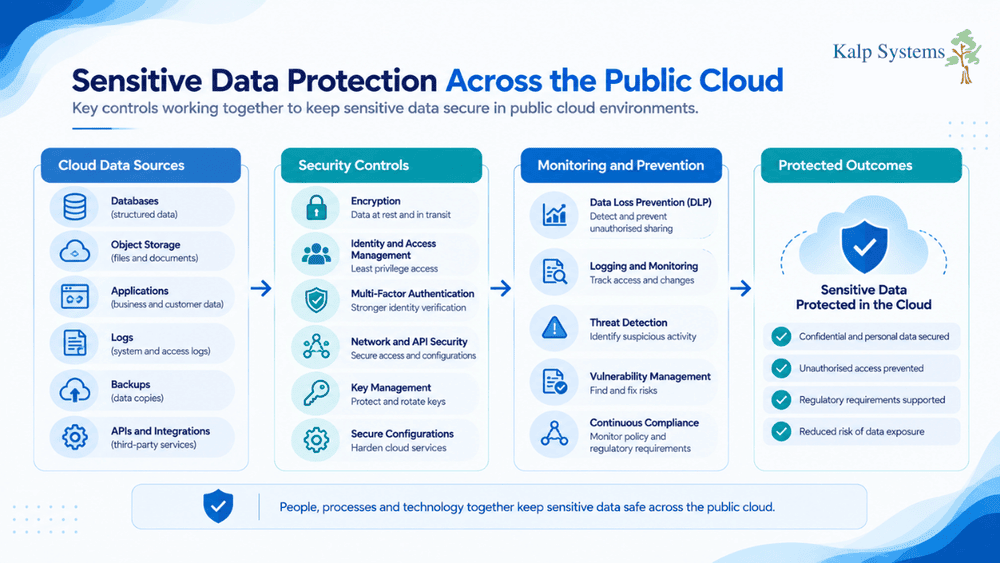
Moving sensitive information to a public cloud changes where that information lives and how it can be accessed. A customer record may sit in a database, pass through an application, appear in logs, and end up in a backup. Access may also involve employees, applications, APIs, service accounts, and third-party integrations.
That makes a simple question important: who can access the data, and under what conditions?
A storage bucket with the wrong permission can expose files to the internet. An overly broad IAM role can give an account access to records it does not need. A compromised credential can allow an attacker to reach cloud resources without breaking into the underlying cloud infrastructure.
Sensitive information can include personal details, payment records, health information, credentials, intellectual property, and confidential customer information. The consequences of exposing such data can include regulatory action, financial losses, reputational damage, and disruption to normal operations.
The problem becomes harder to manage when data is spread across several cloud accounts, regions, services, and applications. Security teams need a clear view of where sensitive information is stored and how it moves through the environment.
Understanding Public Cloud Data Protection
Public cloud data protection covers the measures used to keep sensitive information secure while it is stored, transferred, processed, and accessed.
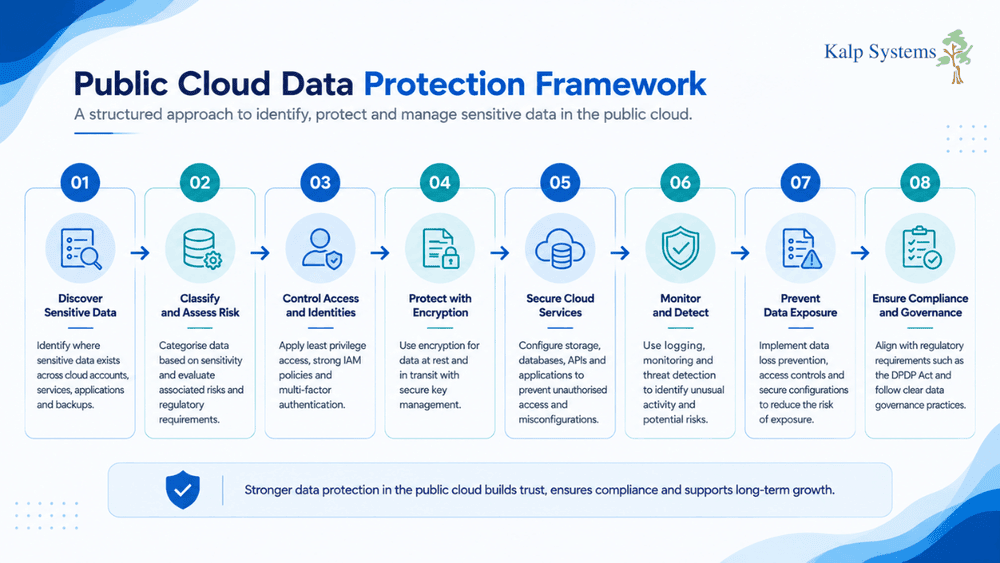
A practical approach starts with knowing what information exists in the cloud. From there, data can be classified according to its sensitivity and the level of protection it requires. Personal data subject to the DPDP Act, for example, may require different handling from information intended for public access.
Protection also depends on the controls surrounding that data. Encryption can protect information stored in databases, object storage, and backups. IAM policies determine which identities can access it. Secure API configurations help prevent unwanted access through applications and integrations. Logging and monitoring provide visibility into what happened when data was accessed.
These controls need to work together. Strong encryption cannot compensate for an account that has unnecessary permissions, and careful access control cannot prevent exposure caused by a publicly accessible storage resource. Effective public cloud data protection therefore requires attention to the data itself as well as the services and identities that interact with it.
Identifying and Classifying Sensitive Data
Sensitive information can be scattered across a public cloud environment. Customer records may sit in a database, while copies can appear in backups, object storage, application logs, or connected services. Finding these locations is an important part of protecting the information they contain.
Sensitive Data Discovery
Before deciding how to protect sensitive information, security teams need to know where it is stored. This can include databases, object storage, backups, applications, logs, and different cloud accounts.
The type of information also matters. Personal details, payment information, health records, credentials, authentication tokens, intellectual property, and confidential customer records may all require different levels of protection.
A regular review can reveal information that has been copied, left in an unexpected location, or retained after it is no longer needed. It can also show which systems and applications have access to the same records.
Data Classification and Risk Assessment
Not every piece of information carries the same level of risk. Public information may require little protection, while confidential customer records or regulated personal information need much tighter controls.
A practical classification system can include:
- Public: Information intended for anyone to access
- Internal: Information intended for authorised users
- Confidential: Information that requires controlled access
- Restricted: Highly sensitive information subject to strict access and regulatory requirements
Classification gives the security team a clearer basis for deciding how information should be stored and who should be allowed to access it. For information covered by the DPDP Act, the sensitivity and purpose of processing should also be considered when deciding the appropriate safeguards.
This makes it easier to focus stronger controls where the consequences of exposure would be higher, instead of treating every dataset in the same way.
Key Security Controls for Sensitive Data
Protecting sensitive information in a public cloud depends on several controls working together. Encryption protects the contents, access controls limit who can reach them, and the services holding the information need to be configured carefully.
Encryption and Key Management
Sensitive information stored in databases, object storage, and backups should use encryption at rest. Encryption should also protect information as it moves between users, applications, and cloud services.
Key management deserves the same attention. Encryption provides limited protection if the keys can be accessed too easily. Key rotation, restricted permissions, and appropriate cloud key management services can help keep control of those keys.
Identity and Access Controls
Access should be limited to the people, applications, and service accounts that actually need it. Broad permissions can leave sensitive records exposed when an account is compromised or misused.
Least privilege should therefore apply to both human and non-human identities. Privileged accounts should use multi-factor authentication, while access policies can take factors such as the user, device, location, and risk into account.
Regular access reviews also help remove permissions that are no longer required.
Securing Cloud Storage, Databases and APIs
Storage services need careful configuration because a simple public access setting can expose sensitive files. Public access should remain disabled unless there is a clear reason to allow it, with appropriate access policies applied to the resources.
Databases containing sensitive records should use suitable access controls and network restrictions. Applications connecting to those databases also need protection against vulnerabilities that could expose stored information.
APIs require similar attention. Authentication and authorisation should be enforced, while rate limiting and activity monitoring can help identify attempts to misuse an interface or retrieve information that should remain restricted.
Preventing Sensitive Data Exposure
Sensitive information can become exposed through a simple configuration mistake. A storage resource may be left publicly accessible; an access policy may grant broader permissions than intended, or a newly deployed service may bypass controls that were already in place.
Preventing Cloud Misconfigurations and Public Access
Cloud resources should be checked regularly for settings that could expose sensitive information. Public access to storage should remain disabled unless there is a specific requirement for it. Access policies should also be reviewed to make sure permissions match the actual needs of users and applications.
Configuration reviews can cover storage permissions, network access, identity policies, database settings, and other services that handle sensitive records. Automated checks can help identify changes that introduce exposure, particularly when cloud resources are created or modified frequently.
Data Loss Prevention and Continuous Monitoring
Data loss prevention tools can help identify sensitive information and flag activity that could result in inappropriate sharing, downloads, or transfers. Rules can be configured around the types of information that require closer control.
Monitoring provides another layer of visibility. Logs can record who accessed a resource, when the access occurred, which service was involved, and whether the request was allowed or denied. Unusual access patterns can then be investigated before they develop into a larger incident.
Regular monitoring also helps identify changes in cloud configurations and access permissions that may leave sensitive information exposed.
Shared Responsibility for Cloud Data Security
Public cloud security responsibilities are divided between the cloud provider and the customer. The provider manages the underlying infrastructure, while the customer remains responsible for how cloud services are configured and how sensitive information is handled.
Cloud providers typically take responsibility for areas such as physical data centres, hardware, core network infrastructure, and the availability of their services. The customer is responsible for areas such as access permissions, application configuration, encryption settings, key management, and the information stored within those services.
The exact division depends on the cloud service being used. Infrastructure, platform, and software services can place different responsibilities on the customer, so security teams should understand the model that applies to each service.
A clear understanding of these responsibilities helps prevent gaps in protection. A provider can secure the underlying infrastructure, for example, but it cannot decide which employees should have access to a particular database or whether a storage resource has been configured for public access.
Compliance and Data Governance
Sensitive information stored in the public cloud may fall under different legal, contractual, or industry requirements. The controls used to protect it should therefore reflect the type of information being handled and the requirements that apply to its use.
For Indian companies handling personal information, the Digital Personal Data Protection Act (DPDP Act) is an important consideration. The relevant requirements should be reflected in how personal information is collected, stored, accessed, shared, and protected.
Companies operating across jurisdictions may also need to consider requirements such as the GDPR, along with standards such as ISO 27001 and SOC 2, depending on their activities and contractual obligations.
Good data governance also requires clear ownership and supporting records. Access reviews, security logs, configuration records, and other evidence can help demonstrate that appropriate safeguards are in place when an audit or security review takes place.
Data Protection Requirements Under the DPDP Act
Public Cloud Data Protection in India should take the requirements of the Digital Personal Data Protection Act (DPDP Act) into account when personal information is collected, stored, accessed, shared, and protected in cloud services. Security measures should reflect the sensitivity of the information and the way it is processed.
Maintaining Compliance and Audit Evidence
Compliance also depends on being able to show that appropriate safeguards are in place. Access reviews, security logs, configuration records, security assessments, and other relevant records can provide evidence during audits or security reviews.
Clear data ownership also helps keep responsibilities defined. Teams should know who manages sensitive information, who can approve access, and which controls need regular review. This makes it easier to maintain consistent protection as cloud resources and access requirements change.
Public Cloud Data Protection Best Practices
A practical protection programme should focus on the controls that have the greatest effect on sensitive information. Key practices include:
- Identify sensitive information across cloud accounts, storage, databases, applications, and backups.
- Classify records according to their sensitivity and the level of protection they require.
- Apply least privilege so users, applications, and service accounts receive only the access they need.
- Encrypt sensitive information at rest and in transit, with appropriate controls for encryption keys.
- Keep public access disabled for storage and other resources unless there is a clear requirement.
- Review cloud configurations and access permissions regularly to catch unwanted changes.
- Protect APIs and integrations with strong authentication, authorisation, and activity monitoring.
- Use DLP controls where appropriate to detect and restrict unauthorised sharing or transfer.
- Maintain logs that show access to sensitive resources and review unusual activity.
- Keep security records and audit evidence that support applicable data protection and compliance requirements.
These practices provide a practical foundation for public cloud data protection. The exact controls will depend on the services in use, the type of information being handled, and the requirements that apply to it.
Conclusion
Sensitive information can move through several parts of a public cloud environment, and a security gap in any one of them can create an opportunity for exposure. That makes visibility and control important from the point where information enters a cloud service to the point where it is stored, accessed, or transferred.
The responsibility also extends beyond the cloud provider. The provider can secure the infrastructure, but access permissions, resource configurations, encryption settings, and the handling of sensitive information remain under the customer’s control.
A regular review of cloud resources, identities, permissions, and data flows can reveal problems before they become incidents. When those reviews are supported by appropriate technical safeguards and clear data governance, sensitive information has a stronger layer of protection throughout its cloud lifecycle.
Frequently Asked Questions
How do you protect sensitive data in public cloud environments?
First, find out where the information is stored and which accounts, applications, or services can reach it. From there, access can be restricted, sensitive records can be encrypted, and cloud resources can be checked regularly for unwanted exposure.
Is sensitive data safe in the public cloud?
The public cloud itself does not make sensitive information unsafe. The outcome depends largely on how the environment has been configured and managed. A storage service with open access, for example, can expose information even when the underlying cloud infrastructure is properly secured.
How can public cloud data exposure be prevented?
Public access should be disabled for resources that do not need it, and permissions should be reviewed when users or applications change. Storage settings, API access, network rules, and configuration changes also deserve regular checks. Activity logs can provide an early indication when something does not look right.
What are the key controls for public cloud data protection?
There is no single control that covers every situation. Encryption protects the contents; IAM controls access, secure configuration reduces exposure, and monitoring provides visibility into activity. Data classification and DLP can add further protection when sensitive records require tighter handling.
Who is responsible for protecting data in the public cloud?
The cloud provider and the customer have different responsibilities. The provider takes care of the underlying infrastructure, while the customer controls things such as permissions, configurations, applications, encryption settings, and the information placed in the cloud.