HomeBlogCyber Incidents and AttacksDPDP Act Compliance 2026: A Practical Guide for Ahmedabad MSMEs
DPDP Act Compliance 2026: A Practical Guide for Ahmedabad MSMEs

Overview
Personal data is already part of day-to-day business operations. A customer enquiry comes through the website. Employee details go into the payroll system. Sales teams maintain contact lists. Vendors may receive information through email, ERP systems or other business platforms.
For an MSME, these activities can add up over time. Data ends up in different places, sometimes across systems that have been used for years.
The DPDP Act brings greater attention to how businesses handle this information. Companies need to understand what personal data they collect, where it is stored, and how it is being used. Security also becomes an important part of the picture, particularly when business data is spread across websites, cloud platforms, databases, and internal systems.
This matters to Ahmedabad businesses as well. Manufacturing companies, logistics firms, service providers and technology businesses all rely on digital systems and may process personal data during their regular operations.
This guide covers the main areas businesses should consider while working towards DPDP Act compliance. We will look at common gaps, data and security practices, and practical steps that Ahmedabad MSMEs can take to review their current position.
What Is DPDP Act Compliance and Does It Apply to Your Business?
A lot of businesses already collect personal information as part of their normal work. With the growing focus on DPDP compliance in India, businesses also need to understand how this information is collected, used and handled.
Think about a small example. Someone fills out a contact form on your website. Your team receives their name, phone number and email address. The details may then be added to a CRM or shared with a sales employee. After that, the information may remain in the system even if the person never becomes a customer.
The same thing happens across many parts of a business. Employee records sit with HR or payroll teams. Customer information is stored in business software. Some data may also be shared with outside service providers.
The DPDP Act is relevant because businesses need to take responsibility for how such digital personal data is handled. Before looking at security tools or compliance processes, it helps to know what data the business actually has and who is involved in handling it.
Understanding Digital Personal Data and Data Fiduciaries
Personal data can be something as basic as a person’s name, phone number or email address when it relates to an identifiable individual. Businesses may collect this information through websites, enquiry forms, applications, customer registrations and internal systems.
Under the DPDP framework, the organisation that decides why personal data is being collected and how it will be processed is generally referred to as a Data Fiduciary.
For example, if a company collects customer details through its website and decides how those details will be used, the company has responsibilities regarding that data.
For an MSME, the practical starting point is simple: look at the systems the business uses and identify where personal information is being collected or stored.
Data Fiduciary and Data Processor Responsibilities
Businesses do not always handle every piece of data themselves.
A company may use a cloud provider, payroll company, CRM platform or another external service. These providers may process personal data for the business.
In simple terms, the Data Fiduciary decides the purpose of processing, while a Data Processor handles the data on behalf of the Data Fiduciary.
That is why third-party services should also be part of a business’s data review. If personal information moves from your systems to another provider, you should know where it is going and what role that provider plays in the process.
Key DPDP Act Compliance Requirements for MSMEs
Once a business knows what personal data it handles, the next question is what needs to be done with it.
There is no single document or software that makes a company compliant. Different parts of the business may need attention, depending on the type of data being collected and how it is used. For most MSMEs, the work usually starts with understanding their data and then reviewing the processes around it.
Data Mapping and Personal Data Management
Many businesses know they collect personal data but cannot immediately say where all of it is stored.
Customer details may be in a CRM. Employee information may sit in HR and payroll software. Older records may still be stored in spreadsheets or databases. There may also be copies in email accounts, cloud storage or backups.
Data mapping helps bring this information together. The purpose is to understand what personal data the business holds, where it came from, who can access it and where it moves.
Without this visibility, reviewing data practices becomes difficult. A business cannot properly assess a system it has forgotten about.
Notice and Consent Management
Businesses also need to look at how personal data is collected.
For example, a website form may ask for a name, phone number and email address. The person providing that information should receive clear information about why it is being collected and how it will be used.
Consent processes should also be reviewed. Businesses need to know what the person agreed to and keep their data practices aligned with the purpose for which the information was collected.
This is particularly relevant for businesses that collect leads through websites, mobile applications or digital marketing campaigns.
Reasonable Security Safeguards
Personal data can be exposed through many routes. An outdated server, weak passwords, an unpatched application or an insecure API can all create problems.
The security measures needed will depend on the systems and risks involved. For an MSME, this may include access controls, regular patching, backups, security monitoring and testing of internet-facing systems.
A security review should also consider older business applications. Legacy ERP systems and databases are often overlooked because they continue to work as expected, even though their security may not have been reviewed for a long time.
Data Breach Preparedness and Response
A business should also know what it will do if personal data is exposed or compromised.
During an incident, time is usually spent figuring out what happened, which systems were affected and who needs to take responsibility. Without a defined process, the response can become slow and unorganised.
An incident response plan can help assign responsibilities in advance. The business should know who investigates the incident, who manages containment and how the situation is escalated internally.
The Cost of DPDP Act Non-Compliance
The financial penalty is usually the first thing that gets attention when businesses discuss the DPDP Act. However, the impact of poor data practices can extend beyond a penalty.
A data breach can affect daily operations, customer relationships and business partnerships. For an MSME, dealing with an incident can also mean spending time and resources on investigations and remediation when the business should be focusing on its regular work.
Financial Penalties and Regulatory Risks
The DPDP Act provides for significant financial penalties for certain instances of non-compliance. The amount can depend on the nature of the violation and the requirements involved.
One of the most serious areas relates to the failure to take reasonable security safeguards that can prevent a personal data breach. The penalty framework under the Act includes penalties of up to ₹250 crore for certain breaches.
For a small or medium-sized business, the figures themselves show why data protection cannot be ignored. Businesses should understand their responsibilities and review their current practices before an incident exposes a gap.
Business, Operational and Reputational Impact
The effect of a data incident can continue after the technical issue has been fixed.
A business may need to investigate what happened, identify the affected data and take steps to contain the problem. Customers or business partners may also question how their information was being handled.
For Ahmedabad MSMEs that work with larger companies, data security can also become part of vendor and contractual requirements. A weak security posture may affect business relationships, especially when the company handles customer or partner information.
Common DPDP Compliance Gaps in Ahmedabad MSMEs
In many MSMEs, data protection issues do not usually come from one major mistake. They often develop over time.
A business adopts a new software tool, launches a customer portal or keeps using an older ERP system because it still supports daily operations. Meanwhile, personal data continues to move through these systems. Over time, it becomes difficult to keep track of every application, database and access point.
Some common gaps are seen in the following areas.
Legacy ERP Systems and Database Security Gaps
Many manufacturing and trading businesses still rely on ERP systems that have been in place for several years. These systems may contain customer information, employee records, vendor details and other business data.
The problem arises when security updates and regular assessments are overlooked. An old system may continue to work without showing any obvious issues, while vulnerabilities remain unaddressed.
Databases also need attention. Weak access controls, outdated software and poorly secured applications can increase the risk of unauthorised access. Businesses should know which systems hold personal data and review whether they are being properly maintained and secured.
Unsecured APIs and Digital Portals
Customer portals, mobile applications and online tracking systems have become common across many businesses. These platforms often connect with other applications through APIs.
If these connections are not properly secured, they can expose data or provide an entry point into internal systems. The issue can become difficult to spot when APIs are created for a specific project and are later forgotten.
Regular security testing can help identify weaknesses in web applications, APIs and internet-facing systems before they are exploited.
Poor Consent and Data Management Practices
Consent and data management can also become difficult when information is collected through different channels.
A business may have website forms, marketing campaigns, CRM systems and customer databases, each collecting information in a slightly different way. Without a clear process, it can be difficult to understand why certain data was collected and how it is currently being used.
Old records are another concern. Businesses sometimes continue to retain data simply because it already exists in their systems. Reviewing these practices helps organisations understand what information they hold and whether their current processes need improvement.
A Practical DPDP Act Compliance Roadmap for Ahmedabad MSMEs
For many MSMEs, the biggest challenge is deciding where to start. Trying to review everything at once can make compliance look more complicated than it needs to be.
A practical approach is to begin with the areas where personal data is already being handled and then work through the gaps step by step.
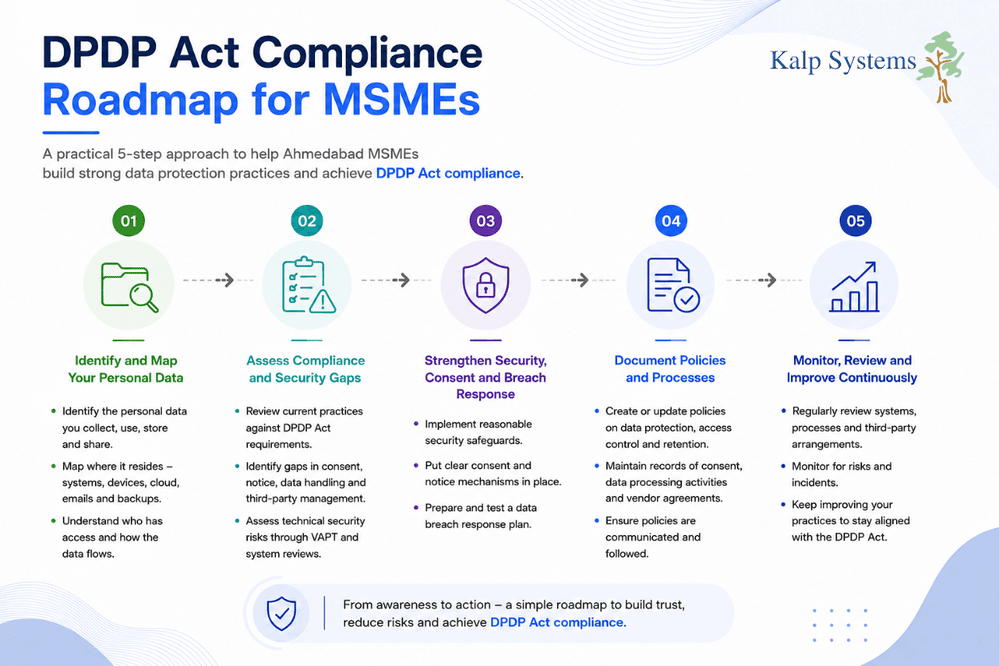
Identify and Map Your Personal Data
Start by finding out what personal data your business collects and where it is stored.
This may include customer details in a CRM, employee records in payroll software, information collected through website forms or data stored in ERP systems and cloud applications.
It is also worth checking older systems and databases. Sometimes data remains in applications that are no longer actively used but are still accessible.
The aim is to get a clear picture of the data your business holds and how it moves between systems.
Assess Compliance and Security Gaps
Once the data and systems are identified, the next step is to review the gaps.
Look at how personal data is collected, who has access to it and whether third parties are involved in processing it. Review existing consent processes and check whether important systems have appropriate security controls.
This review can also highlight technical issues. Older applications, exposed services, weak access controls or unpatched systems may need attention.
The purpose is not to fix everything in one day. It is to identify the areas that need action and address them based on the level of risk.
Strengthen Security, Consent and Breach Response
After identifying the gaps, businesses can start improving their processes.
This may involve strengthening access controls, patching vulnerable systems, reviewing how consent is collected or improving the security of applications and APIs.
Businesses should also have a clear process for dealing with a data incident. The relevant people should know what to do if personal data is exposed, which systems need to be checked and how the incident should be managed.
Working through these areas step by step can make DPDP compliance more manageable for an MSME.
Where Does VAPT Fit into DPDP Act Compliance?
VAPT is often discussed when businesses start looking at DPDP compliance. This makes sense because personal data is usually stored or processed through websites, applications, databases, ERP systems and other digital platforms.
If one of these systems has a security weakness, the data stored in it could be exposed.
VAPT, or Vulnerability Assessment and Penetration Testing, helps businesses check their systems for such weaknesses. It can be particularly useful when a company is unsure about the security of an older application, a customer portal or an internet-facing system.
Why VAPT Supports Reasonable Security Safeguards
A Vulnerability Assessment identifies security weaknesses that may exist in a system. Penetration Testing checks how those weaknesses could potentially be used to gain access.
During this process, businesses may find issues they were not aware of. This could include an unpatched application, weak access controls, an exposed service or an API that has not been properly secured.
The findings give the technical team something specific to work on. Instead of assuming that a system is secure, they can identify the issues and take action to fix them.
For MSMEs with older ERP systems, databases or web applications, this can be useful because some systems continue to run for years without a proper security assessment.
Why VAPT Alone Does Not Ensure DPDP Compliance
VAPT can tell you about security weaknesses. It cannot review every part of how your business handles personal data.
For example, a VAPT report will not tell you whether your business has an appropriate process for collecting consent. It will not show why certain personal data is being collected or whether information is being retained longer than necessary.
These areas need to be reviewed separately.
So, VAPT should be treated as part of the security work involved in protecting personal data. It is useful, but it does not replace the wider review of data handling, consent and other business processes.
DPDP Act Compliance Checklist for MSMEs
At this point, your business should have a clearer idea of what needs to be reviewed.
Start with the personal data you collect. Check where it is stored and which systems or third parties have access to it. Review how the data enters your business, including website forms, customer portals and other digital channels.
Look at the security of the systems that handle this information. Older applications, databases and internet-facing systems should not be left out. It is also important to review who can access personal data and whether there is a process for dealing with a security incident.
You should also look at how personal data is managed after collection. This includes the information provided to individuals, consent processes and the role of third-party service providers.
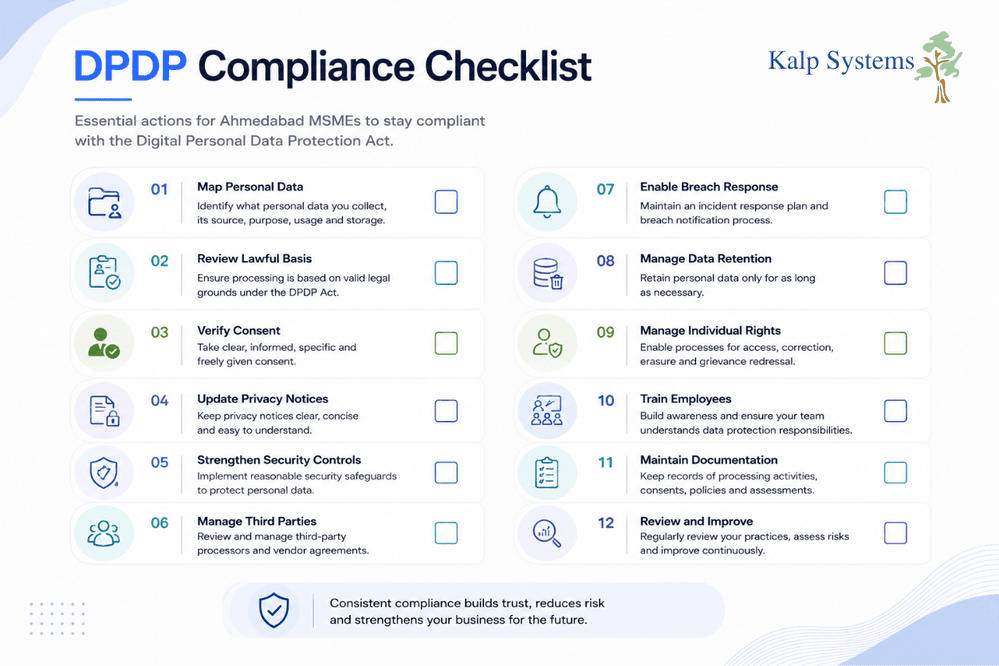
The following checklist brings these areas together and can help you review what has already been covered and what still needs attention.
Why DPDP Compliance Matters for Ahmedabad Businesses
Ahmedabad has a wide mix of businesses, from manufacturing and trading companies to logistics firms, technology companies and service providers. As more of these businesses depend on digital systems to manage customers, employees, vendors and day-to-day operations, DPDP Act compliance in Ahmedabad has become an important area to consider.
As a business grows, more systems are usually added. A CRM may be used for customer details, an ERP for operations and separate software for HR or payroll. Data may also be shared with vendors, cloud providers and other service partners.
This makes it important to understand how personal data moves across the business.
For companies working with larger organisations, data security can also affect business relationships. Clients may want to know how their vendors protect information and what security practices are in place.
Taking time to review data handling and security can therefore help businesses identify gaps before they become a bigger problem.
Conclusion
DPDP compliance can seem like a large task, especially for an MSME that already uses several systems and applications. The best place to start is with the basics.
Find out what personal data your business holds. Check where it is stored and who has access to it. Review the systems that process the data and look for gaps in security or existing processes.
The work may not happen all at once. Some businesses may first need to review older databases or applications. Others may need to look more closely at consent, access controls or their response to a data breach.
What matters is knowing where the gaps are and taking action on them.
For Ahmedabad businesses and other Gujarat MSMEs, this can be a useful time to review both data handling and cybersecurity practices. The systems that support everyday business operations also need to be considered when personal data is involved.
Frequently Asked Questions
Does the DPDP Act apply to small businesses in Ahmedabad?
The size of a business does not automatically decide whether the DPDP Act is relevant. If a business handles digital personal data, it should understand the requirements that apply to its activities. for a small business, this may include information collected through website forms, customer databases, employee records or other digital systems.
What are the main DPDP Act compliance requirements for MSMEs?
The requirements will depend on how a business handles personal data. Some of the main areas include understanding what personal data is being processed, reviewing how it is collected, managing consent, protecting the systems involved and preparing for possible data breaches. businesses may also need to consider third party service providers that process data on their behalf.
What is the difference between a Data Fiduciary and a Data Processor?
A Data Fiduciary decides the purpose and means of processing personal data. A Data Processor processes personal data on behalf of the Data Fiduciary. for example, a business may use an external payroll provider to process employee information. The payroll provider may act as a Data Processor for that activity.
Is VAPT enough for DPDP Act compliance?
No. VAPT focuses on identifying security weaknesses in systems and applications. It can help businesses improve the security of systems that handle personal data. however, DPDP compliance also involves other areas, such as data handling, consent and business processes. A VAPT alone cannot cover all of these areas.
What should a business do if a data breach occurs?
The first step is to understand what happened and contain the incident. The business should identify the affected systems and determine whether personal data has been involved. having an incident response process in place can make this easier. The relevant team members should know their responsibilities and the steps to follow when an incident occurs.