HomeBlogNetwork SecurityNetwork Security Beyond Firewalls: Rethinking Modern Network Defence
Network Security Beyond Firewalls: Rethinking Modern Network Defence

Why Firewalls Alone are No Longer Enough
Firewalls have traditionally been placed at the network perimeter to control traffic entering and leaving an environment. They can restrict connections based on defined rules and help prevent unauthorised access to protected systems.
The difficulty comes from how network environments are now structured. Cloud workloads, remote users, SaaS applications, APIs and third-party connections can sit outside the traditional perimeter. Users may access applications from different locations, while workloads communicate across on-premises infrastructure and cloud platforms.
This creates security gaps that a perimeter firewall cannot address by itself. A compromised account, for example, may give an attacker legitimate access to an application without triggering a traditional perimeter control. A compromised endpoint can create another route into internal resources, while excessive permissions can allow access to systems that the user does not actually need.
Encrypted traffic also creates visibility challenges. Security teams may have limited insight into what is happening within an encrypted session unless additional inspection and monitoring controls are in place. Similarly, a firewall focused on north-south traffic may have limited ability to identify suspicious activity moving between internal systems.
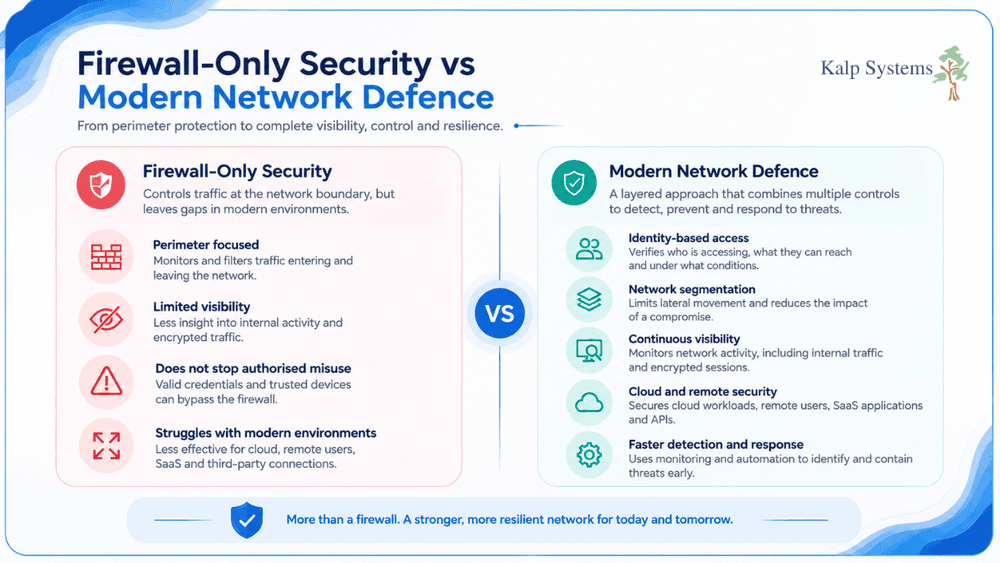
The issue is therefore not the firewall itself. It is the assumption that one perimeter control can provide sufficient protection for an environment with multiple users, devices, applications and connections. Network security needs controls that can work together across these different layers.
How Attackers Bypass Firewall-Based Defences
A firewall can control traffic at the network boundary, but that does not mean every attack has to pass through that boundary. An attacker who obtains valid credentials, finds an exposed service or gains control of a trusted device may already have a way into the environment.
Credential-Based Attacks
Compromised credentials can give an attacker access without requiring them to defeat a firewall. If a username and password are valid, the connection may appear legitimate from the network’s point of view.
The level of access attached to the account then becomes important. An account with access to several applications or internal systems gives an attacker more room to operate after the initial compromise. Multi-factor authentication and least-privilege access can reduce this risk by adding another verification step and limiting what an account can reach.
Misconfigurations and Exposed Services
Misconfiguration is another common source of exposure. A cloud security group may allow more traffic than required; a service may be left accessible from the internet, or a firewall rule may remain in place after it is no longer needed.
These issues can be difficult to spot when infrastructure changes frequently. Cloud resources, applications and network controls may also be managed separately, leaving gaps between them. Regular configuration reviews and security assessments can help identify unnecessary exposure.
Trusted Services and Lateral Movement
An attacker who gets inside the environment may use tools that are already trusted there. PowerShell, remote administration software and cloud APIs can all have legitimate purposes, so their presence alone does not indicate malicious activity.
The bigger concern is what happens after the first system is compromised. If internal connections are broadly permitted, an attacker may move from one system to another and gradually gain access to more resources. Network segmentation and microsegmentation can restrict those paths, while network monitoring can help identify unusual movements.
What Modern Network Security Needs Beyond Firewalls
A firewall still has a place in the security setup, particularly at points where network traffic needs to be controlled. The gap appears when it is expected to handle access decisions, internal movement and activity across cloud environments as well.
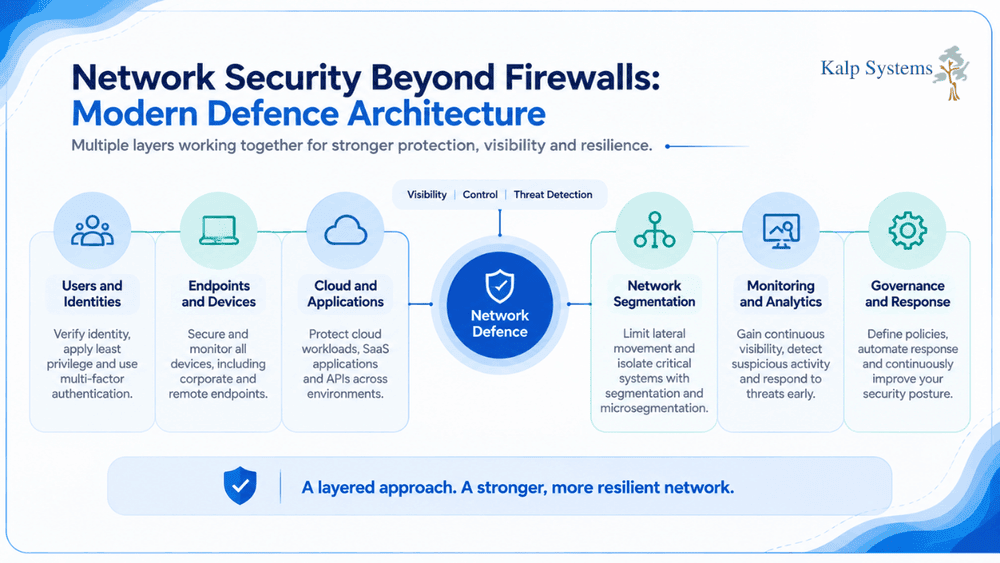
A stronger approach brings several controls together. Each one deals with a different part of the network and, more importantly, gives security teams a better view of what is happening after a connection has been allowed.
Zero-Trust and Identity-Based Access
Zero-Trust starts with a simple question: who is requesting access, what are they trying to reach, and should they be allowed to do it?
A user being connected to the internal network does not automatically make every application available to them. Access can be checked using identity, device condition, location and other relevant risk signals.
This is particularly useful when staff work remotely, or applications are hosted across different environments. The access decision can follow the user and the resource instead of depending entirely on where the connection originates.
Network Segmentation and Microsegmentation
A flat network gives an attacker more room to move after gaining access to one system. Segmentation reduces that room by separating systems and controlling which parts of the environment can communicate.
Microsegmentation takes this further by applying more specific rules between individual workloads, applications or services. For example, a compromised application server should not automatically be able to communicate with a database or administrative system simply because both sit on the same internal network.
The value of segmentation becomes clearer during an incident. If an attacker does get through one layer, restricted connections can prevent the compromise from spreading easily.
Continuous Network Visibility and Monitoring
Security teams also need to see what is happening across the network after access has been granted. Traffic patterns, connections between systems and unusual account activity can provide useful clues when something is wrong.
Network monitoring can help identify behaviour that a basic firewall rule would not necessarily flag. A sudden connection between systems that rarely communicate, unusual data movement or unexpected activity from a normally quiet account may warrant investigation.
This is where network visibility becomes important. The more complete the view of users, devices and connections, the easier it is to spot activity that does not fit the normal pattern.
Securing Cloud and Distributed Networks
Network security becomes harder to manage when applications and data are spread across cloud platforms, on-premises systems and remote locations. A user may connect from outside the office, while an application communicates with a service hosted in another environment.
The security controls need to work across those connections rather than stopping at the edge of the traditional network.
Hybrid and Multi-Cloud Security
Hybrid and multi-cloud environments can have different security settings, access policies and monitoring tools. A control applied to one environment may not cover another.
Consistent access policies, secure connections between workloads and regular reviews of cloud configurations help reduce these gaps. It is also important to monitor traffic between cloud resources, since an attacker who gains access to one workload may try to reach another.
Cloud security posture management can support this work by identifying configuration issues and helping security teams keep track of security settings across cloud resources.
Remote Users, SaaS and API Security
Remote access has changed how users connect to applications. Staff may work from home or while travelling, and SaaS platforms and external services can exchange data through APIs.
These connections need their own access controls and monitoring. Identity verification, appropriate permissions and secure authentication help control who can use an application or service. API activity also needs attention because an exposed or poorly secured interface can provide access to data and functions that were never intended to be public.
The result is a network that needs to be treated as a collection of connected environments rather than a single perimeter.
Building a Layered Network Defence Strategy
A layered approach brings the different controls together instead of treating each one as a separate task. The starting point should be the systems, users and connections that carry the greatest risk.
Identity controls can restrict who gets access. Segmentation can limit where access can lead. Network and endpoint monitoring can provide the visibility needed to spot unusual activity. Cloud controls add another layer where workloads and applications sit outside the traditional network.
Integrating Identity, Endpoint and Network Controls
These controls work better when they share relevant security information. A login from an unfamiliar device, for example, may look less concerning on its own. When combined with unusual network activity or an unexpected attempt to access a sensitive application, it gives security teams a clearer reason to investigate.
Access should also match what a user actually needs. Administrative accounts, service accounts and ordinary user accounts should not all have the same level of access. Reducing unnecessary permissions limits the damage when an account or device is compromised.
Automation and Threat Response
Security teams can receive a large number of alerts across networks, endpoints, and cloud systems. Reviewing each one manually can slow down the response, particularly when several events are connected to the same incident.
Automation can help bring related events together, flag activity that needs attention and trigger predefined actions where appropriate. For higher-risk incidents, automated containment can restrict a suspicious connection or account while the security team investigates.
The aim is to make the different controls work as one security process, with enough visibility to detect a problem and enough control to contain it quickly.
Why Modern Network Defence Matters for Indian Companies
Indian companies are operating across a wider mix of cloud services, remote access, connected applications and third-party platforms. This makes network security in India relevant well beyond the office perimeter.
A weakness in one part of the environment can affect systems elsewhere. A compromised account may expose sensitive applications, while poor access controls or an exposed service can give an attacker a starting point for further activity.
There is also a regulatory consideration. The Digital Personal Data Protection Act places responsibilities around protecting personal data and maintaining appropriate safeguards. Network security forms part of the wider technical measures used to protect that data, alongside access controls, monitoring and other security practices.
A network defence strategy should therefore take account of the actual environment; the information being protected and the ways users and systems connect to it. For Indian companies, this means looking at perimeter controls alongside identity, segmentation, cloud security and continuous monitoring.
Real Incident Example: Microsoft Ransomware Incident
A useful, documented case is a Microsoft Incident Response ransomware case study. Attackers initially gained access through an internet-exposed RDP service and then moved beyond the perimeter by stealing credentials, performing network discovery and using legitimate remote access mechanisms for lateral movement. Microsoft documented the use of credential harvesting techniques and RDP sessions to move between systems.
The key takeaway from this example is:
A firewall can control what enters and leaves the network, but it cannot, by itself, determine whether an authenticated user, compromised endpoint or legitimate administrative connection is behaving maliciously inside the network.
How Kalp Systems Supports Modern Network Defence
Kalp Systems helps companies review and strengthen network security across their infrastructure. The work starts with understanding where access is currently allowed, how systems communicate and where gaps may exist.
Our approach can include:
- Assessing the existing network security posture and identifying gaps
- Designing Zero-Trust-aligned network architectures
- Implementing network segmentation and secure access controls
- Improving network visibility and threat detection
- Reviewing cloud and network security controls
- Aligning security measures with relevant regulatory requirements
The focus is on bringing these controls together rather than relying on a single layer of protection. This helps create a network security framework that can adapt as infrastructure, applications and access requirements change.
Conclusion
Firewalls remain an important part of network security, but they cannot address every access path in a distributed environment. Cloud workloads, remote users, connected applications and compromised credentials create risks that sit beyond the traditional perimeter.
A stronger network defence combines firewall controls with identity-based access, Zero-Trust, segmentation, monitoring and cloud security measures. These controls work together to limit unnecessary access, restrict lateral movement and give security teams better visibility into activity across the environment.
The goal is not to remove firewalls. It is to place them within a wider security framework that reflects how networks actually operate today.
Frequently Asked Questions
Are Firewalls Still Necessary for Network Security?
Yes. A firewall is still useful for controlling network traffic and restricting unwanted connections. If an attacker gets in through a stolen account, compromised device or exposed service, however, the firewall may not be enough to stop what happens next.
What Can Protect a Network Beyond a Firewall?
A firewall cannot fully control user identity, device security, access permissions or activity between internal systems. Zero–Trust, multi-factor authentication, network segmentation, endpoint security and network monitoring can help address these areas.
How does Zero-Trust Improve Network Security Beyond Traditional Firewalls?
A user inside the network does not automatically give them access to everything. Zero–Trust checks the access request and applies controls based on factors such as identity, device and the resource being requested. This can be useful when users work remotely or applications are spread across cloud environments.
How do Network Segmentation and Microsegmentation Reduce Security Risks?
They put limits on how systems can communicate with each other. If an attacker gains access to one server, segmentation can prevent that server from freely reaching other parts of the network. Microsegmentation allows those controls to be applied more closely around individual applications and workloads.
What is a Layered Network Defence Strategy?
It is a security approach where different controls cover different parts of the environment. A firewall can control network traffic, identity controls can manage access, segmentation can restrict movement, and monitoring can help spot suspicious activity. No single control has to carry the entire load.