HomeBlogNetwork SecurityNetwork Visibility: Components, Challenges, and Best Practices
Network Visibility: Components, Challenges, and Best Practices

What is Network Visibility and How does it Work
Network visibility means having a clear view of what is happening across a network. This includes the traffic moving between systems, the devices connected to the environment, user activity, applications, cloud workloads, and connections with external parties.
Security teams use this information to understand how the network normally behaves and to notice activity that looks unusual. For example, an employee account suddenly accessing an unfamiliar server, a device communicating with systems it has never contacted before, or an unexpected transfer of data can raise questions that would be difficult to answer without sufficient visibility.
The information can come from different sources, including network traffic, device and endpoint activity, authentication records, application logs, and cloud environments. Looking at these sources together gives the security team more context when something unusual occurs.
This matters during an investigation. Seeing that a connection took place is useful, but knowing who made the connection, which device was involved, what system was accessed, and whether the activity matches normal behaviour gives the security team a much clearer picture of what may be happening.
That is why network visibility plays an important role in security monitoring. It helps teams see activity across different parts of the environment and provides the context needed to investigate suspicious events.
Why Network Visibility Matters for Network Security
A security team can only investigate activity it can see. When parts of the network are missing from monitoring, suspicious behaviour may continue without drawing attention. This becomes harder to manage as traffic moves between offices, cloud services, remote users, applications, and third-party systems.
Good network visibility gives security teams the context needed to spot unusual activity and investigate it while there is still time to act.
Threat Detection and Incident Response
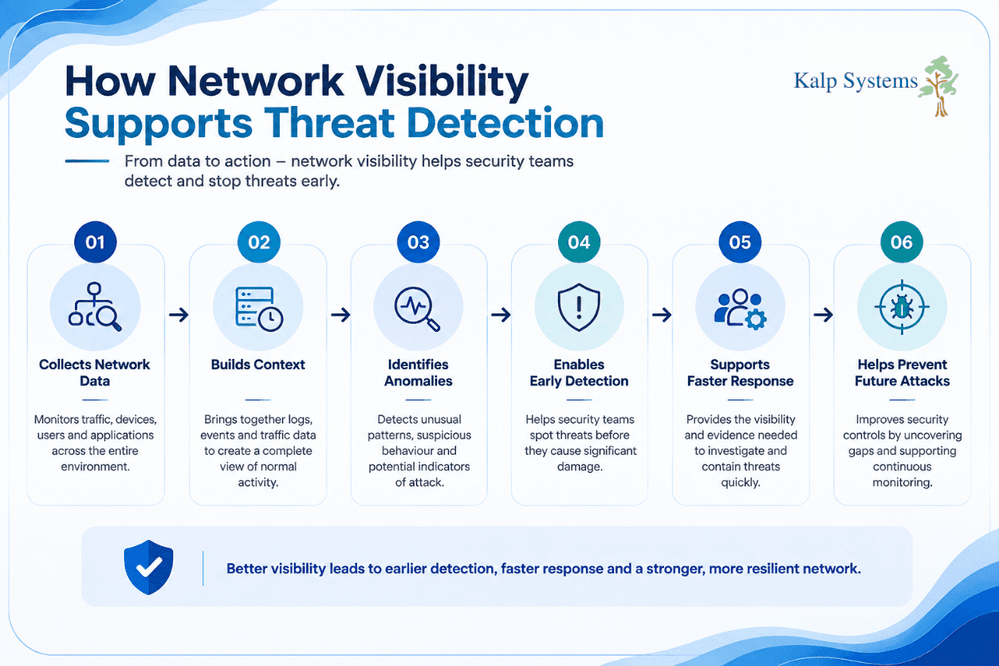
Attackers do not always trigger an obvious security alert when they enter a network. They may use valid credentials, communicate with internal systems, or move between devices in ways that initially resemble normal activity.
Network visibility helps security teams notice these changes by showing traffic patterns, access activity, device communication, and other signals together. An unusual connection or unexpected data transfer may then become easier to investigate.
The same information is useful during incident response. Once suspicious activity has been identified, security teams can use network records to trace affected systems, understand how an attacker moved through the environment, and determine where containment is needed.
Identifying Network Blind Spots and Vulnerabilities
A network blind spot is an area where security teams have little or no useful visibility into activity. Unknown devices, unmanaged endpoints, poorly monitored cloud services, remote connections, and gaps between security tools can all create these conditions.
Blind spots can make it difficult to identify unauthorised access or unusual communication. Regular visibility checks help teams find these gaps and determine whether important systems, traffic paths, or user activities are missing from their monitoring.
Security Monitoring and Compliance
Network visibility also supports routine security monitoring. Centralised traffic and event information makes it easier to review access activity, investigate unusual behaviour, and maintain records needed for security investigations.
For businesses operating in India, visibility can also support compliance activities by providing evidence of access, monitoring, security events, and incident handling. The exact requirements depend on the applicable regulatory or contractual framework, but reliable records can make audits and investigations easier to manage.
Key Components of Network Visibility
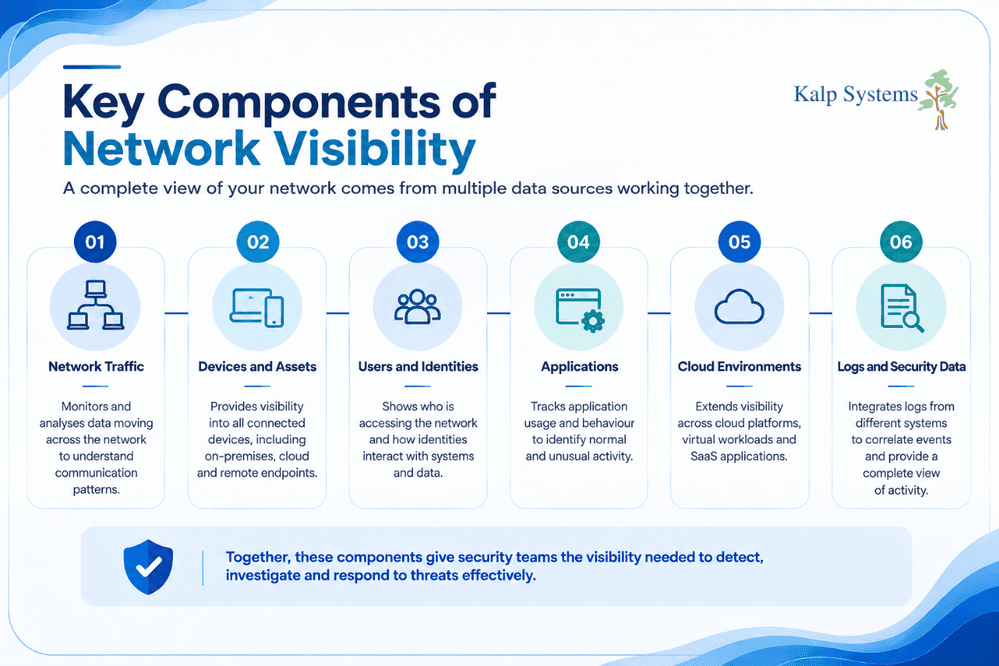
Network visibility depends on seeing activity from different parts of the environment. Network traffic is one part of that picture, but it also includes connected devices, users, applications, cloud workloads, and the logs generated by these systems.
Network Traffic Monitoring and Analysis
Network traffic shows how systems communicate with one another. By analysing network flows and communication patterns, security teams can identify unusual connections, suspicious activity, and unauthorised data transfers.
Traffic analysis also helps establish what normal activity looks like within the environment. Once that baseline is known, changes such as unexpected communication between systems or unusual volumes of data can be investigated more closely.
Asset, Device, and Identity Visibility
Security teams need to know which devices and systems are connected to the network. Unknown or unmanaged assets can create gaps in monitoring and make it harder to determine what is happening when an incident occurs.
User identity adds another important layer. Connecting network activity with user accounts helps show who accessed a system, what they accessed, and whether the activity was expected. This can be particularly useful when investigating compromised credentials or inappropriate use of privileged access.
Log Collection and Event Correlation
Useful network information is often spread across different systems. Firewalls, servers, endpoints, applications, and authentication systems can each generate their own logs.
Bringing these records together makes it easier to connect to related events. A failed login, followed by unusual internal communication and an unexpected data transfer, may look insignificant when viewed separately. When correlated, the same events can provide a clearer indication of suspicious activity.
Cloud, Application, and Hybrid Network Visibility
Cloud services and hybrid environments have added more places for network activity to occur. Traffic may move between on-premises systems, cloud workloads, applications, remote users, and third-party services.
Visibility therefore needs to extend beyond the traditional network perimeter. Cloud workloads, application traffic, APIs, and remote connections should also be considered when reviewing where monitoring is available and where gaps may exist.
How Attackers Exploit Network Visibility Gaps
Attackers actively seek environments where monitoring is limited or fragmented. A gap in visibility can give an attacker room to move between systems, communicate with compromised infrastructure, or access sensitive resources without immediately attracting attention. The problem becomes harder to manage when activity is spread across premises infrastructure, cloud platforms, remote connections, and third-party services.
A security team may have monitoring in place and still miss important activity if the available data does not provide enough context. An unusual connection, for example, may look harmless when viewed on its own. When it is linked with an unfamiliar device, unexpected account activity, or an unusual transfer of data, the same event can tell a very different story.
Encrypted Traffic and Hidden Malicious Activity
Encryption protects sensitive information as it moves across a network, but it can also make traffic harder to inspect. Attackers can use encrypted sessions to conceal malicious communications, command-and-control activity, or data movement within traffic that otherwise appears legitimate.
This does not mean that encrypted traffic should simply be treated as suspicious. Security teams need to look at the information that remains available, such as connection metadata, traffic patterns, timing, destination, volume, and the behaviour of the systems involved. A sudden connection from an internal device to an unfamiliar external destination, particularly when it differs from the device’s normal activity, may warrant further investigation.
Without sufficient visibility into these patterns, malicious activity can blend into legitimate encrypted communication. This is particularly relevant in environments where applications, cloud services, remote users, and external platforms generate large amounts of encrypted traffic.
Lateral Movement across Internal Networks
Once initial access is gained, an attacker may try to move through the internal environment rather than immediately target the system where access was obtained. The attacker may look for additional accounts, servers, applications, or data that can help them reach a more valuable target.
Limited internal traffic visibility makes this movement harder to identify. Communication between internal systems can appear routine, especially when legitimate administrative tools and valid credentials are being used. An attacker who understands the environment can take advantage of this normal activity to avoid drawing attention.
Monitoring internal connections gives security teams more information about how systems communicate and whether those relationships are expected. Changes in communication patterns, access to unfamiliar systems, or unusual activity involving privileged accounts can provide useful clues during an investigation.
Cloud and Remote Access Blind Spots
Cloud services and remote access have changed where network activity takes place. Users may connect from outside the traditional office network, while applications and workloads can operate across on-premises infrastructure, private cloud environments, public cloud platforms, and third-party services.
This creates additional areas where visibility can become fragmented. Misconfigured cloud services, exposed APIs, excessive permissions, unmanaged remote connections, and unusual access to cloud resources may go unnoticed when monitoring is limited to the traditional network.
A useful visibility strategy therefore needs to account for activity across these environments. Security teams should be able to understand how users, devices, applications, and cloud resources interact, particularly when sensitive systems or data are involved.
Common Network Visibility Challenges
Building network visibility can become difficult when the IT environment has grown over time without a common monitoring approach. Different teams may use different security tools; older infrastructure may still be in place, and cloud or remote access may introduce systems that are monitored separately. These conditions can leave security teams with pieces of information that are useful individually but difficult to connect during an investigation.
Disconnected Security Tools
A typical security environment can include firewalls, endpoint security, identity systems, cloud security controls, SIEM platforms, and other monitoring tools. When these solutions operate independently, each one provides only part of the picture.
This can make it harder to recognise an attack that moves across several systems. An endpoint alert may show unusual activity on a device, while a firewall records an external connection, and an identity system records an unusual login. If these events cannot be viewed together, the relationship between them may be missed.
Bringing relevant security data into a connected monitoring process gives analysts more context. It also reduces the time spent moving between separate tools while investigating an incident.
Legacy Infrastructure and Hybrid Environments
Older network infrastructure can create visibility problems because it may not support the same monitoring capabilities available in newer systems. Some devices may provide limited logging, while older applications can be difficult to integrate with current security tools.
Hybrid environments add another layer of complexity. Traffic and workloads may be spread across premises systems, cloud platforms, branch locations, and remote users. Monitoring each area separately can leave gaps between environments.
A visibility strategy therefore needs to account for the systems already in use rather than assuming that every part of the environment can be monitored in the same way.
Resource and Skills Constraints
Network data can become difficult to manage when security teams receive more alerts and events than they can reasonably investigate. Collecting additional information does not automatically make investigations easier if there are not enough people with the skills and time to interpret it.
Security teams need to determine which data is useful, establish what normal activity looks like, and focus attention on events that could indicate genuine risk. Clear processes also matter. Without them, valuable network information can remain unused or receive attention only after an incident has already occurred.
Best Practices for Effective Network Visibility
A useful visibility programme starts with knowing what is already connected and how those systems normally communicate. From there, security teams can decide which activity needs closer attention and where additional monitoring is required. The focus should remain on information that can support detection and investigation rather than collecting network data without a clear purpose.
Establish a Complete Network Baseline
Start by mapping the network and identifying the systems, devices, applications, users, and connections that need to be monitored. This provides a reference point for normal activity.
A baseline should reflect how the environment actually operates. For example, a database server may regularly communicate with a specific application server, while a user workstation may have a much smaller set of expected connections. Changes to these patterns can be easier to recognise when normal behaviour has already been documented.
The baseline should also be reviewed when infrastructure changes, new applications are introduced, or working arrangements change.
Centralise Monitoring and Correlation
Visibility becomes more useful when relevant information from different security controls can be reviewed together. Network traffic, endpoint events, authentication records, firewall logs, and cloud activity can each contribute information during an investigation.
Centralising this data makes it easier to connect events that occur across different systems. It also gives analysts a more consistent view when they are trying to understand whether several seemingly unrelated events are part of the same incident.
Prioritise Actionable Security Insights
Security teams can quickly become overwhelmed when every network event is treated as equally important. The aim should be to identify activity that needs investigation and provide enough context for an analyst to decide what to do next.
Useful alerts should answer practical questions such as which account or device was involved, what resource was accessed, where the connection originated, and whether the activity differs from the expected pattern. This makes network data more useful during day-to-day monitoring and incident investigations.
Integrate Visibility with Incident Response
Network visibility should form part of the incident response process rather than sitting separately from it. When a security incident occurs, traffic records, access logs, endpoint information, and other network data can help establish what happened and which systems may have been affected.
This information can support containment by helping teams identify suspicious connections and potentially compromised systems. It can also be useful during eradication and recovery, particularly when checking whether unusual activity has stopped after corrective action.
Continuously Review Visibility Gaps
Networks change regularly. New devices, applications, cloud services, remote connections, and third-party integrations can alter the way systems communicate.
For this reason, visibility should be reviewed as the environment changes. Security teams can periodically check whether important assets are being monitored, whether new traffic paths have appeared, and whether existing controls still provide the information needed for detection and investigation.
Network Visibility and Zero-Trust
Zero-Trust depends on continuous checks of users, devices, and access rather than assuming that activity inside the network is safe. Network visibility provides the information needed to make those checks meaningful.
With visibility across users, devices, applications, and network traffic, security teams can see how access is being used and identify activity that falls outside expected patterns. This is particularly useful when employees connect remotely; applications run across cloud and premises environments, or third-party services interact with internal systems.
Network visibility can support Zero-Trust by helping teams:
- Monitor access activity beyond the initial login
- Identify unauthorised or unusual connections
- Understand device and user behaviour
- Detect the misuse of valid credentials
- Review whether access patterns match established policies
- Investigate activity that may indicate a compromised account or device
This connection also works in the other direction. Zero-Trust policies determine who should have access to a resource and under what conditions, while visibility provides the information needed to see whether those conditions are being followed. Together, they give security teams a clearer way to monitor access and respond when behaviour changes.
Network Visibility for Regulatory Compliance in India
Network visibility can support compliance by giving security teams records of access, network activity, security events, and data movement. These records can become useful when a business needs to review how sensitive information is accessed or investigate a security incident.
Compliance requirements in India vary depending on the nature of the enterprise, the information being handled, and the applicable regulatory or contractual frameworks. Network visibility in India can support these requirements by providing useful records of access, network activity, security events, and data movement. Network visibility does not by itself make a business compliant, but it can provide supporting evidence for security controls and internal reviews.
It can help with:
- Tracking access to sensitive data: Network and access records can show when systems or resources are accessed and help identify unusual activity.
- Detecting unauthorised data transfers: Unexpected transfers can be investigated using traffic information and related security events.
- Supporting audits and investigations: Centralised records give security and audit teams information they can refer to when reviewing security controls or investigating an incident.
- Maintaining incident records: Network logs and related events can help establish what happened, which systems were involved, and what actions were taken.
- Reviewing control effectiveness: Regular monitoring can show whether security controls are working as expected and where visibility gaps remain.
For compliance teams, the practical value of network visibility lies in having reliable records that can support security reviews, investigations, and evidence gathering when required.
Kalp Systems Approach to Network Visibility
Kalp Systems approaches network visibility as part of a broader security and monitoring process. The focus is on helping security teams gain useful insight across different parts of the IT environment, rather than relying on visibility from a single security tool.
The approach can include:
- Visibility across network environments: Monitoring activity across premises infrastructure, cloud environments, endpoints, and connected systems.
- Integration with security operations: Connecting network visibility with SOC and threat detection processes so suspicious activity can be investigated with greater context.
- Alignment with business and compliance needs: Considering the security, operational, and regulatory requirements relevant to the business.
- Practical implementation: Adapting visibility measures to the existing infrastructure, security controls, and monitoring capabilities.
- Continuous monitoring and improvement: Reviewing network activity and visibility gaps regularly as systems, users, applications, and connections change.
The objective is to turn network data into information that security teams can use during monitoring, investigation, and incident response. By combining technology, security expertise, and defined processes, Kalp Systems helps businesses build a clearer view of network activity and identify areas where additional monitoring may be required.
Conclusion
Network visibility gives security teams a clearer picture of what is happening across their environment. It helps them see how users, devices, applications, and systems communicate, making unusual activity easier to spot and investigate.
The challenge is that networks keep changing. Cloud services, remote access, new applications, third-party connections, and older infrastructure can all create gaps in monitoring. These gaps can make it harder to understand an incident or determine how far suspicious activity has spread.
A practical network visibility strategy should therefore cover the areas that matter most to the business, connect relevant security data, and be reviewed as the environment changes. When visibility is part of regular security monitoring and incident response, teams have better information to work with when something goes wrong.
Frequently Asked Questions
What is Network Visibility in Cyber Security?
Network visibility means having a clear view of what is happening across the network. This includes communication between devices and systems, user activity, application traffic, and connections to external or cloud services. Without this information, it can be difficult to tell whether unusual activity is part of normal network behaviour or something that needs investigation.
Why is Network Visibility Important?
Security teams need visibility to investigate activity across the network. If a device connects to an unfamiliar system, a user accesses something they normally do not, or a large amount of data is transferred unexpectedly; the surrounding network activity can help explain what happened. This information is also useful when responding to a security incident.
What are the Main Components of Network Visibility?
Network traffic monitoring is one part of it, but there are several others. A useful setup should provide information about connected devices, users and identities, applications, cloud environments, and security logs. Bringing these sources together helps teams see the relationship between events instead of investigating each event separately.
How does Network Visibility Improve Threat Detection?
It gives security teams more information to work with when something looks unusual. For example, an unexpected login may not mean much on its own. If it is followed by unusual internal connections or an unexpected data transfer, the combined activity may provide a stronger reason to investigate. This context can help teams identify threats earlier.
What are Common Network Visibility Challenges?
Visibility can become difficult when security tools are disconnected; older systems provide limited monitoring information, or network activity is spread across cloud platforms, remote users, and third-party services. Limited security resources can make the problem harder because collecting network data is only useful when someone has the time and expertise to review it.