HomeBlogApplication SecurityHow to Secure Legacy Applications Without Rewriting Them
How to Secure Legacy Applications Without Rewriting Them
Why Legacy Applications Still Need Modern Security
Legacy applications continue to run the core operations of many businesses across banking, manufacturing, healthcare, aviation, and government sectors. While these systems are critical for business continuity, they also represent one of the largest and most overlooked security risks in modern digital environments.
Most of these applications were built before the current threat landscape emerged. Security expectations have changed considerably since then, but the applications themselves often remain in place because they still support important business processes. Rewriting or replacing them can mean dealing with high costs, complicated dependencies, lengthy migration projects, and the possibility of disrupting operations.
Why Businesses Still Depend on Legacy Applications
A legacy application may have been around for years, but that does not mean the business can simply switch it off. It may handle a core business process, connect to several other systems, or contain business logic that is difficult to reproduce elsewhere.
Some common characteristics of legacy applications include:
- Outdated programming languages or frameworks
- Hard-coded authentication and authorisation logic
- Limited or no encryption for data at rest or in transit
- Poor documentation and limited dependency visibility
- Tight coupling with business workflows and third-party systems
These dependencies are one reason a complete rewrite is not always the first step a business should take. The application may need to remain operational while a longer-term modernisation or replacement plan is considered.
Common Security Risks in Legacy Applications
The security problems usually become more difficult to manage when an older application has to work with newer systems. A legacy application that was originally designed for a controlled internal environment may now be connected to cloud platforms, mobile applications, APIs, remote users, or external networks.
Some of the common risks include:
- Unpatched vulnerabilities in unsupported software components
- Weak authentication mechanisms and limited support for multi factor authentication
- Insecure APIs exposed through newer integrations
- Limited logging and monitoring capabilities
- Poor visibility into application dependencies
- Difficulty protecting sensitive data with newer security controls
- Gaps in meeting current security and compliance requirements
That does not mean every legacy application needs to be rewritten. In many cases, security teams can address immediate exposure by adding controls around the existing application. Stronger authentication, WAF protection, API security, network segmentation, encryption, and external monitoring can all improve the security of an older system without requiring changes to its core code.
Why You Do Not Always Need to Rewrite a Legacy Application
Application rewrites are often positioned as the ideal solution for legacy systems. In practice, replacing an application can create as many challenges as it solves.
Cost and Complexity of Rewriting
A complete rewrite can require significant development and migration effort, particularly when an application has been running for many years. Much of its business logic may not be documented, and its dependencies may not be fully understood.
Common challenges include:
- High development and migration costs
- Long timelines with uncertain outcomes
- Loss of business logic because of undocumented processes
- The possibility of introducing new vulnerabilities
- Resistance from business stakeholders
There can also be dependencies outside the application itself. Databases, internal systems, third-party services, and established business workflows may all rely on the existing application.
Business Disruption and Downtime Risks
For a business-critical application, migration is not simply a matter of moving from an old system to a new one. The existing application may need to continue running throughout much of the project.
This is particularly important for systems supporting banking transactions, manufacturing processes, healthcare services, government operations, or other activities where extended downtime is difficult to accept.
A rewrite can still be part of the longer-term plan. It does not necessarily need to be the first response to a security weakness.
When Layered Security Makes More Sense
If an application still performs an important business function, security controls can be added without changing the application itself. An external identity layer can strengthen authentication. A WAF can filter malicious web traffic. An API gateway can control access to older APIs, while network segmentation can limit which systems and users can reach the application.
Other controls, including encryption, logging, vulnerability assessment, and continuous monitoring, can address weaknesses that the original application was never designed to handle.
This approach gives security teams a way to reduce exposure while the business decides what should happen to the application over time. Some systems may eventually be modernised or replaced. Others may remain in service with additional security controls because the cost and disruption of replacement are not justified by the remaining risk.
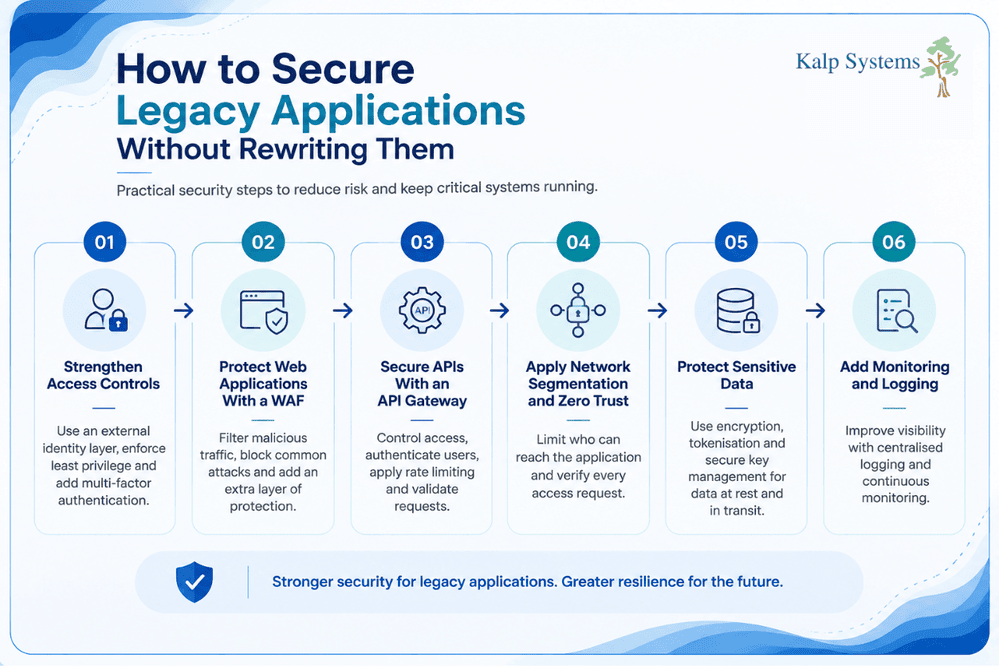
How to Secure Legacy Applications Without Rewriting Them
Securing a legacy application does not always mean changing the application itself. In many cases, security controls can be introduced around the existing system and its connections. This allows the application to continue doing its job while weaknesses in authentication, traffic handling, network access, and monitoring are addressed.
The approach will depend on how the application is used and where it is exposed, but several controls can be applied without modifying the core code.
Strengthen Identity and Access Controls
Older applications may have authentication and authorisation logic built into the application itself, making it difficult to introduce modern access controls directly.
An external identity layer can help address this limitation. It can connect the legacy application with modern Identity and Access Management platforms and provide controls such as:
- Multi-factor authentication
- Centralised access control
- Role-based access
- User authentication and authorisation
- Access logging and auditing
This keeps the existing application in place while moving important identity controls outside it.
Protect Legacy Web Applications With a WAF
A Web Application Firewall can be placed in front of a legacy web application to inspect incoming traffic before it reaches the application.
A properly configured WAF can help:
- Block SQL injection and cross-site scripting attempts
- Inspect and filter application traffic
- Apply rate limiting
- Detect suspicious requests
- Protect older web applications that cannot easily be modified
This is particularly useful when the application is exposed to the internet, but its underlying code cannot be changed quickly.
Secure Legacy APIs with an API Gateway
Legacy applications are increasingly connected to mobile applications, cloud platforms, and other modern services through APIs. Those connections can introduce another point of exposure.
An API gateway can sit between the legacy application and the systems using its APIs. It can enforce authentication and authorisation, control traffic, apply rate limits, validate requests, and provide visibility into API activity.
Before putting these controls in place, security teams should identify which legacy APIs are exposed, what systems use them, and what level of access each integration actually requires.
Apply Network Segmentation and Zero-Trust
Legacy applications should not operate on flat networks where a compromised system can provide an easy route to other critical resources.
Network segmentation can restrict communication between the legacy application, databases, users, and other systems. Zero Trust principles can add another layer by requiring access to be verified rather than relying on a user’s location within the network.
This can include:
- Restricting access based on identity and device posture
- Limiting users and systems to the resources they need
- Separating applications and databases into controlled zones
- Monitoring east-west traffic for unusual activity
If the legacy application is compromised, these controls can make lateral movement more difficult.
Protect Sensitive Data with Encryption and Tokenisation
Some older applications were not designed with the encryption and data protection controls expected today. Where changing the application is not practical, protection can be added at the infrastructure or data layer.
Businesses can use database encryption, tokenisation, and secure key management to protect sensitive personal and financial information. These measures can reduce the impact of a data breach while helping address data protection requirements without changing application logic.
Add Security Monitoring and Logging
Legacy applications often provide limited logging or lack the level of visibility security teams need to investigate suspicious activity.
External log collectors and SIEM integrations can bring application and infrastructure events into a central monitoring environment. Security teams can then look for unusual access patterns, failed authentication attempts, suspicious API activity, and other indicators that may otherwise be missed.
Continuous vulnerability assessment and behavioural analytics can add further visibility, particularly where the legacy application itself cannot provide modern security telemetry.
Secure Legacy APIs, Data and Access Without Changing Application Code
Adding modern security controls around a legacy application is only part of the job. The connections around the application also need attention. APIs, databases, and user access can expose an older system even when the application itself is not directly accessible from the internet.
Control API Authentication and Authorisation
Legacy APIs often become exposed when an older application is connected to newer applications, mobile services, or cloud platforms. The API should not automatically trust every system that can reach it.
An API gateway can enforce authentication and authorisation before requests reach the legacy application. Access can then be limited according to the user, application, service, or operation making the request.
Rate limiting and input validation can also help prevent abusive requests and common attacks against older APIs. Security teams should regularly review which APIs are exposed, who can access them, and whether each integration still needs the level of access it has.
Protect Sensitive Data and Databases
Legacy applications may store personal, financial, or other sensitive information in databases that were designed before current data protection practices became standard.
Where application-level encryption is not available, businesses can introduce protection at the database or infrastructure layer. Encryption can protect stored data, while tokenisation can reduce the exposure of sensitive values when they need to be used by other systems.
Key management is equally important. Encryption provides limited protection if the keys are poorly managed or accessible to the same users and systems that can access the protected data.
Restrict Access to Critical Resources
Not every user or connected system needs access to the entire legacy environment. Access should be limited to the resources required for a specific role or business process.
This can be enforced through role-based access controls, network restrictions, and least privilege policies. Critical databases and supporting systems should also be separated from unnecessary connections.
These controls are particularly useful when the legacy application cannot be modified. The surrounding infrastructure can enforce restrictions that the original application was never designed to provide.
Monitor Legacy Applications and Address Compliance Requirements
One of the difficulties with older applications is simply knowing what is happening inside them. Logging may be limited, security events may not be collected centrally, and older components may provide little information when something goes wrong.
Centralise Logs and Security Monitoring
If the application cannot produce enough useful logs, monitoring can be added outside it. Application, server, database, firewall, and access events can be collected through external log collectors and sent to a SIEM platform.
This gives the security team a broader view of activity around the application. Failed login attempts, unusual access patterns, unexpected API requests, and other suspicious events can be investigated without relying entirely on the application’s built-in logging.
Behavioural analytics can provide another layer of visibility by highlighting activity that differs from normal usage.
Identify and Manage Vulnerabilities
A system being difficult to modify does not mean its weaknesses should go unreviewed. A security assessment can examine the application, its supporting infrastructure, dependencies, interfaces, and external exposure.
Where a vulnerability cannot be fixed in the application itself, compensating measures can help reduce the risk. Depending on the weakness, this could mean restricting network access, placing a WAF in front of the application, tightening user permissions, or adding additional monitoring.
Regular reviews are also important because the risk can change as new integrations, users, and external connections are introduced.
Align With DPDP Act and ISO 27001 Requirements
Older software still needs to be considered part of the wider compliance picture. If it processes personal, financial, or other sensitive information, the surrounding safeguards should be reviewed against the applicable requirements.
Depending on the environment, this may involve:
- Restricting access to sensitive information
- Maintaining appropriate audit trails
- Protecting data through encryption or tokenisation
- Reviewing vulnerabilities and remediation measures
- Monitoring access and security events
- Keeping evidence of security measures and risk decisions
The DPDP Act, ISO 27001, ISO 27701, and sector-specific requirements may all bring different considerations. The specific controls required will depend on the type of data, business activity, and applicable obligations.
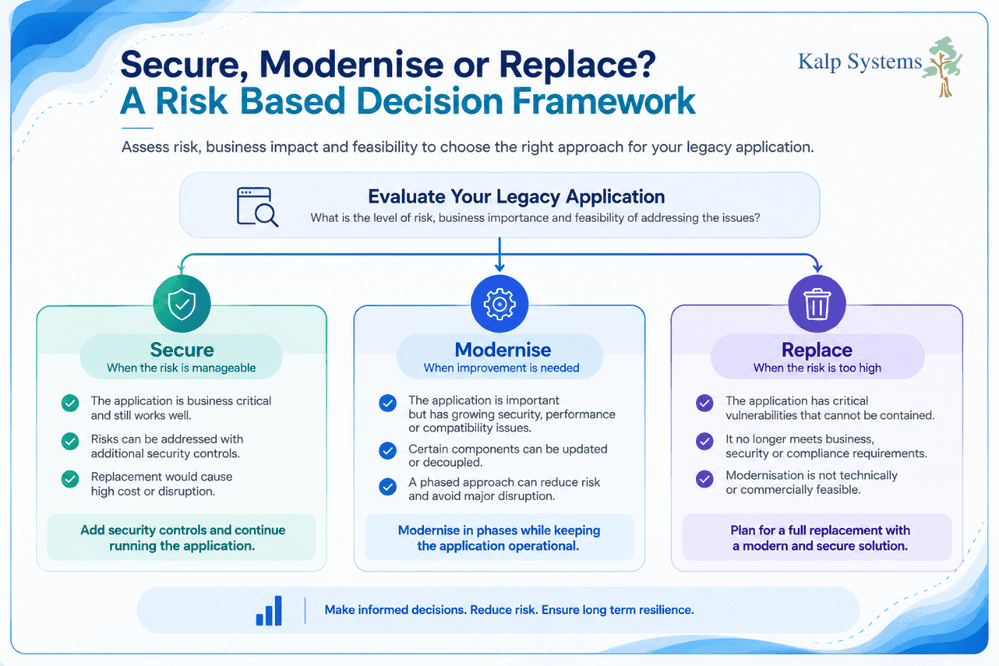
When Should You Secure, Modernise or Replace a Legacy Application?
Keeping an older application running indefinitely is not always the answer. At the same time, replacing it simply because it is old can create unnecessary cost and disruption.
The decision should come from the level of risk, the importance of the application, and how practical it is to address its weaknesses.
When to Secure and Contain Risk
Additional security controls can be a sensible choice when the application remains reliable and important to day-to-day operations, but its underlying code is difficult to change.
This approach may work when:
- The application performs a critical business function
- Its vulnerabilities can be reduced through compensating controls
- Access can be restricted effectively
- Sensitive data can be protected
- The supporting technology can still be monitored and maintained
In these cases, controls such as WAF protection, stronger identity checks, network segmentation, encryption, and continuous monitoring can reduce exposure while the application remains in service.
When to Modernise in Phases
Some applications have reached a point where additional controls are no longer enough. They may need better integration, stronger access management, improved scalability, or changes to the underlying technology.
A phased approach can avoid the disruption of replacing everything at once. Individual interfaces, identity functions, data layers, or connected services can be modernised while the core application continues to operate.
This can also provide time to test each change before moving further into the modernisation process.
When Replacement Becomes Necessary
There are cases where containment is no longer a sensible long-term option. Replacement should be considered when vulnerabilities cannot be adequately controlled; the underlying technology is no longer supportable, or the application creates unacceptable operational or compliance risk.
Business criticality should also be weighed against the cost of keeping the application in service. A system that is difficult to secure, increasingly expensive to maintain, and no longer meets business requirements may be a stronger candidate for replacement.
The choice does not have to be permanent. A legacy application can be secured today while a longer-term modernisation or replacement plan is developed.
How Kalp Systems Helps Secure Legacy Applications
A legacy application does not have to be replaced before its security can be assessed and improved. Kalp Systems helps businesses examine the risks around existing applications and put practical safeguards in place without disrupting the systems they depend on.
Our application security approach includes:
- Legacy application security assessments
- Threat modelling and exposure analysis
- WAF, IAM, and Zero Trust integration
- Data protection and compliance alignment
- Continuous monitoring and security governance
The focus is on finding the areas that create the most risk, addressing them with appropriate security measures, and helping teams make informed decisions about future modernisation or replacement.
Conclusion
Legacy applications are not going away anytime soon. Many businesses still depend on them for critical operations, and replacing them is not always practical or necessary. The cost of redevelopment, long migration timelines, business dependencies, and the risk of disrupting existing operations can make a complete rewrite difficult to justify.
That does not mean an older application should be left exposed. Security teams can add protection around the existing system, including stronger access controls, WAF and API protection, network segmentation, encryption, and continuous monitoring. These measures can address security weaknesses while the application continues to support the business.
There will also be cases where additional controls are not enough. If an application can no longer be supported securely, has serious vulnerabilities that cannot be contained, or creates unacceptable business or compliance risks, modernisation or replacement may be the better option.
The important point is to make that decision based on actual risk rather than the age of the application alone. A system that still works and can be adequately protected does not necessarily need to be rewritten immediately.
Security is not about replacing what works. It is about protecting what matters.
Frequently Asked Questions
Can you secure a legacy application without rewriting it?
In many cases, yes. Rewriting is not the only way to address security weaknesses in an older application. A WAF, external identity provider, network segmentation, API gateway, encryption, and additional monitoring can be introduced around the existing system. The application can continue to run while these controls reduce its exposure.
How do you secure a legacy web application?
Start with the points where the application is exposed. If it is accessible through the internet, a Web Application Firewall can help filter malicious requests before they reach the application. Access should also be reviewed, particularly authentication, user permissions, and remote access. Logging and vulnerability checks are useful for finding problems that are otherwise difficult to see in an older system.
How can you secure APIs exposed by legacy applications?
First, find out which APIs are actually exposed and which systems are using them. An API gateway can then be used to control requests before they reach the legacy application. Authentication, authorisation, rate limiting, and request validation can be enforced at this layer. Old APIs that are no longer required should also be removed rather than left exposed.
Can Zero Trust secure legacy applications?
Zero Trust can be applied without rebuilding the application. The controls can sit around it, limiting who can connect, which devices can be used, and what resources an authenticated user or system can reach. Network segmentation is particularly useful here because it can prevent a compromised legacy system from becoming a convenient route into other parts of the environment.
When should a legacy application be replaced instead of secured?
There is no fixed age at which an application should be replaced. Replacement becomes harder to avoid when its vulnerabilities cannot be adequately contained; its underlying technology is no longer supportable or maintaining it creates more risk than business value. If the risks can still be managed, keeping the application protected while working towards phased modernisation may be the more practical choice.