HomeBlogPolicy and ProcessesIdentity and Access Management for Government Organisations
Identity and Access Management for Government Organisations

What is Identity and Access Management for Government?
Government agencies manage a wide range of systems and data, including citizen records, tax information, healthcare records, employee information, and critical infrastructure. Access to these resources often involves employees, contractors, service providers, administrators, and other authorised users.
Identity and Access Management (IAM) provides the policies, processes, and technologies needed to control who can access these systems and what they are permitted to do. It connects each user’s identity with defined roles and access rights, helping ensure that people receive only the permissions required for their responsibilities.
For government environments, IAM also supports identity verification, access approval, authentication, privilege management, and access reviews. When these controls work together, security teams can maintain clearer oversight of accounts and permissions across departments and connected systems.
As public services become increasingly digital, managing identities carefully becomes an important part of protecting sensitive information and maintaining reliable access to essential government services.
Why Identity and Access Management is Critical for Government
Government systems connect multiple departments, applications, offices, and external partners, which makes access control difficult to manage through isolated security measures. A centralised IAM approach gives security teams a consistent way to assign permissions, verify users, review access, and maintain records of access activity.
Protecting Sensitive Government and Citizen Data
Government systems can contain personally identifiable information, healthcare records, tax details, and other sensitive data. IAM helps restrict these resources to authorised users based on their roles and responsibilities. Strong authentication and carefully defined permissions can reduce the likelihood of sensitive records being exposed through compromised or unnecessary access.
Controlling Access across Departments and Third Parties
Government services often involve employees from different departments as well as contractors, consultants, system integrators, and other external parties. Their access requirements can vary significantly. IAM helps apply appropriate permissions to each user, while access reviews can identify accounts or privileges that are no longer required.
Supporting Compliance and Audit Requirements
Government systems are subject to data protection, security, and sector-specific requirements. IAM supports these obligations by providing controlled access, audit trails, identity records, and traceability of user activity. Identity and Access Management in India can also support government agencies in managing access to personal data and meeting requirements under frameworks such as the DPDP Act.
Key IAM Challenges in Government
Implementing IAM across government systems can be difficult because every department may have different applications, access requirements, and responsibilities. Some systems may be old and difficult to integrate, while others may involve temporary users such as contractors and consultants. Keeping permissions accurate across all these environments requires regular attention from security and IT teams.
Legacy System Integration
Many government applications were developed more than a decade ago. Some of these systems may not support authentication standards such as SAML, OAuth, or OpenID Connect, which makes integration with newer IAM platforms difficult.
Replacing a legacy application simply to introduce IAM may not be practical. Custom connectors and additional security controls can help connect to these systems while allowing them to continue supporting essential government services.
Third-Party and Privileged Access
Government projects often involve contractors, consultants, system integrators, and healthcare partners. These users may need access to specific applications or information for a limited period, but their permissions can become difficult to track when several departments and systems are involved.
Privileged accounts need particular attention because they can provide access to critical systems. Secure credential storage, controlled privilege escalation, session monitoring, and regular reviews can help keep administrative access under control.
Insider Threats and Excessive Privileges
Not every access risk comes from an external attacker. A user who has permissions beyond their actual responsibilities can also create a serious security problem, whether through deliberate misuse or simple human error.
This is why access should be reviewed when responsibilities change and unnecessary privileges should be removed. Keeping permissions close to the user’s actual role also makes it easier to identify unusual access activities.
Managing IAM at Scale
A government IAM environment can include employees, contractors, citizens, administrators, and external stakeholders across numerous departments and applications. The number of identities can become difficult to manage when access is handled manually.
Changes also happen frequently. People move between roles, projects end, new systems are introduced, and users leave. IAM processes need to account for these changes so that access is updated or removed at the right time.
Core Components of a Government IAM Framework
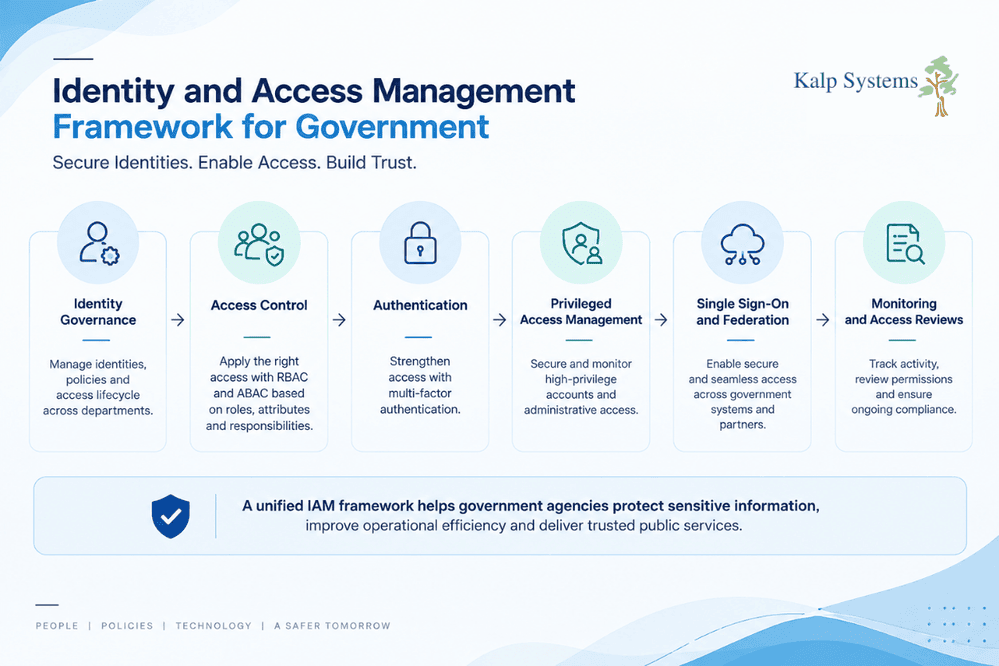
A government IAM framework brings several controls together to manage identities and access across different systems. The exact setup may vary between departments, but the basic purpose remains the same: verify users, assign appropriate permissions, protect privileged accounts, and keep access under review.
Identity Governance and Administration
Identity Governance and Administration (IGA) manages an identity throughout its lifecycle. It covers activities such as onboarding, role changes, access provisioning, and offboarding.
For government environments, IGA can also support access certification and segregation of duties checks. Role-based access control (RBAC), Attribute-based access control (ABAC) and automated provisioning help keep permissions connected to a user’s responsibilities.
Role-Based and Attribute-Based Access Control
RBAC assigns access according to a person’s defined role. For example, an employee working in one department may receive access to the applications required for that position, while an administrator may have a different set of permissions.
ABAC takes additional information into account when making an access decision. Attributes such as department, job function, location, device, or the sensitivity of a resource can be used to determine whether access should be permitted.
Together, these approaches give government teams more control over who can access specific systems and information.
Multi-Factor Authentication
Passwords alone provide limited protection when credentials are stolen or exposed. Multi-Factor Authentication (MFA) adds another verification step before access is granted.
Depending on the system and risk involved, this could include an authentication app, security key, biometric verification, or another approved factor. MFA is particularly useful for remote access to sensitive government systems, administrative portals, and other services where compromised credentials could have serious consequences.
Privileged Access Management
Privileged accounts can make changes to critical systems, security settings, databases, and infrastructure. They therefore require tighter controls than standard user accounts.
Privileged Access Management (PAM) can provide secure credential vaulting, just-in-time access, session monitoring, and controlled privilege escalation. These controls give security teams greater visibility into administrative activity and help limit unnecessary privileged access.
Single Sign-on and Identity Federation
Single Sign-On (SSO) allows users to access multiple approved applications through a central authentication process. This can reduce the number of separate credentials users need to manage while giving administrators a central point for authentication controls.
Identity federation extends this approach across trusted systems or domains. In government environments, federation can support collaboration between departments and integration with national digital identity platforms where appropriate.
IAM Implementation and Governance Best Practices
A government IAM programme needs clear rules for how access is requested, approved, reviewed, and removed. These rules should be documented and applied consistently across departments and systems. The technology supports the process, but the underlying policies determine how access decisions are made.
Define Access Policies and Least Privilege
Access policies should set out who can request access, who can approve it, and what level of access is appropriate for each role. Least privilege should be part of these rules, so users receive only the permissions needed for their assigned responsibilities.
Emergency access should also have a defined process, including approval, monitoring, and subsequent review. This gives security teams a clear record of why elevated access was granted and whether it should remain active.
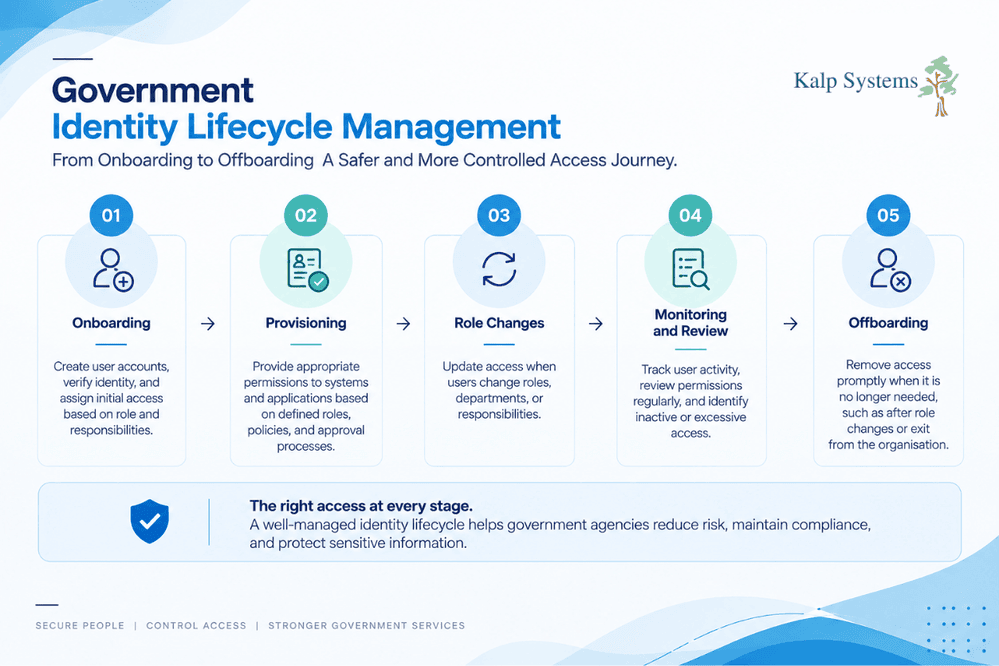
Manage the Identity Lifecycle
IAM controls should follow the identity from the point of onboarding through changes in responsibilities and eventual departure. A typical process includes verified onboarding, provisioning based on the user’s role, ongoing monitoring, access changes, and secure deprovisioning.
Role changes deserve particular attention. When someone moves to another department or takes on different responsibilities, their previous permissions may no longer be appropriate. Removing those permissions as part of the role change helps prevent access from accumulating over time.
Conduct Regular Access Reviews
Access should be reviewed periodically rather than being treated as a one-time decision. Reviews can identify accounts that are no longer needed, permissions that exceed current responsibilities, and access that should be changed following a role or project change.
For sensitive systems and privileged accounts, more frequent reviews may be appropriate. Keeping a record of these reviews also provides useful evidence during security assessments and audits.
Integrate IAM with Security Monitoring
IAM data becomes more useful when it is connected with security monitoring and incident response processes. Integrating IAM with SIEM and SOC platforms allows security teams to examine authentication events, privilege changes, and unusual access behaviour alongside other security activity.
This can help identify suspicious access patterns earlier and give security teams additional context when investigating an incident.
IAM, Zero-Trust and Emerging Government Security Trends
Government systems increasingly need to make access decisions that take more than a username and password into account. IAM provides the identity layer for these decisions, while newer security approaches consider the user’s device, behaviour, and the context of each access request.
How IAM Supports Zero-Trust
Zero-Trust requires each access request to be verified rather than assuming that a user should be trusted simply because they are already inside a government network. IAM provides the identity information needed to make those decisions.
Access can be evaluated using factors such as the user’s identity, device posture, role, and behaviour. Permissions can then be limited according to the resource and the level of access required. Continuous monitoring adds another layer by helping identify changes in behaviour after access has been granted.
AI-Driven Identity Analytics
AI can assist IAM teams by analysing identity and access activity at a scale that would be difficult to handle manually. It can help identify unusual behaviour, assign risk scores to users, and highlight access patterns that may need further review.
For example, a sudden change in a user’s normal access behaviour could prompt a closer look by the security team. AI-driven analysis can therefore support existing access controls and monitoring processes rather than replacing them.
Integration with Digital Identity Systems
Government services are increasingly connected to digital identity initiatives. IAM frameworks need to work with these systems while maintaining appropriate access controls and privacy safeguards.
Integration can make it easier to establish trusted identities across connected services and support secure access to digital government platforms. It also requires clear rules around identity verification, permissions, data handling, and accountability.
Benefits of Identity and Access Management for Government
A well-planned IAM framework gives government teams better control over who can access systems and information. It also makes access decisions easier to track as users move between roles, departments, or projects.
With appropriate identity controls in place, government agencies can reduce the risk associated with compromised credentials and unnecessary privileges. Regular access reviews and audit records also make it easier to demonstrate how permissions are managed when security or compliance assessments take place.
IAM can also reduce some of the administrative work involved in managing accounts and access manually. When identity processes are handled consistently, users can receive the access they need while outdated permissions can be removed as their responsibilities change.
For digital government services, these controls contribute to safer access to systems that citizens and public-sector teams rely on.
Integrated Identity and Access Management Solutions by Kalp Systems
Government environments can include cloud platforms, legacy applications, multiple departments, and different types of users. Bringing identity and access controls together across these systems can make access management easier to control and monitor. Kalp Systems provides integrated IAM tool solutions designed to work with existing technology environments.
The solutions can bring together Single Sign-On (SSO), Multi-Factor Authentication (MFA), Privileged Access Management (PAM), and Identity Governance and Administration (IGA) across hybrid environments. This gives security teams a more consistent way to manage user identities, authentication, permissions, and privileged access.
Kalp Systems can also integrate cloud platforms and legacy applications using custom connectors and automated identity workflows. This helps connect different systems within the existing infrastructure while keeping identity-related processes more consistent.
For access control, the solution can apply context-aware access policies and fine-grained Role-Based Access Control (RBAC). These controls can restrict access according to the user’s role and the circumstances of the access request, helping reduce unnecessary permissions and the risk of unauthorised lateral movement.
The focus is on integrating the required IAM tools with the existing environment so government teams can manage identities and access through a more structured and controlled setup.
Conclusion
Managing identities and access is a basic requirement for protecting government systems. The challenge is keeping those controls accurate when access is spread across departments, applications, employees, contractors, and external service providers.
A good IAM setup gives agencies a clearer way to decide who should have access, what they should be able to do, and when that access needs to be removed. MFA, least privilege, privileged access controls, identity reviews, and monitoring all have a role to play here.
This becomes particularly important as more public services depend on digital systems. A forgotten account or unnecessary privilege can create an access risk that may go unnoticed for a long time. Regular reviews and well-defined IAM processes help keep those risks under control while allowing authorised users to get on with their work.
That makes IAM a practical part of day-to-day government cybersecurity, rather than something that only matters during an audit or after a security incident.
Frequently Asked Questions
What is Identity and Access Management in Government?
IAM is about controlling access to government systems. It starts with knowing who a user is and what that person is allowed to access. If an employee moves to another department, for example, their old permissions should not simply remain active. The same applies when a contractor finishes a project, or an administrator no longer needs elevated access.
Why is IAM Important for Government Agencies?
Think about the number of people who may need access to a government system. There can be permanent staff, temporary workers, contractors, administrators, and external service providers. Their access needs will not be the same.
IAM puts some structure around those differences. A person gets access based on their work, and that access can be changed or removed when the situation changes. This matters even more when the system contains citizen records, tax information, healthcare data, or other sensitive information.
What are the Main Components of Government IAM?
There are several parts to IAM, and each one deals with a different access problem. Identity Governance and Administration looks after identities and their lifecycle. RBAC and ABAC deal with permissions. MFA adds another check when someone signs in, while PAM is used for accounts with higher levels of access.
SSO and identity federation become useful when users need to work across several connected applications or systems. Regular access reviews sit alongside these controls to check whether existing permissions still make sense.
How does IAM Support Zero-Trust in Government?
Zero-Trust does not treat a user as trusted simply because they have already logged in or are connected to an internal network. The access request still needs to be checked.
IAM supplies some of the information needed for that decision. The system can look at the user’s identity, role, permissions, and, where required, information about the device or access request. That makes it possible to restrict access to the particular system or resource the user actually needs.
How can Government Agencies Implement IAM Effectively?
There is no need to start by changing everything at once. A useful first step is to look at the access that already exists. Check the user accounts, privileged accounts, applications, and permissions. Look for accounts that have been left behind and permissions that no longer match someone’s current role.
The next step is to deal with the biggest gaps first. MFA may be a priority for remote access, while PAM may need attention around administrator accounts. Access reviews, least privilege, and proper account removal can then become part of the normal process rather than something done only when an audit is coming up.