HomeBlogCloud SecurityHybrid Multi-Cloud Security: Challenges and Best Practices
Hybrid Multi-Cloud Security: Challenges and Best Practices

What is Hybrid Multi-Cloud Security?
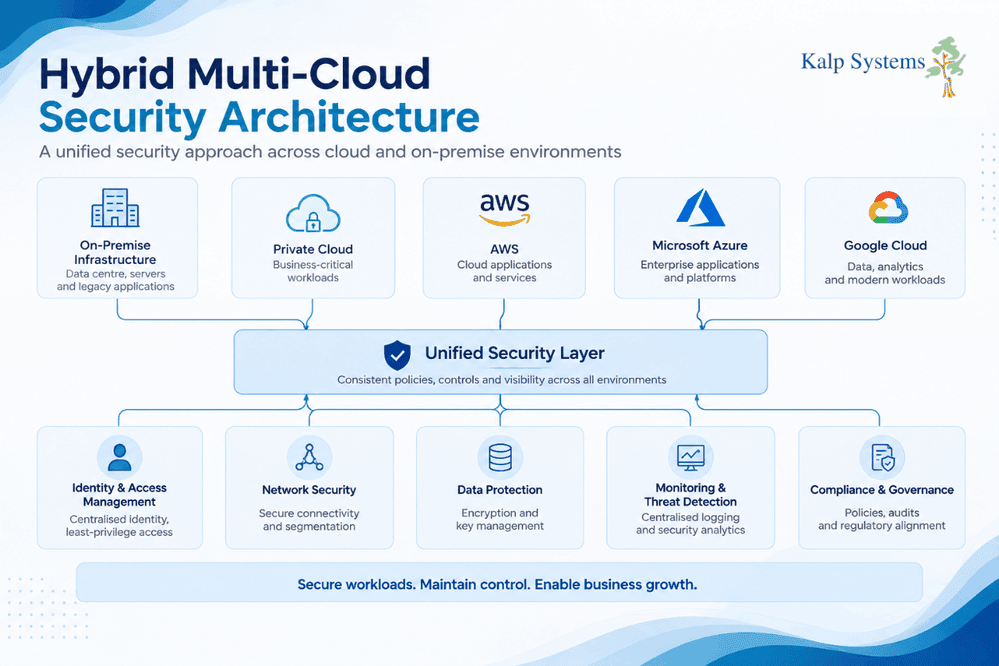
Hybrid multi-cloud security refers to the policies, technologies and processes used to protect workloads, identities, networks and data across multiple cloud providers, private cloud environments and on-premises infrastructure. A typical setup may include AWS, Microsoft Azure or Google Cloud alongside a private cloud and existing data centre system.
The security challenge comes from keeping these connected environments under consistent control. Each provider has its own identity services, network controls, configuration settings and monitoring capabilities. A strong security approach therefore needs clear policies that can be applied across the entire environment while still accounting for the differences between platforms.
For companies using a hybrid multi-cloud model, security also needs to cover how data and workloads move between environments. Access permissions, network connections, encryption, configuration changes and security events should be monitored as part of the same security strategy.
Multi-Cloud vs Hybrid Cloud
A multi-cloud environment uses services from two or more public cloud providers. For example, a company might run applications on AWS, use Microsoft Azure for specific workloads and rely on Google Cloud for data analytics. This approach can support different technical requirements and reduce dependence on a single provider.
A hybrid cloud environment combines cloud infrastructure with on-premises systems, usually involving public or private cloud resources. This model is often used when sensitive workloads, legacy applications or specific regulatory requirements require some systems to remain within an existing data centre.
The two models can also exist together. A company may use several public cloud providers while maintaining critical systems on-premises. In that case, security controls need to work across both the multi-cloud and hybrid components.
Why Security Must be Consistent across Environments
Different cloud platforms can use different tools and configurations for identity, networking, encryption and monitoring. Without common security policies, a control applied in one environment may be missing or configured differently in another.
Consistent security controls help maintain the same baseline for access, data protection and monitoring across connected environments. This includes applying least-privilege access, securing connections between cloud and on-premises systems, monitoring configuration changes and collecting security events from each platform.
The aim is to give security teams a clear view of the complete environment, rather than treating each cloud platform as a separate security boundary.
Key Security Challenges in Hybrid Multi-Cloud Environments
Running workloads across several cloud platforms and on-premises infrastructure creates security issues that are easy to miss when each environment is managed separately. A permission change in one cloud, an exposed API or an incorrectly configured storage service can affect the wider environment, especially when systems are connected.
The difficulty is usually less about the individual security tools and more about keeping security controls consistent as infrastructure grows and changes.
Fragmented Security Controls and Limited Visibility
AWS, Azure, Google Cloud and on-premises infrastructure all come with their own security controls, consoles and configuration methods. Security teams may end up checking several places to understand who has access, which systems are exposed and whether a control has been applied correctly.
This makes gaps harder to spot. A security policy may be properly enforced in one cloud while a similar workload in another environment follows a different rule. Bringing asset information, access data, configuration findings and security events into a central view can make these differences much easier to identify.
Expanded Attack Surface and Misconfiguration Risks
A hybrid multi-cloud environment can contain cloud workloads, APIs, containers, virtual machines, storage services, development pipelines and connections to internal systems. Each one needs to be accounted for when assessing the attack surface.
Misconfiguration is another practical concern. An overly permissive firewall rule, publicly accessible storage resource or unused account with active privileges can create an entry point. Regular configuration checks and security baselines help catch these issues before they are overlooked in day-to-day operations.
Identity and Access Complexity
Access becomes harder to control when the same users, applications and service accounts interact with different cloud platforms. Privileged access can also spread across several environments, making it difficult to determine whether permission is still required.
A consistent IAM approach helps bring this under control. Least-privilege access, multi-factor authentication and regular reviews of privileged accounts should apply across cloud and on-premises systems. Service accounts and machine identities also need attention because they can retain access long after their original purpose has changed.
Compliance and Data Residency Challenges
Data can move between cloud providers, private infrastructure and on-premises systems as applications communicate and workloads are processed. That creates a practical question for security teams: where is sensitive data located at each stage, and who can access it?
This becomes particularly important when personal data is involved. The DPDP Act introduces data protection requirements that need to be considered alongside the technical design of cloud environments. Clear data classification, access controls and records of data locations can help security and compliance teams maintain better oversight.
Best Practices for Hybrid Multi-Cloud Security
A practical security approach starts with a common baseline for every environment. The exact tools may differ between cloud providers, but the expectations around access, network protection, data handling and security monitoring should remain clear.
Apply Zero-Trust and Centralised IAM
Identity should be checked before access is granted to applications, workloads or sensitive data. Zero-Trust supports this by requiring verification based on the user, device, workload and context rather than relying on network location alone.
Centralised IAM can make this easier to manage across cloud and on-premises systems. Apply least-privilege permissions, use multi-factor authentication for sensitive access and review privileged accounts regularly. Service accounts and API identities should also have only the permissions required for their specific tasks.
Secure Networks and Segment Critical Workloads
Network segmentation can limit how far an attacker can move after gaining access to one workload. Critical applications, databases and sensitive systems should be separated from less trusted resources, with access between segments restricted to required communication paths.
Connections between cloud platforms and on-premises infrastructure should use secure, controlled routes. Firewall rules and network policies also need regular review as workloads and application dependencies change.
Protect Data with Encryption and Key Management
Data should remain protected while it is stored and while it moves between connected environments. Encryption at rest and in transit provides an important layer of protection, particularly for sensitive and personal data.
Key management needs the same level of attention. Access to encryption keys should be restricted, key rotation should follow defined policies, and responsibilities for managing keys should be clear. Where several cloud providers are involved, these controls should be reviewed across each environment rather than managed in isolation.
Standardise Security Policies and Automate Controls
A shared security baseline helps reduce differences between cloud platforms. Policies can define requirements for identity, encryption, network access, logging, configuration and data protection, while individual cloud controls can enforce those requirements within each provider.
Automation can reduce the amount of manual checking involved. Infrastructure as Code, configuration policies and automated security checks can identify or prevent settings that fall outside the approved baseline before they become a wider problem.
Monitoring and Incident Response across Cloud Environments
A hybrid multi-cloud setup can change from week to week. A new workload may be added; an access rule may be changed, or a connection between environments may be opened for an application. These changes can introduce security issues without being immediately obvious.
Regular monitoring gives the security team a way to see what is changing and investigate unusual activity before it develops into a larger incident.
Cloud Security Posture Management and Configuration Monitoring
Cloud Security Posture Management (CSPM) can help check whether cloud resources are configured according to defined security requirements. This is useful when the environment includes several cloud providers, where checking every account and resource manually becomes difficult.
Configuration reviews can identify issues such as exposed services, excessive permissions and security settings that have drifted from the approved baseline. Automated checks are particularly useful after deployments or infrastructure changes, when an incorrect setting can easily be introduced.
Centralised Logging and Threat Detection
Logs from cloud platforms, identity systems, applications and network infrastructure can tell an important part of the story during a security investigation. Keeping these records in separate places makes it harder to connect to related events.
A centralised logging approach allows activity from different environments to be viewed together. For instance, an unusual sign-in followed by a privilege change and access to a sensitive workload may warrant investigation. Looking at those events together provides more context than examining each log separately.
Incident Response Across Cloud and On-Premises Environments
An incident that begins in one cloud environment can affect connected systems elsewhere. A compromised account, for example, may have permissions that reach an on-premises application or another cloud platform.
Incident response procedures should therefore cover the complete environment. Teams should know how to revoke access, isolate affected workloads, preserve relevant evidence and check connected systems. Response exercises can also expose practical gaps, such as unclear responsibilities or missing access to critical logs, before those issues become a problem during an actual incident.
Compliance and Governance for Hybrid Multi-Cloud Security
Security controls need to work alongside the rules that apply to the data and systems being protected. In a hybrid multi-cloud environment, this can become difficult when information is stored across different cloud platforms and on-premises systems. Clear governance helps define how that data is handled, who can access it and how security controls are reviewed.
Data Protection and Regulatory Requirements
The location and type of data should be considered when deciding where it can be stored, processed and accessed. Personal data may move between applications and cloud environments, so security teams need visibility into these flows and the controls applied to them.
For companies in India handling personal data, the Digital Personal Data Protection Act, 2023 (DPDP Act) is an important consideration for hybrid multi-cloud security. Requirements related to personal data should be reflected in access controls, data handling practices and security measures. Where workloads span multiple cloud providers, these requirements need to be considered across the complete data flow rather than within one platform alone.
Security Policies and Regular Audits
A written security policy gives teams a common reference point when managing different cloud environments. It can define requirements for access, encryption, logging, configuration, data handling and incident response, while individual platforms can implement those requirements through their own controls.
Regular audits help check whether those controls are still working as intended. They can also identify differences between environments that developed as infrastructure changes. Reviewing permissions, configurations, security logs and compliance requirements at defined intervals keeps governance connected to the actual cloud environment.
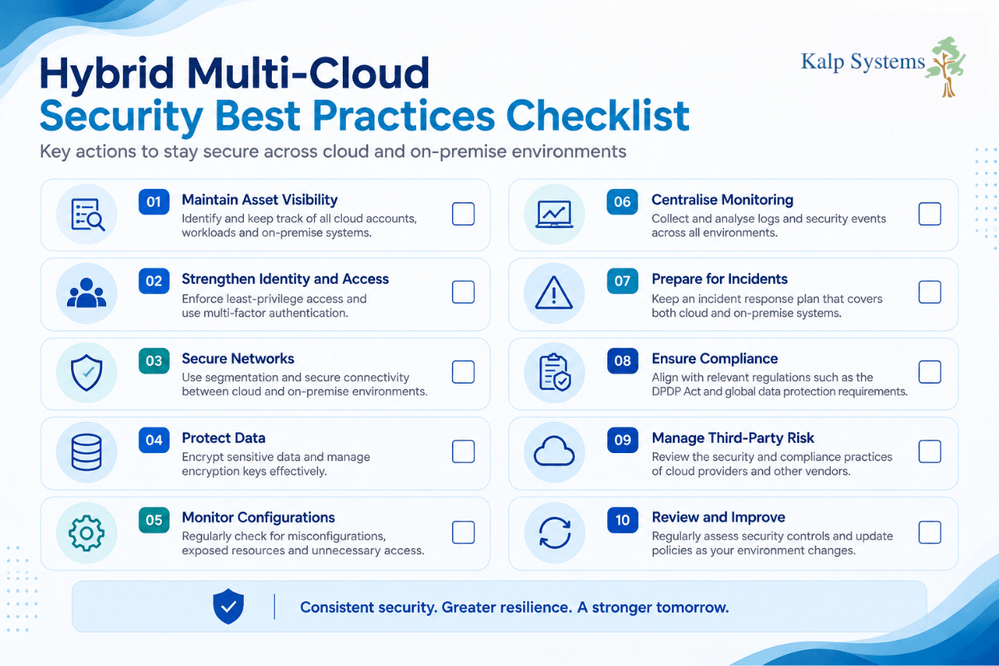
Hybrid Multi-Cloud Security Best Practices Checklist
Before signing off on a hybrid multi-cloud setup, check the basics across every environment:
- Are all cloud accounts, workloads and on-premises systems known and accounted for?
- Have unnecessary users, administrators, service and API permissions been removed?
- Is multi-factor authentication enabled for privileged and sensitive access?
- Are critical workloads separated from systems that do not need direct access to them?
- Are connections between cloud platforms and on-premises infrastructure properly secured?
- Is sensitive data encrypted, with clear control over the encryption keys?
- Are cloud configurations checked regularly for exposed resources and unsafe changes?
- Can the security team view and investigate relevant activities across all environments?
- Does the incident response plan include both cloud and on-premises systems?
- Are security policies reviewed when workloads, infrastructure or access requirements change?
A checklist like this is more useful when it is used during an actual security review. The answers should lead to specific actions, rather than becoming a compliance exercise that is completed once and forgotten.
Conclusion
Hybrid multi-cloud security depends on how well security controls work across the whole environment. With cloud platforms, private infrastructure and on-premises systems connected together, a gap in one area can affect systems elsewhere.
A practical approach starts with clear access controls, Zero-Trust, network segmentation and proper data protection. Regular configuration checks, centralised monitoring and tested incident response procedures then help the security team deal with changes and security events as they occur.
Consistent policies and regular reviews also keep security aligned with data protection and compliance requirements. When these measures are built into day-to-day cloud management, hybrid multi-cloud environments can be managed with a clearer view of their risks and security requirements.
Frequently Asked Questions
What is Hybrid Multi-Cloud Security?
It means protecting a setup where more than one cloud provider is used alongside private cloud or on-premises infrastructure. The security work covers the connections between these environments as well as the users, applications, workloads and data running within them.
What are the Main Security Challenges in Hybrid Multi-Cloud Environments?
Visibility and consistency are two of the harder problems. Different cloud providers have different security controls and management tools, while permissions, network rules and configurations can change as workloads move or new services are added. Misconfigurations and excessive access can then go unnoticed if there is no regular review.
How does Zero-Trust Help Secure Hybrid Multi-Cloud Environments?
Zero–Trust puts the focus on the access request rather than assuming that someone is safe because they are already inside a particular network. A user or workload requesting access can be checked using its identity, device, context and required permissions before access is allowed.
How can Businesses Maintain Consistent Security Across Multiple Cloud Providers?
Start with a common set of security requirements for areas such as IAM, encryption, network access, logging and configuration. Each provider may use different controls to meet those requirements, but the expected security standard should remain the same. Periodic reviews can then highlight where one environment has fallen behind.
What Tools Help Monitor Hybrid Multi-Cloud Security?
CSPM tools can help identify cloud configuration and security posture issues, while SIEM and other monitoring platforms can bring security events together for investigation. The right combination depends on the infrastructure, but the important point is being able to see activity across cloud and on-premises environments rather than monitoring each one separately.