Introduction
The digital transformation of education has accelerated rapidly in recent years. Online learning platforms, digital classrooms, AI-powered tutoring systems, and learning analytics tools have become common across schools, universities, and training institutions.
While these technologies improve access to education and personalise learning, they also generate large volumes of sensitive student data. Names, learning behaviour, academic performance, device data, and parent information are now stored and processed by EdTech platforms every day.
As education becomes increasingly digital, the importance of safeguarding personal data has grown significantly. The DPDP Act (Digital Personal Data Protection Act) establishes a structured legal framework in India governing how organisations collect, process, store, and protect personal data.
For EdTech companies, the responsibility is even greater because a large portion of their users are minors. Protecting student data is no longer just a technology concern. It is now a regulatory requirement, a trust factor for parents and institutions, and a critical part of platform governance.
Understanding the DPDP Act and Why It Matters for EdTech Companies
The DPDP Act is India’s primary law governing the processing of digital personal data. It applies to organisations that collect or process personal data digitally within India, including technology companies that provide educational services.
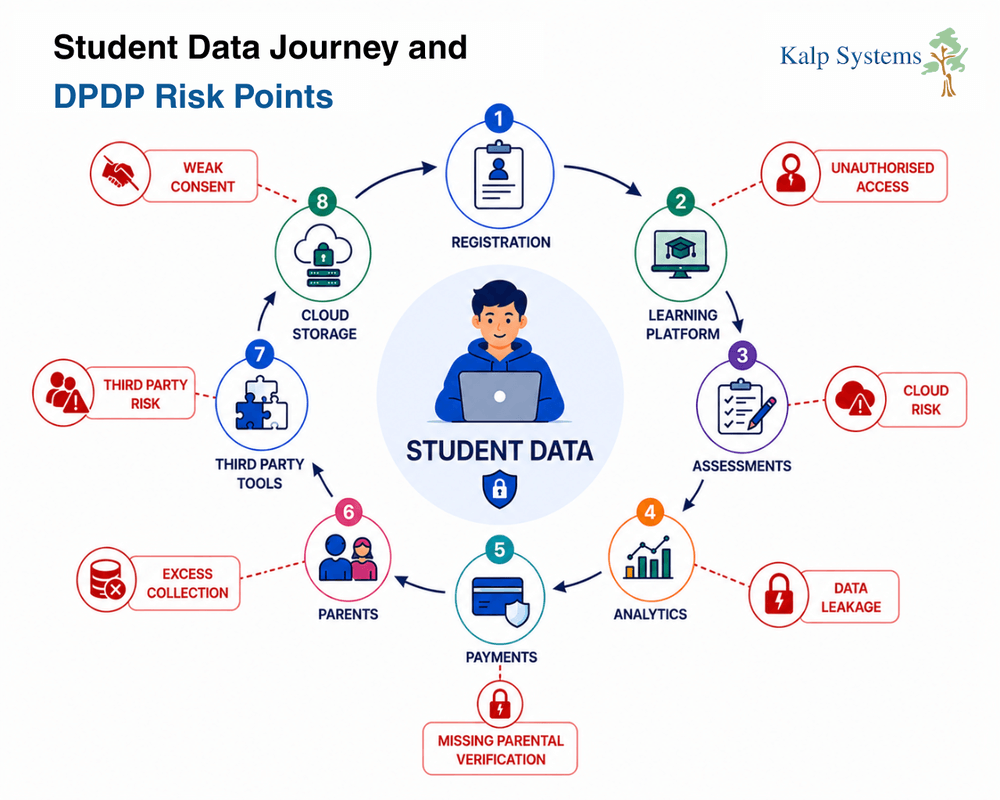
EdTech companies process personal data at multiple stages. From student registration and course enrolment to assessments and performance tracking, data is continuously generated across the learning journey.
The law introduces several important obligations for organisations handling personal data.
Key principles of the Digital Personal Data Protection Act
The DPDP framework is built around a few core principles that directly affect EdTech platforms.
- Personal data must be collected for a specific and lawful purpose
- Organisations must ensure that people understand how their data will be used and give explicit permission for it
- Organisations must ensure reasonable security safeguards
- People should have the ability to review their stored information, update inaccurate details, or request that their data be removed
These principles require education technology providers to rethink how they design data systems, privacy policies, and user consent processes.
How DPDP impacts online learning platforms and educational institutions
An online learning platform doesn’t collect just one type of student information. It gathers registration details, attendance records, assignment submissions, assessment results, learning progress, and sometimes even behavioural insights that help personalise lessons. Over months or years, those records become a detailed digital profile of every learner.
The DPDP Act brings greater responsibility to how this information is managed. Schools, universities, coaching institutes, and EdTech providers all need to know why student data is being collected, where it is stored, who can access it, and when it should be removed. This becomes even more relevant when the platform serves minors, where parental consent and responsible data handling become part of everyday operations rather than occasional compliance tasks.
What Student Data Do EdTech Platforms Collect and Why Does It Need Protection?
Education technology platforms rely heavily on data to deliver personalised learning experiences. However, much of this information falls under personal data protection regulations.
Personal identification and student profile information
Basic student details are collected during account creation and onboarding.
Examples include:
- Student name and age
- Email address or phone number
- School or institution information
- Parent or guardian contact details
This information forms the foundation of a student profile and must be protected under the DPDP Act.
Academic performance and learning records
One of the major advantages of digital learning is the ability to track progress and personalise education.
Platforms often record:
- Assignment and test scores
- Learning progress reports
- Subject-level performance data
- Participation in online classes
While this improves the learning experience, it also creates a detailed academic record that must be secured.
Behavioural analytics and platform usage data
EdTech platforms analyse behavioural data to improve engagement.
This can include:
- Time spent on lessons
- Quiz attempts and completion rates
- Navigation patterns inside the platform
- Device and login activity
When linked to an identifiable student, this behavioural information becomes personal data under the DPDP Act.
Payment, subscription, and communication records
Many EdTech platforms operate through subscription-based models.
This involves collecting payment information such as:
- Billing details
- Transaction records
- Subscription plans linked to student accounts
Financial information requires additional security safeguards.
DPDP Compliance Requirements Every EdTech Company Should Understand
The DPDP Act introduces clear expectations for organisations that process personal data. For EdTech companies, compliance involves both technical and operational changes.
Parental consent requirements for minor users
Since many EdTech users are under the age of 18, parental or guardian consent becomes essential.
Platforms must ensure that:
- Consent is verified before collecting data from minors
- Parents understand how student data will be used
- Consent mechanisms are clear and transparent
Purpose limitation and lawful data collection
Under the DPDP Act, organisations must collect data only for clearly defined purposes.
For example, if student data is collected to track learning progress, it should not later be used for unrelated advertising or profiling activities.
Data minimisation and retention requirements
Another key requirement is collecting only the data that is necessary.
EdTech platforms should avoid storing excessive personal information that does not directly support the learning service.
Reducing unnecessary data also lowers the risk of breaches.
Student data access, correction, and Data Principal rights
Students or parents must be able to request:
- Access to stored personal data
- Correction of inaccurate information
- Deletion of personal records where applicable
Platforms must build processes to handle these requests efficiently.
Major Student Data Security Risks Facing EdTech Platforms
As digital education grows, cyber threats targeting educational platforms are also increasing.
Several factors make EdTech platforms attractive targets for attackers.
Managing large volumes of sensitive student data
Education platforms often manage data from thousands or even millions of users.
This concentration of information makes them valuable targets for cybercriminals.
Third-party integrations and vendor risks
Many EdTech systems integrate with external services such as video conferencing tools, cloud platforms, analytics systems, and payment gateways.
Each integration creates an additional security dependency.
Cloud infrastructure and cybersecurity challenges
Most education platforms rely on cloud services for scalability.
While cloud platforms provide strong security capabilities, configuration mistakes or weak access controls can expose student data.
How EdTech Companies Can Strengthen Student Data Protection Under DPDP
To meet the expectations of the DPDP Act, EdTech companies must implement strong technical safeguards.
Identity and access management
Access to student data should be restricted to authorised users.
Role-based access control ensures that employees only see the data necessary for their responsibilities.
Encryption and secure data storage
Encryption protects personal data both during storage and transmission.
Even if systems are compromised, encrypted data cannot be easily accessed.
Continuous monitoring and incident detection
Modern cybersecurity tools can monitor platform activity in real time.
This helps identify unusual behaviour such as unauthorised login attempts or abnormal data access patterns.
Regular security assessments and vulnerability testing
Security audits and vulnerability assessments help organisations identify weaknesses before they become serious threats.
These assessments also support compliance with the DPDP Act.
Building Student Data Governance and Privacy by Design into EdTech Platforms
Trust is a major factor in the adoption of digital learning platforms. Parents and institutions expect education providers to handle student information responsibly.
Strong data governance practices demonstrate that an organisation takes privacy seriously.
Key elements of responsible data governance include:
- Transparent privacy policies
- Clear communication about data usage
- Secure vendor management practices
- Data lifecycle management
- Incident response planning
Organisations that invest in these practices are more likely to build long-term credibility in the education ecosystem.
Creating privacy first learning platforms
Good privacy starts long before a student creates an account. It begins while the platform is being designed.
Simple decisions often have the biggest impact. Ask only for information that supports the learning experience. Limit access to student records based on job roles. Keep privacy notices easy to understand instead of filling them with legal language. When these practices become part of product design, privacy feels natural rather than something added later to satisfy compliance requirements.
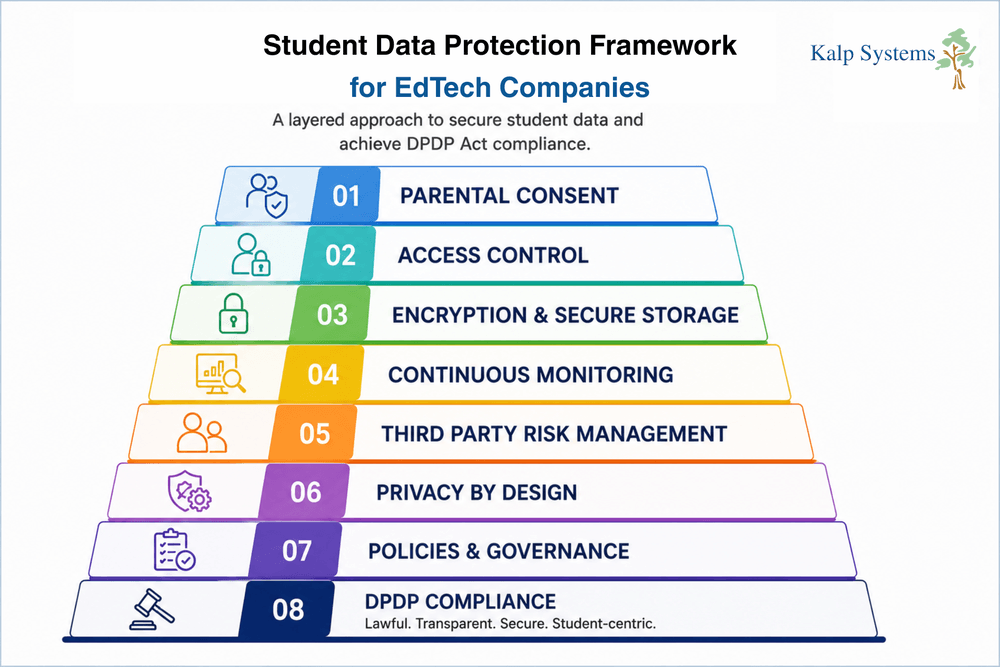
The framework below highlights the building blocks of a privacy-first learning platform. Together, these controls help EdTech companies protect student information while creating a safer environment for learners, parents, and educational institutions.
Strengthening governance and accountability
Protecting student data isn’t something the IT team can manage alone. Admissions, academics, customer support, finance, marketing, and technology teams all interact with personal data at different stages of the student journey. If every department follows its own process, maintaining consistent privacy standards becomes difficult.
Clear ownership makes a noticeable difference. Teams should know what student data they are responsible for, how long it needs to be retained, and when it should be securely deleted. Regular policy reviews, employee awareness, and oversight of third-party vendors help keep these practices consistent. Over time, good governance becomes part of everyday operations rather than an activity carried out only before an audit.
A Practical DPDP Compliance Checklist for EdTech Companies
Privacy programmes rarely improve because of a single policy or security tool. Progress usually comes from a series of practical steps that reduce risk over time. For EdTech companies, those steps should cover the entire student data lifecycle, from collecting information during registration to securely deleting it when it is no longer needed.
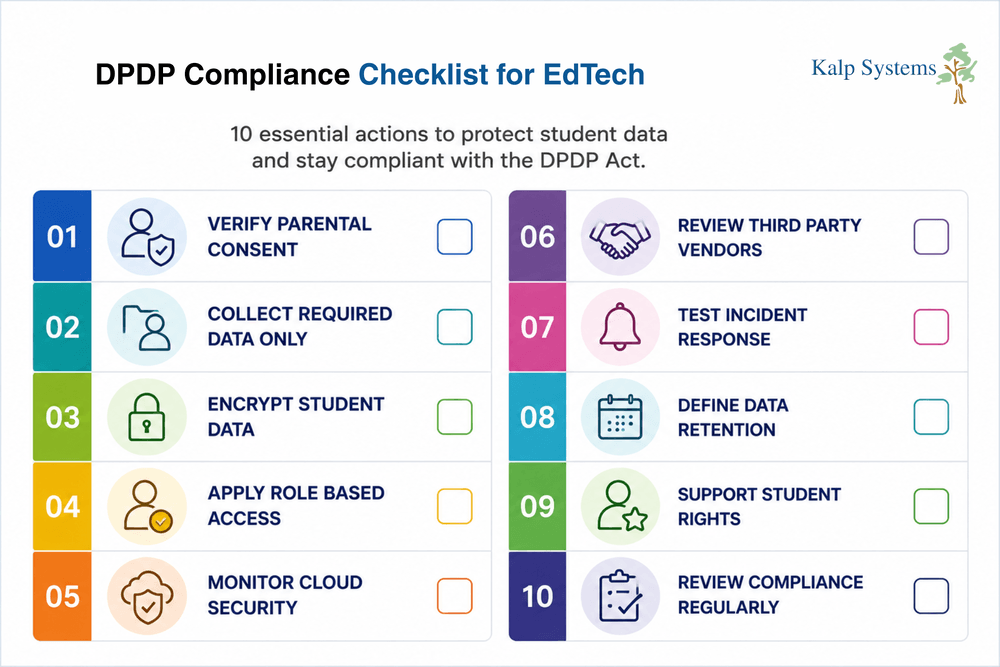
The checklist below highlights the controls that help strengthen privacy, improve operational consistency, and support DPDP compliance without adding unnecessary complexity.
Key compliance controls
Strong compliance comes from getting the basics right. Verify parental consent where required, collect only the information needed for educational purposes, protect student data with appropriate security controls, and review third party vendors before sharing personal information. These measures reduce unnecessary risk and create a stronger foundation for long term compliance.
The checklist infographic provides a practical starting point for reviewing existing processes and identifying areas that may need attention.
Ongoing monitoring and continuous improvement
Privacy is not something an organisation reviews once and forgets. New features are released, vendors change, regulations evolve, and the amount of student data continues to grow. Regular security assessments, policy reviews, access audits, and incident response testing help ensure that privacy controls remain effective as the platform changes.
EdTech companies that review their privacy programme regularly are often better prepared to address new risks without disrupting the learning experience.
Future Trends Shaping Student Data Protection and EdTech Compliance
The intersection of education and technology will continue to evolve. As new digital learning tools emerge, expectations around data privacy will also increase.
AI-driven learning systems and privacy
Artificial intelligence is being used to personalise education at scale. These systems rely on large datasets, which raises questions about transparency and responsible data use.
Growing focus on student privacy
Parents and institutions are becoming more aware of data protection risks. Platforms that demonstrate strong privacy practices will have a competitive advantage.
Privacy by Design in education technology
Many organisations are now adopting privacy by design principles. This approach integrates data protection controls directly into platform architecture instead of adding them later.
Conclusion
Digital learning platforms have transformed how education is delivered and accessed. However, this transformation also comes with the responsibility of protecting large volumes of student data.
The DPDP Act establishes a clear legal framework for responsible data processing in India. For EdTech companies, compliance requires more than updating privacy policies. It involves strengthening consent processes, improving security controls, and ensuring transparent data governance.
By prioritising student data protection, education technology providers can create safer digital learning environments while building long-term trust with students, parents, and educational institutions.
Frequently Asked Questions
What is the DPDP Act, and how does it affect EdTech companies?
The DPDP Act (Digital Personal Data Protection Act) regulates how organisations in India collect, process, and protect digital personal data. EdTech companies must follow this law because they handle sensitive student and parental information.
Why is student data considered sensitive?
Student data includes personal identification details, academic performance records, and behavioural insights. When combined, this information can create detailed profiles of individuals, which makes proper protection essential.
Do EdTech platforms need parental consent?
Yes. Since many users are minors, the DPDP Act requires EdTech platforms to obtain verifiable parental or guardian consent before collecting or processing student data.
What happens if an EdTech company fails to comply with the DPDP Act?
Non-compliance may lead to regulatory penalties, investigations by the Data Protection Board of India, reputational damage, and loss of trust from institutions and parents.
How can EdTech platforms improve student data protection?
Companies can strengthen data protection by implementing encryption, identity and access management, regular security audits, and strong cloud security practices.