HomeBlogCyber Security AwarenessWhy Executives Are Targeted by Cyber Attacks and How to Protect Them
Why Executives Are Targeted by Cyber Attacks and How to Protect Them

Why Executives are High-Value Cyber Targets
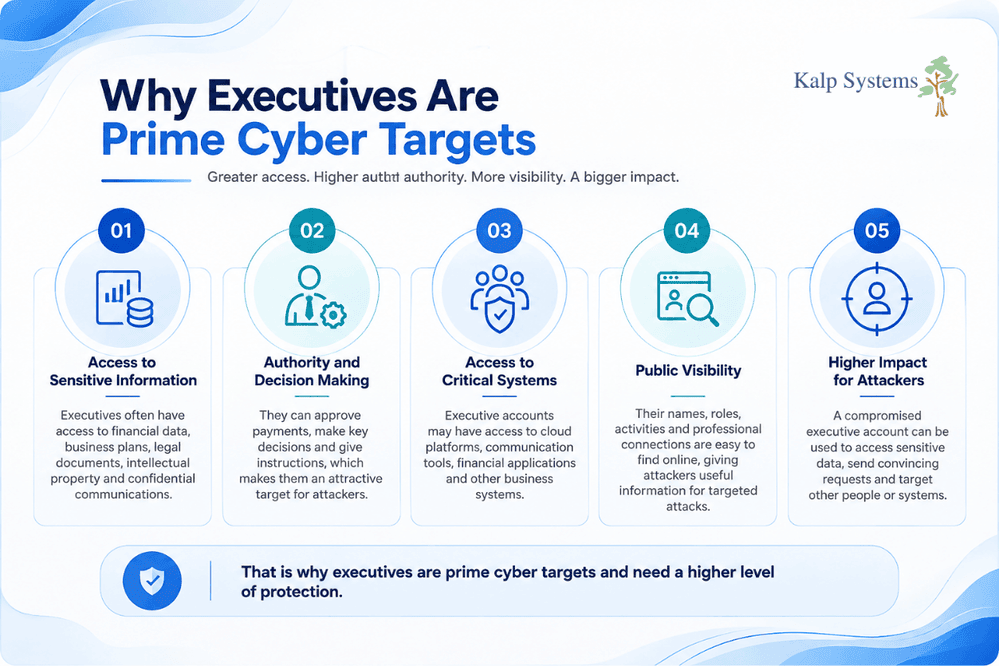
Executives are attractive targets because they often have access to the things attackers want most. Financial information, business plans, legal documents, confidential communications, and intellectual property may all pass through their hands. They also have the authority to approve payments, make decisions, and give instructions to other teams.
There is another reason senior leaders attract attention: they are visible. Their names, roles, business activities, professional connections, and public appearances are often easy to find online. That information can help an attacker understand how an executive works and who they regularly communicate with.
A compromised executive account can therefore create problems well beyond that individual. An attacker may use the account to access sensitive information, send convincing requests to employees, or attempt to reach other systems and accounts.
Access to Sensitive Business and Financial Information
Senior leaders may have access to financial systems, mergers and acquisitions information, legal documents, intellectual property, and confidential communications. For an attacker, gaining access to one executive account can reveal a considerable amount of useful information.
Financial authority also makes these accounts particularly attractive. A fraudulent request that appears to come from a Chief Executive Officer or Chief Financial Officer may be acted on quickly, especially when it involves a payment, supplier, or other familiar business process.
Executive Authority and Privileged Access
Attackers can take advantage of the trust attached to senior positions. Employees may hesitate to question a request when it appears to come from someone with the authority to make business decisions.
Executives may also have access to cloud platforms, internal communication tools, financial applications, and other business systems. Once an attacker gains access to those accounts, they can use the information they find to plan further attacks or attempt to move into other parts of the business.
Public Exposure and Professional Information
Finding information about an executive is often straightforward. Company websites, LinkedIn profiles, press releases, interviews, conferences, and industry events can reveal a person’s role, professional relationships, recent activities, and other useful details.
Attackers can use those details when preparing a targeted message. An email referring to a recent business announcement, a conference, a meeting, or a known colleague can feel much more believable than a generic phishing message. That familiarity is what makes executives focused on social engineering particularly difficult to spot.
How Cyber Attackers Target Executives
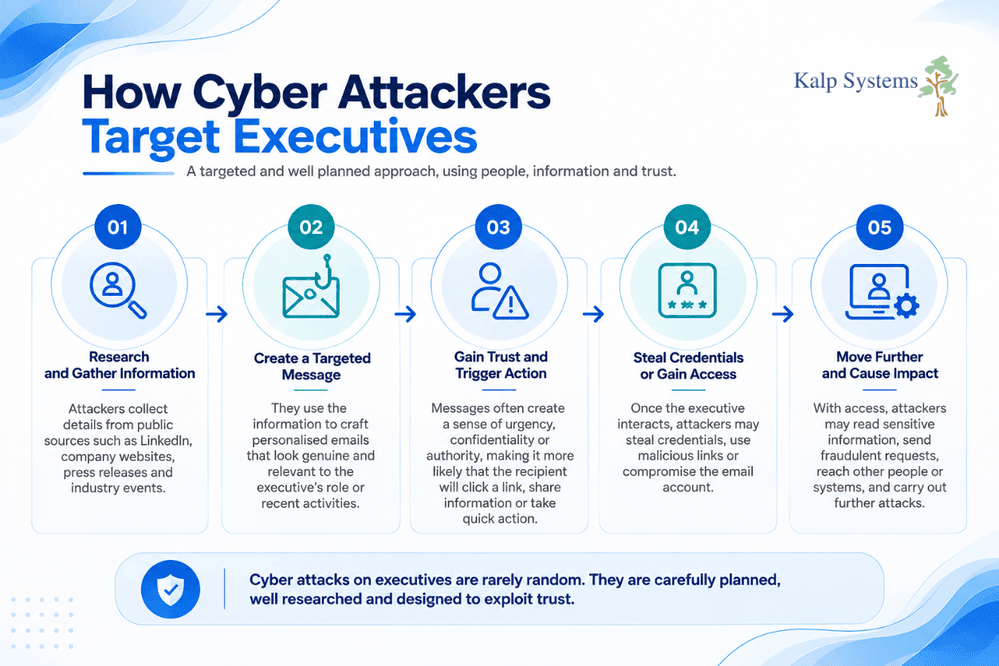
A direct attack on an executive account can start with a simple email. The attacker may pretend to be a colleague, a supplier, a finance team member, or even another executive. The request might involve a payment, a document, account access, or some other routine business task.
What makes these attacks difficult is the preparation behind them. Attackers can spend time looking at information about the executives and the people around them. A recent conference, business announcement, work trip, or professional connection can give them enough context to make a message feel genuine.
Spear Phishing and Whaling Attacks
Spear phishing targets a particular person. Whaling takes the same approach but focuses on senior executives and other high-profile individuals.
These emails are usually written for a specific recipient. An attacker might copy the style of an internal message or pretend to be someone the executive already knows. A message that fits the recipient’s role or current work can be much harder to dismiss than a generic phishing email.
Business Email Compromise
Business email compromises are often used to trick employees into making payments or changing financial details. An attacker may compromise an executive’s email account or impersonate the executive and contact someone in finance, a supplier, or a business partner.
The request may sound familiar. It could be a payment that needs to go out quickly or an instruction to use new bank details. Adding pressure to the request can leave little time for the recipient to stop and verify it.
Social Engineering and Impersonation
Social engineering attacks take advantage of how people respond to trust, authority, urgency, and confidentiality.
An attacker may first gather details about an executive from LinkedIn, company websites, press releases, conferences, or other public sources. Those details can then be worked into a message. For example, someone travelling to an international conference could receive an email about hotel arrangements or travel plans. The reference may seem harmless, but it can make the phishing attempt much more convincing.
Executives are also exposed through their digital relationships, communication patterns, and business activities. Every interaction with a prospective client, vendor, or business partner can become part of an attacker’s social engineering strategy. The question is not only, “Can an attacker send a convincing email?” It is also, “Can an attacker become someone our executives are expecting to hear from?”
Credential Theft and Account Takeover
A stolen password can give an attacker access to an executive’s email and other connected services. From there, they can see ongoing conversations and learn how payments, suppliers, approvals, and other business activities are handled.
That information can be useful for the next step. The attacker may continue an existing email conversation, send a request in the executive’s name, create forwarding rules, or use the compromised account to approach other employees.
Why Executive Cyber Attacks are So Effective
Many attacks aimed at senior leaders succeed because the message fits the way people work. An urgent request from a senior person may not seem unusual, especially when the executive is travelling, dealing with a confidential matter, or working outside the office.
The information needed to build such a request is often available online. A few details about a person’s role, colleagues, recent activities, or travel can be enough to make a message feel familiar.
Exploiting Trust, Authority and Urgency
A request that appears to come from a Chief Executive Officer or Chief Financial Officer can carry considerable weight. An employee may assume that the instruction is genuine and act without checking it in the usual way.
Attackers can make this harder to question by adding urgency or asking for confidentiality. A message asking for an immediate payment or a quick response may leave little time for the recipient to stop and verify what they have received.
Executive Reconnaissance and Personalised Attacks
Before sending a targeted message, attackers can study information that an executive has already made public. Company websites, LinkedIn profiles, press releases, conference details, and professional relationships can all provide useful clues.
The information does not need to be particularly private. Knowing that an executive is attending an event or working with a particular business partner may be enough to give a phishing email a believable context.
For example, an executive attending an international conference could receive a message about travel arrangements or hotel booking. Because the situation itself is familiar, the recipient may have less reason to suspect that the message is part of an attack.
Remote Work, Travel and Mobile Access
Remote and hybrid work have changed how executives connect to business systems. A senior leader may need to work from a hotel, airport, client site, or another location while travelling.
Personal devices, public Wi-Fi, and frequent changes in location can make secure access more difficult. Mobile devices also mean that an executive may review emails or approve requests while away from their usual working environment.
These circumstances can create opportunities for credential theft and session hijacking, particularly when security measures such as multi-factor authentication, device protection, and secure access controls are not applied consistently.
What Happens When an Executive Account is Compromised
The compromise of an executive account can lead to a series of security incidents. Once attackers gain access, they may use the account to access sensitive information, communicate with employees or external contacts, and carry out further attacks.
Financial Fraud and Unauthorised Transactions
An attacker who gains control of an executive email account may use it to request payments or financial changes. When the message appears to come from a Chief Executive Officer or Chief Financial Officer, employees may be less likely to question the request.
Business email compromise can result in fraudulent wire transfers and other unauthorised transactions. Attackers may also use information from previous conversations to make these requests appear legitimate.
Sensitive Data Exposure and Further Account Compromise
Once an executive’s credentials are stolen, attackers can gain access to email systems, cloud platforms, and internal communication tools. From there, they can gather intelligence and attempt further attacks.
Sensitive customer data, employee information, financial records, and strategic plans may be exposed. Cloud email platforms are especially attractive because they are accessible from different locations and are often connected to multiple business applications.
Business, Reputational and Regulatory Impact
A compromised executive account can affect more than the security of the account itself. When sensitive or personal data is exposed, the incident may also create regulatory implications under laws such as the Digital Personal Data Protection Act.
Reputational damage is another concern. A publicised executive-level breach can affect customer trust and investor confidence, while also disrupting normal business operations and long-term growth.
How to Protect Executives from Cyber Threats
Protecting executives requires technical control, behavioural awareness, and governance alignment. Executive accounts need particular attention because of the access and authority associated with them.
Phishing Resistant Multi-Factor Authentication
Implementing strong authentication mechanisms such as phishing-resistant multi-factor authentication is critical for executive accounts.
Privileged access should follow the principle of least privilege and be continuously reviewed. Email security controls, anomaly detection, and conditional access policies can provide additional protection.
Executive Email Security and Access Controls
Executive accounts should have appropriate email security and access controls in place. Suspicious activity, unusual access patterns, and other signs of account compromise should be identified as early as possible.
Access should also be limited to the systems and applications required for the executive’s role. This reduces the amount of information and functionality available through a compromised account.
Executive Focused Security Awareness
Executives need targeted training that reflects the types of attacks they are most likely to face. This includes real-world scenarios involving fraud requests, credential harvesting, and impersonation attempts.
Training should emphasise verification of culture, secure communication practices, and awareness of psychological manipulation techniques.
Continuous Monitoring and Incident Response
Executive accounts should be subject to enhanced monitoring for suspicious activity, including unusual login locations, abnormal access patterns, and unauthorised forwarding rules.
Clear incident response playbooks should also be in place. If an executive account is compromised, the security team needs to know how to contain the account and assess what other systems or information may have been affected.
Why Executive Cyber Security is a Leadership Responsibility
Cybersecurity is no longer solely an IT concern. It is a leadership responsibility.
Executives set the tone for security across the business. When senior leaders follow secure communication practices, use verification processes, and take security requirements seriously, those practices are more likely to be followed by other employees.
Executive participation also matters during a cyber incident. Leadership may need to make decisions about business continuity, customer communication, financial controls, and regulatory requirements while the security team works to contain the attack.
By actively participating in cybersecurity initiatives, executives can reduce their own exposure while strengthening the wider security posture of the business.
Conclusion
Executives are attractive targets for a simple reason: their accounts can give attackers access to valuable information, money, systems, and people. A successful attack on one senior leader can therefore have consequences far beyond a single compromised account.
The risk is not limited to phishing emails. Attackers can use information available about executives, impersonate trusted contacts, steal credentials, and take advantage of the authority attached to senior roles.
That is why executive security needs attention at the leadership level. Strong authentication, appropriate access controls, focused security awareness, monitoring, and a clear response plan can all reduce the damage when an attack is attempted or an account is compromised.
Frequently Asked Questions
Why are Executives Targeted by Cyber Criminals?
A senior leader can be a useful entry point for an attacker. Their email may contain financial information, business plans, confidential conversations, or access to other systems. There is also the authority factor. A request that appears to come from a CEO or CFO may receive a quicker response than a message from an unknown sender.
What are the Most Common Cyber Threats Targeting Executives?
Phishing, whaling, business email compromise, social engineering, and credential theft are among the main threats. Account takeover is another serious concern. In some attacks, stolen credentials are only the beginning, with the compromised account then being used to reach other people or applications.
What is Whaling in Cyber Security?
Whaling is a type of phishing that focuses on senior executives and other high value targets. The emails are usually prepared with the individual in mind. A message might imitate a colleague, refer to a current business matter, or ask for an action that would not immediately seem unusual.
How can Companies Protect Executives from Phishing Attacks?
Phishing resistant multi-factor authentication should be a starting point for important executive accounts. Access should be limited to what is actually needed, while email activity and unusual sign ins should be monitored.
There is a human side to this as well. Senior leaders and the teams that work with them should know when a payment request, credential request, or unusual instruction needs to be checked through another channel.
What should a Company do if an Executive Account is Compromised?
Treat it as a potential wider security incident, not simply a password problem. Access should be secured, active sessions and forwarding rules checked, and connected applications reviewed.
The investigation should also establish what the account was used to access. If sensitive information was exposed or the compromised mailbox was used to contact other employees or business partners, those areas may need to be investigated too.