HomeBlogCyber Security AwarenessOT and IT Security Challenges in Smart Manufacturing
OT and IT Security Challenges in Smart Manufacturing

Why OT and IT Security Matters in Smart Manufacturing
The equipment in a smart manufacturing operation may include PLCs running production equipment, sensors providing data on the state of machinery, robotics executing repetitive tasks, and software monitoring the production process. These systems may be integrated with enterprise applications, cloud environments, or remote diagnostics tools. This enables teams to be aware of what is happening in the plant and respond to production data.
The security concern begins when these connections are not properly secured.
An OT environment has needs that are different from an IT network. You might not be able to shut down a production line just to install the latest security patch. Some machinery could be running end-of-life software or proprietary vendor systems that are costly and time-consuming to replace. At the same time, your plant might still be using email accounts, laptops, remote workstations, cloud apps, and other systems that are vulnerable to attack.
These can open up multiple entry points into a production environment. An attacker who compromises a password, a remote connection that is not properly secured, or a connected device that has not been protected could ultimately reach industrial systems. Ransomware is also a risk, especially when a production outage puts pressure on teams to get operations running again as quickly as possible.
The impact can be significant for the pharmaceutical and healthcare manufacturing industries, with a single incident capable of disrupting production schedules, electronic batch records, quality data, or the availability of critical products. For this reason, OT and IT security should be designed alongside production continuity, system reliability, and regulatory requirements, rather than treated as an IT add-on.
How IT and OT Convergence Increases Cyber Risk
Working together, IT and OT integration is becoming a staple of smart manufacturing. Production equipment needs to share data with enterprise applications, cloud platforms, and monitoring and control systems used throughout the plant. Remote access also allows engineers and suppliers to monitor equipment, identify problems, and perform maintenance even when they are not on site.
However, the challenge is that each new connection can create an additional attack surface. If there is a vulnerability in the IT infrastructure with a path towards OT systems, the impact is unlikely to remain within the office environment. Therefore, when looking at the coexistence of IT and OT, it is crucial to understand how they interact when assessing the security of a connected factory.
Understanding IT and OT in Manufacturing
IT and OT serve different roles in a factory, although they often overlap. IT platforms typically handle ERP, finance, HR, email, cloud-based applications, and business data. OT systems, on the other hand, tend to control and monitor physical processes.
Some examples of OT components include PLCs, SCADA, Distributed Control Systems, HMIs, industrial robots, and connected sensors. These OT components need to remain available and stable. If they are disrupted, the impact can extend to machinery, manufacturing processes, and the safety of plant operations.
Sometimes, the priorities are simply different. In IT security, the focus is primarily on data, applications, user accounts, and IT infrastructure. In an industrial OT environment, however, ensuring that production continues safely can be just as important as protecting the data flowing through those systems.
This difference can become more difficult to manage when IT and OT are connected. Production data might need to be integrated with enterprise applications or stored in the cloud, while field engineers and vendors might need remote access to equipment for troubleshooting and maintenance.
How Connected Systems Expand the Attack Surface
When plant systems are connected to IT networks, manufacturing data may become more accessible, but so may an attacker. An infected laptop, stolen login credentials, an inadequate remote access solution, or a connected device that is not properly secured can all serve as an entry point.
An attacker may then attempt to move through the network towards systems that are directly linked to the production environment. The risk becomes greater when there is little separation between corporate IT and OT networks or when remote access has few restrictions.
For instance, a phishing attack may begin with the compromise of an employee’s account. When that account has access to systems that connect to the plant network, the breach may extend beyond email or other office applications, potentially affecting systems used for manufacturing, monitoring, and other operational functions.
The link between IT and OT therefore needs to be managed carefully. Network separation, controlled remote access, strong identity controls, and the ability to monitor OT traffic can significantly reduce the risk of an IT security incident developing into an operational problem.
Key OT and IT Security Challenges in Smart Manufacturing
Manufacturing is becoming more interconnected, but that is not the only area where this is happening. Within a smart factory, there could be connected sensors, industrial machinery, third-party software, legacy control systems, and remote access tools. If any of these elements are compromised, the impact can spread to other parts of the factory.
The problems are not confined to a single type of cyber-attack. Manufacturers may also face legacy OT environments, limited visibility into plant networks, ransomware, third-party access, and devices that were not designed with strong security controls. These challenges can become even more difficult to address when production needs to remain available with minimal disruption.
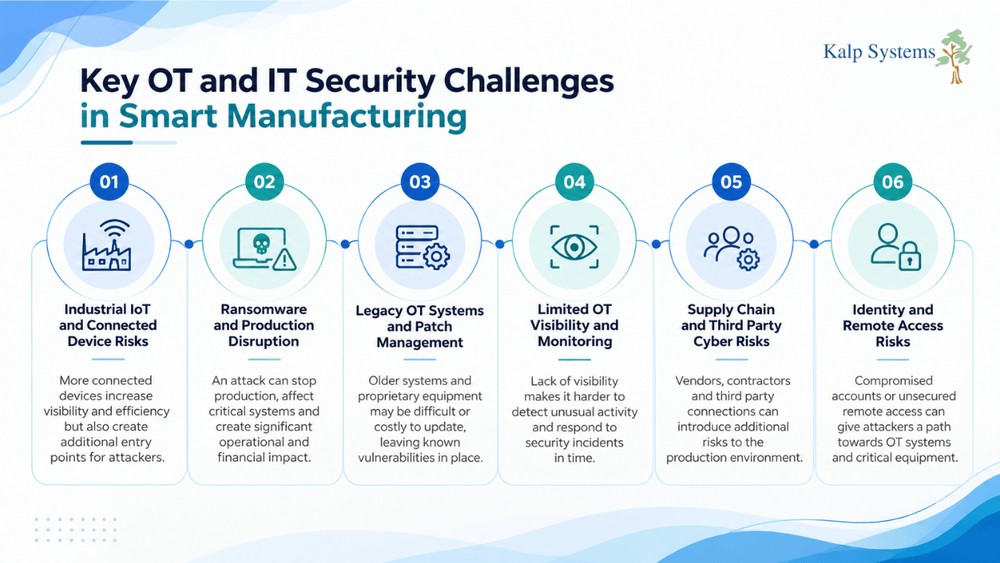
Industrial IoT and Connected Device Risks
Industrial IoT devices are increasingly being used in manufacturing equipment monitoring, production data collection, building systems control, and remote diagnostics. Sensors, HVAC systems, automation systems, and other connected devices can send valuable data back to production teams.
The security issue arises when these devices are installed without proper protection. Weak authentication, default passwords, outdated firmware, and unencrypted communications can leave a device exposed. If an individual network device is compromised, an attacker could attempt to use it as a staging point to access other systems on the OT network.
Manufacturers therefore need to be aware of what connected devices are present on site, how they interact with each other, which systems they connect to, and whether their firmware and security controls are being kept up to date.
Ransomware and Production Disruption
Ransomware continues to be a significant concern for manufacturing because production systems rely heavily on availability. Ransomware that affects the IT environment can also cause problems with OT systems when the two are connected or share common access points.
For example, a ransomware incident could affect MES and ERP integrations, production records, quality systems, or automated production lines. Even if the attacker does not directly encrypt files on an industrial controller, the surrounding systems may still be compromised, making normal operations difficult or impossible.
Similarly, the urgency to get production back online can complicate the response. Manufacturers need to understand which systems can be disconnected, which processes need to remain online, and how production can be restored without allowing the attacker to regain access.
Legacy OT Systems and Patch Management
Many manufacturing plants continue to operate OT systems that have been in use for years. They might use outdated operating systems, proprietary software, or equipment that is no longer readily available from the original vendor.
Applying security patches can also be disruptive. Updating systems may require downtime if equipment has to be taken out of service for maintenance, while unsupported systems may no longer receive security updates. In some cases, updates also need to be tested with the equipment supplier before they can be introduced into production.
Therefore, asset visibility and risk awareness are important. Even if a system cannot be patched straight away, controls such as network segmentation, access restrictions, monitoring, and secure configuration can help reduce its exposure.
Limited OT Visibility and Monitoring
Visibility across the OT environment can be difficult when a manufacturing plant contains different types of industrial equipment, communication protocols, and legacy systems. Traditional IT security tools may not provide enough information about what is happening across the production network.
Industrial protocols such as Modbus, DNP3, OPC UA, and PROFINET can carry important information between devices and control systems. Without suitable OT monitoring, unusual communication or changes in system behaviour may go unnoticed.
Limited visibility can also make it difficult to identify which assets are connected, what they are communicating with, and whether an unfamiliar device has appeared on the network. This can give an attacker more time to remain inside the environment before the activity is detected.
For this reason, OT monitoring should provide a clear view of network traffic, connected assets, and unusual activity without affecting the normal operation of production systems.
Supply Chain and Third-Party Cyber Risks
Smart manufacturing does not operate through plant systems alone. Equipment vendors, system integrators, cloud providers, maintenance contractors, and other third parties may need access to production environments. Each external connection can introduce another security consideration.
A compromised vendor account could give an attacker access to systems that support manufacturing operations. There is also a risk from software or firmware updates supplied through third parties, particularly when the source or integrity of an update cannot be properly verified.
Third-party access therefore needs to be controlled in the same way as internal access. Manufacturers should know which suppliers can access their systems, what level of access they have, and when that access is required. Remote sessions should also be monitored so that unusual activity can be identified.
Identity and Remote Access Risks
Remote access has become useful for maintenance and troubleshooting, but it can also create a direct path towards OT systems. Engineers, vendors, and support teams may need access to plant equipment without being physically present at the facility.
A compromised account can become a serious problem when it has unnecessary privileges or unrestricted access to production systems. Weak passwords, shared accounts, and poorly controlled remote connections can make this risk greater.
Access should therefore be limited according to the actual requirements. Multi-factor authentication, role-based access, session monitoring, and temporary access for vendors can reduce unnecessary exposure. Keeping track of who can access OT systems and what they can do after connecting is equally important.
Best Practices for Strengthening OT and IT Security
To improve OT and IT security, adding security tools to the existing environment alone is not enough. Manufacturers first need to know what is connected to the network, which systems are exposed, and who has access to production systems.
At the same time, security controls should not create unnecessary problems for the production team. A manufacturing plant cannot always stop equipment whenever a security change is required. This is why asset visibility, risk assessment, network segmentation, remote access, monitoring, and incident response all need to be considered together.
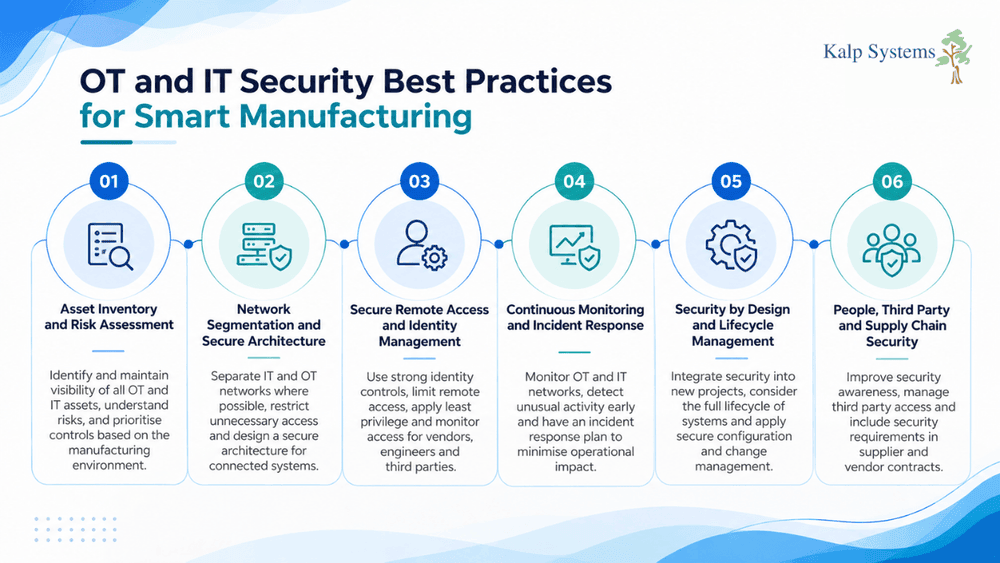
Asset Inventory and Risk Assessment
The first step is to know what is actually present in the OT environment. This can include PLCs, engineering workstations, servers, robotics, sensors, HMIs, connected devices, and cloud-hosted systems. If there is no proper record of these assets, it becomes difficult to know which systems are exposed or what could be affected during a cyber incident.
Once the assets are identified, a risk assessment can show which systems need more attention. The role of the asset, how it is connected, known vulnerabilities, who can access it, and what could happen if it stops working are all factors that can be considered.
The asset list should not be treated as a one-time exercise. New equipment can be added to the plant, existing systems can be replaced, and devices can become connected to other networks over time. Keeping this information updated gives security and production teams a clearer view of what is actually running in the OT environment.
Network Segmentation and Secure Architecture
Keeping IT and OT networks separated can make it harder for an attacker to move from one environment into another. Some communication between the two may still be required, especially when production data needs to reach enterprise applications or authorised users need access to plant systems. However, these connections should be limited to what is actually required.
Firewalls, secure gateways, and an industrial DMZ can help control the traffic moving between different network zones. Further segmentation inside the OT environment can also restrict communication between systems that have no reason to communicate with each other.
The architecture should also take recognised industrial security practices into account. IEC 62443, for example, provides security principles and requirements that can be considered when designing and securing industrial automation and control environments.
The basic idea is straightforward; unnecessary connections should be removed where possible. If one system is compromised, limiting its connections can make it harder for an attacker to move further into the production environment.
Secure Remote Access and Identity Management
Remote access has become useful for manufacturers because engineers, vendors and support teams can work on equipment without being physically present at the plant. However, this also means that someone outside the facility may have a way to connect to the OT environment.
The problem becomes bigger when accounts are shared, passwords are weak, or users are given more access than they actually need. If one of those accounts is compromised, an attacker could use the same access to reach production systems.
Manufacturers should therefore keep remote access limited to the systems and people that require it. Multi-factor authentication can be used to add another layer of protection, while session monitoring can help track what happens during a remote connection. For vendor access, temporary or just-in-time access can also be useful, especially when access is only required for a specific maintenance activity.
Access should also be reviewed after the work is completed. There is little reason for a vendor or former user to keep access to a production system when the requirement no longer exists.
OT Monitoring and Incident Response
It is difficult to protect an OT environment when there is little visibility into what is happening across the network. Monitoring can help teams identify unusual communication, unexpected device activity, or changes in traffic that do not normally occur during production.
But identifying an issue is only one part of the response. The team also needs to know what to do once something suspicious is found. An OT incident can affect production, so the response cannot simply follow the same process used for a normal IT incident.
For example, shutting down or disconnecting a system may contain an attack, but it could also stop part of a production process. Teams therefore need to know which systems can be isolated, who can make that decision, and how the equipment should be brought back online safely.
This is where OT specific incident response planning becomes useful. Tabletop exercises and simulated attack scenarios can give IT, security, engineering, and production teams an opportunity to work through these situations before an actual incident occurs.
Emerging Security Priorities for Smart Manufacturing
Smart manufacturing is not standing still, and the security approach cannot remain the same either. As more equipment becomes connected and more production data moves between OT, IT, and cloud systems, manufacturers need to consider how security will work across the entire environment.
Some of the areas receiving more attention include Zero Trust, security by design, and the use of AI to identify unusual activity. These approaches can support existing security controls, but they still need to fit the way the plant actually operates.
Zero Trust and Security by Design
Zero Trust can be useful in a manufacturing environment where different users, devices, vendors, and systems need access to the same production environment. Instead of automatically trusting a connection because it comes from inside the network, access can be checked based on the user, device, system, and level of access required.
Network segmentation, multi-factor authentication, role-based access, and monitoring of privileged accounts can support this model. These controls can also make it more difficult for an attacker to move from one compromised system to another.
Security by design is another area that needs attention when new manufacturing systems are introduced. Security should be considered when equipment, software, remote access, or cloud services are being selected, rather than after everything has already been connected.
This can include checking vendor security requirements, setting up secure configurations, protecting communications, and deciding how remote access will be handled before the system reaches production.
AI Driven Threat Detection
AI can also be used to identify activity that may be difficult to spot through traditional monitoring alone. In an OT environment, this could involve looking at network traffic, system behaviour, device communication, or commands being sent to industrial systems.
For example, if a device suddenly starts communicating with systems it does not normally contact, or there is an unusual change in the way a production system behaves, monitoring tools may be able to flag that activity for investigation.
AI should not replace security teams or normal OT controls. It can instead provide another way to identify unusual activity, particularly in environments where there are large numbers of connected devices and a high volume of network traffic.
How Kalp Systems Helps Strengthen OT and IT Security
Kalp Systems can help manufacturers evaluate existing cybersecurity controls to pinpoint potential vulnerabilities in their IT and OT systems. Companies can focus on evaluating their security posture, fixing weaknesses, and implementing the right controls according to the risk factors of the manufacturing environment.
This can include checking network security, access controls, vulnerabilities, security policies, and how different systems are actually protected. An assessment can also help uncover gaps that may not be obvious during normal production activities.
For manufacturers with connected equipment, third party access, remote access, and older systems, having visibility into these risks can help prioritise security improvements without losing sight of what the business needs.
Conclusion
OT and IT security challenges in smart manufacturing are becoming more complex as Industry 4.0 technologies continue to change production environments. The connection between enterprise IT systems and OT networks has improved visibility and efficiency, but it has also created new security risks.
Manufacturers need to consider risks related to connected devices, ransomware, legacy OT systems, third-party access, remote access, and limited visibility across production networks. Network segmentation, asset visibility, controlled access, monitoring, and OT specific incident responses can help reduce exposure.
Security also needs to be considered when new systems and technologies are introduced into the manufacturing environment. Production systems cannot always be taken offline for security updates, so the security controls need to work alongside operational requirements.
Frequently Asked Questions
What is the Difference Between IT Security and OT Security in Manufacturing?
IT security is intended for enterprise apps, user accounts, company data, and digital infrastructure. OT security is predominantly targeted at systems that deal with the control and supervision of physical production, e.g., PLCs, SCADA, HMIs, and industrial robots. In manufacturing, all of these assets operate closely in tandem and can adversely impact each other if compromised.
Why does IT and OT Convergence Increase Cybersecurity Risks?
Connecting IT and OT systems increases the number of communication paths between systems. An attacker may be able to navigate closer to the OT environment by making use of a vulnerable account, PC, remote access connection, or connected device. Insufficient network separation and unfiltered access can increase the consequences of an incident.
What are the Biggest OT Security Challenges in Smart Manufacturing?
The top challenges worth mentioning are Industrial IoT, ransomware, legacy OT, poor visibility, third party access, remote access, etc. When production equipment needs to be shut down to implement a security patch, some manufacturers may have trouble doing it.
How can Manufacturers Protect OT Systems from Ransomware?
To lower the risk of ransomware, manufacturers may do the following: inventory of OT and IT assets, segment networks, manage remote access, implement strong identity controls, monitor OT traffic, and be prepared with an incident response plan. It is also important to be aware of which systems can be isolated if there is an attack affecting production.
How can Manufacturers Improve OT and IT Security?
Identify what you have and where you are at. Improvement begins by getting a grip on what you already have. Manufacturers can identify their assets and risks, segregate and isolate their IT and OT networks where possible, limit access, track events, and test incident response plans regularly. This process should be reviewed whenever new equipment, software, cloud services, or third-party connections are added.